Introduction
Planning Canadian immigration for 2026? You’ve likely encountered Express Entry and LMIA. Both offer paths to work permits or permanent residence, but their processes, risks, and timelines differ significantly.
Selecting the incorrect path can cause delays, added costs, or refusals. This guide details Express Entry vs. LMIA in 2026, explains Quebec’s unique rules, and helps identify the faster, more reliable option for your circumstances.
Guzun & Associates Lawyers in Montreal assists workers, students, families, and employers daily. We navigate these options, addressing complex Quebec immigration situations and refusals.
Understanding Express Entry for Permanent Residence in Canada (2026): Who Qualifies Best?
Express Entry is Canada’s primary online system for skilled workers seeking permanent residence outside Quebec. It manages three federal programs: Federal Skilled Worker, Canadian Experience Class, and Federal Skilled Trades. You can learn more about the official Express Entry system details here.
In 2026, IRCC continues category-based draws for specific occupations (e.g., healthcare, STEM, trades, agriculture). Higher targets for economic immigrants make Express Entry appealing, especially with a competitive Comprehensive Ranking System (CRS) score.
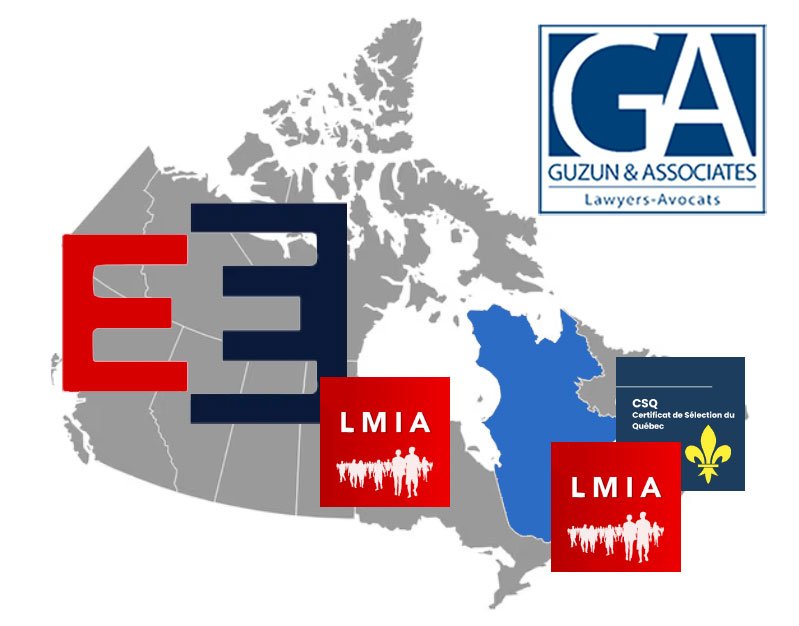
Important for Quebec: Express Entry does not directly apply to Quebec permanent residence. Quebec residents typically require a Quebec Selection Certificate (CSQ). However, Express Entry remains an option if you are willing to reside in other provinces.

Express Entry Processing Times & Reliability (2026 Outlook)
Express Entry is often among the fastest permanent residence options. After receiving an Invitation to Apply (ITA) and submitting a complete application, IRCC aims to process most cases within about six months. However, in practice, many applications take longer due to additional background checks, biometrics, or document verification steps – a trend observed in 2025–2026 processing timelines.
The primary uncertainty lies in securing an ITA. Your CRS score, occupation, and IRCC’s 2026 draw types determine invitation eligibility. Strong language scores, Canadian work/study experience, and a valid job offer can boost your score and reliability.
Boosting Express Entry with Job Offers & LMIA
A valid Canadian job offer can add 50-200 CRS points, depending on the position. This typically requires an approved Labour Market Impact Assessment (LMIA), unless the job is LMIA-exempt (e.g., intra-company transfers or trade agreements).
An LMIA can support both a work permit and your Express Entry profile. This “dual intent” approach – legally recognized under the Immigration and Refugee Protection Act (IRPA) – allows you to hold a temporary work permit while also pursuing permanent residence. Both intentions must be genuine and consistent throughout your applications.
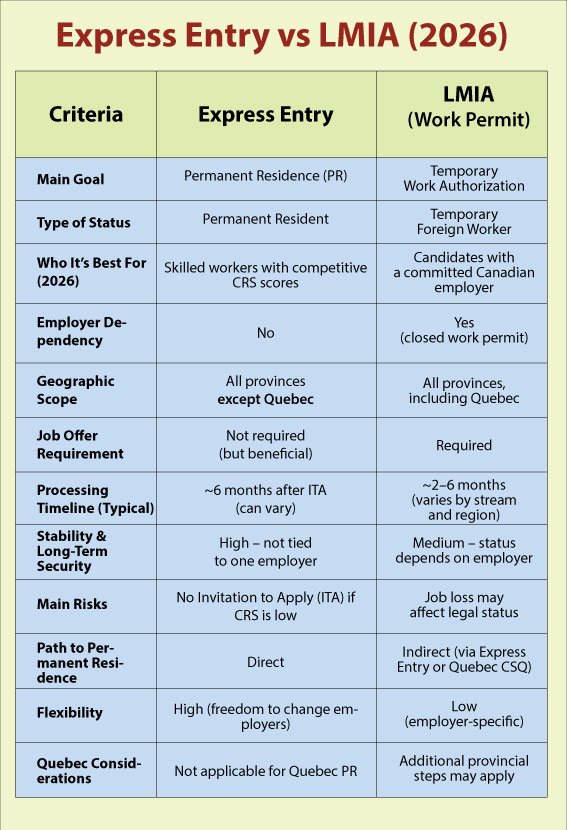
Comparison: Express Entry vs LMIA vs Quebec
| Pathway | Main Goal | Typical Use in 2026 |
| Express Entry | Permanent Residence (PR) | Skilled workers outside Quebec with strong points profiles. |
| LMIA-based Work Permit | Temporary Work Status | Employers hiring foreign workers; faster entry but temporary. |
| Quebec (CSQ + Work Permit) | Quebec Permanent Residence | Workers choosing to settle specifically in Quebec (requires French often). |
Navigating LMIA-Based Work Permits for Canada (2026): Faster Entry to Canada?
An LMIA (Labour Market Impact Assessment) is a document where a Canadian employer proves a need for a foreign worker and that no qualified Canadian is available. A positive LMIA allows the worker to apply for a temporary work permit.
In 2026, ESDC continues to apply detailed LMIA review standards, assessing recruitment efforts, offered wages, and working conditions in line with federal program requirements. Requirements may vary slightly by region and industry, as outlined in ESDC guidelines. Processing times vary significantly by region and stream; for instance, the Global Talent Stream is often faster than standard LMIAs.
An LMIA can be faster than Express Entry if your employer is prepared, the application is complete, and you qualify for a priority stream. However, its stability is lower, depending on the employer’s situation and economic shifts.
LMIA Risks and Employer Dependence in Canada
An LMIA-based permit binds you to one employer (closed work permit) and typically one location. Job loss risks your immigration status, potentially requiring a new LMIA and work permit. This dependency complicates long-term planning.
Refusals often stem from employers’ improper advertising, incorrect wage levels, or incomplete documentation. A lawyer verifying the LMIA strategy and package can prevent costly delays and improve reliability.
LMIA Processing and Quebec’s Unique Requirements
In Quebec, most foreign worker files demand both provincial approval and federal LMIA or LMIA-exempt processing. Quebec has specific occupation lists, wage rules, and sometimes simplified processes, but these also add extra forms and steps.
Consequently, LMIA processing in Quebec can be more complex than elsewhere. Yet, for certain in-demand jobs on the province’s official list, Quebec’s simplified LMIA process can reduce paperwork.
Quebec Immigration Pathways: Beyond Express Entry & LMIA
Quebec manages its economic immigration selection independently. For long-term residency in Quebec, the primary permanent residence route is typically through the Quebec Skilled Worker Program (QSWP), the Quebec Experience Program (PEQ), or other provincial programs, not Express Entry.
The typical Quebec path involves a job offer or study, leading to a temporary work or study permit (often with Quebec forms), then a CSQ, and finally a federal permanent residence application. Dual authority processing can complicate planning.
Strategic planning is crucial. Some clients first obtain temporary status (study or work permit), then transition to Quebec programs. Others initially settle in another province via Express Entry.
Can Quebec-Based Workers Leverage Express Entry?
Express Entry cannot directly grant Quebec permanent residence. However, if you work or study in Quebec and later relocate outside the province, your Canadian experience can still contribute to your Express Entry profile.
A critical legal consideration: you must genuinely intend to live outside Quebec when applying via Express Entry. Misrepresentation can result in refusals and future complications. Professional legal advice is strongly recommended before altering declared intentions.

Express Entry vs. LMIA: Which is Better for You?
Speed and reliability depend on your profile, occupation, employer, and where you want to live.
For permanent residence with a competitive score, Express Entry is often more reliable long-term. It isn’t tied to a single employer and leads directly to PR. However, a low CRS score may mean months in the pool.
With a committed employer, an LMIA-based work permit can offer faster entry to Canada for work, particularly via priority streams. Yet, it is less secure, as your status depends on the job and economic conditions.
Quebec planning requires greater strategy. Consider if your ultimate goal is Quebec permanent residence, federal PR in another province, or a combination of temporary and permanent options over time.
Optimizing Your Strategy: Combining Express Entry & LMIA
For many in 2026, combining both paths is optimal. An employer secures an LMIA to support both a work permit and your Express Entry profile, yielding extra CRS points and Canadian work experience.
This dual approach enhances speed (earlier arrival) and reliability (points and flexibility). Quebec workers might use a similar strategy: a Quebec work permit combined with a CSQ plan, always aligning with genuine intentions.
Summary:
- Choose Express Entry if: You have a high CRS score, want direct Permanent Residence, and plan to live outside Quebec. It offers freedom from a single employer.
- Choose LMIA if: You have a supportive employer and want to start working in Canada quickly (temporary status), or if you need the 50-200 extra points to qualify for Express Entry.
- Choose a Hybrid Strategy: Use an LMIA to get a work permit and gain Canadian experience, then use those points to apply for Express Entry or a Quebec CSQ later
Real Client Success Stories: Express Entry & LMIA Strategies
Case 1 – IT professional choosing between LMIA and Express Entry
Scenario: A skilled IT professional outside Canada received a job offer from a Montreal employer. The employer sought an LMIA for fast entry, while the worker also pursued permanent residence.
Our Strategy: We assessed the position, wages, and worker’s profile. His CRS score was strong, and the job qualified for a fast-track LMIA stream. We assisted the employer with a compliant “Global Talent Stream” LMIA for speed and structured the job offer for Express Entry validity.
Result: he secured a work permit in under five months. Shortly after, the LMIA-backed job offer boosted his CRS score, securing his Invitation to Apply (ITA) for permanent residence while already working in Canada.
Case 2 – Worker in Quebec redirected from risky LMIA to more secure PR route
Scenario: A Quebec client held a closed work permit based on an LMIA. When the employer faced financial issues and declined LMIA renewal, the worker’s status became precarious.
Our Strategy: We analyzed his history, language scores, and family plans. Instead of fighting for a new LMIA, we pivoted him to a Quebec CSQ program based on his acquired experience and French skills, while keeping Express Entry as a backup plan for other provinces.
Result: We helped him secure eligibility for a Bridging Open Work Permit (BOWP) – available only to applicants with a permanent residence application already in process under specific immigration categories – and filed the necessary Quebec documents. A step-by-step plan to permanent residence was created, ensuring his status no longer relied on one company.
FAQ
1. Is Express Entry always faster than LMIA in 2026?
No. Express Entry is fast after you get selected, but you might wait months in the pool. An LMIA-based work permit (especially Global Talent Stream) can get you to Canada faster physically, but it is only temporary status.
2. Which is more secure long term: Express Entry or LMIA?
For permanent settlement, Express Entry or Quebec permanent residence programs offer greater security, as they are not employer-tied. An LMIA is primarily a temporary solution; job loss can jeopardize your status.
3. Can an LMIA help my Express Entry in 2026?
Yes. An LMIA-supported valid job offer provides 50-200 additional CRS points in Express Entry, increasing ITA likelihood. This often makes the difference between being ignored and receiving an invitation. It also allows entry to Canada on a work permit while permanent residence processes.
4. Does Express Entry apply to Quebec immigrants?
No. Express Entry targets permanent residence outside Quebec. For Quebec residency, you typically apply through its provincial programs and obtain a CSQ (Quebec Selection Certificate). If you later intend to live in another province, Express Entry may become an option.
5. How do I know which path is better for my case?
Assess your CRS score, occupation, language level, family situation, employer support, and intended province of residence (Quebec or other). A personalized legal assessment saves time and money by identifying the optimal Express Entry, LMIA, or Quebec program combination.
Optimize Your Canada Immigration Strategy
Ready to start? Contact our Montreal immigration lawyers at Guzun & Associates Lawyers for a personalized assessment of your Express Entry, LMIA, and Quebec immigration options.
- Call: +1 (514) 842-7414
- Email: office@avocatguzun.com
- Visit: 105-1 rue McGill, Suite 15B, Montreal, Quebec
This article provides general legal information and is not a substitute for personal legal advice. Always consult a licensed immigration lawyer about your specific case.