
Assault Charges in Quebec: Levels, Defences, and Consequences
Assault Charges in Quebec: Levels, Defences, and Consequences
In Quebec, assault charges can have far-reaching consequences. A single incident may affect employment, immigration status, family life, and the ability to travel abroad. Canadian law defines assault broadly, and many forms are treated as hybrid offences meaning the Crown can choose to prosecute them either summarily or by indictment. The stakes are high, but with the right knowledge and preparation, it is possible to navigate the process strategically.
How the Criminal Code Defines Assault
Under the Criminal Code, a person commits assault if they intentionally apply force to another person without consent, or if they attempt or threaten to apply force and the other person reasonably believes the threat will be carried out. Assault can also occur when someone blocks another’s path while openly carrying a weapon or an imitation weapon.
The Levels of Assault and Maximum Penalties
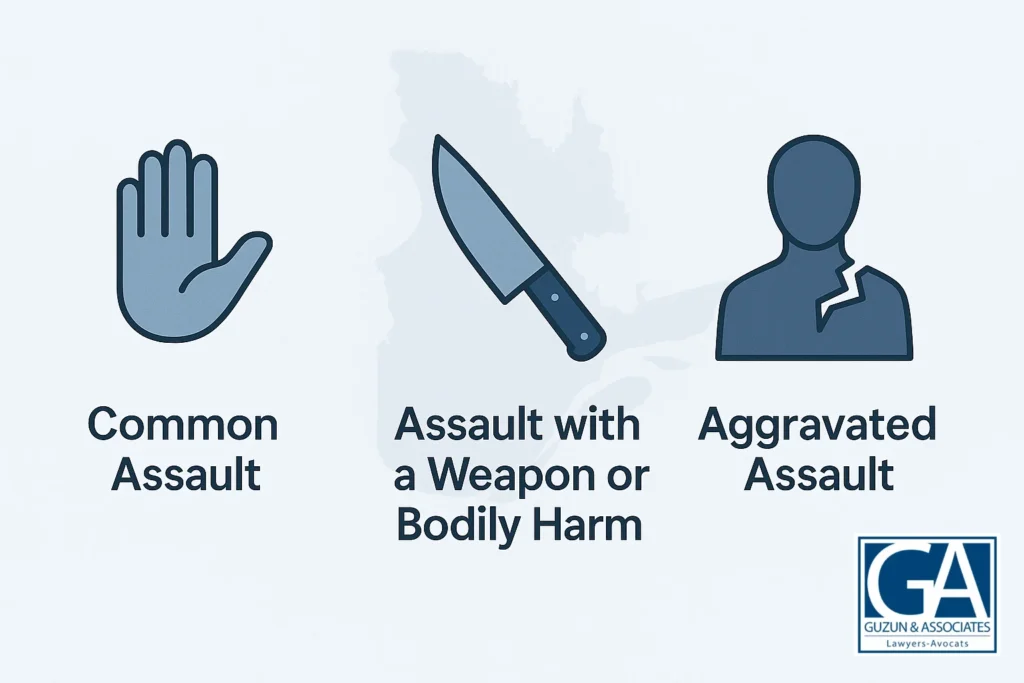
1. Common Assault (Section 266)
- The most basic form of assault.
- Includes pushing, slapping, or grabbing without consent.
- Hybrid offence: up to 5 years in prison if indicted, or up to 2 years less a day and/or a $5,000 fine if prosecuted summarily.
2. Assault with a Weapon or Causing Bodily Harm (Section 267)
- Involves a weapon or an injury that interferes with health or comfort.
- A “weapon” can include everyday objects if used to cause harm.
- Includes choking, suffocating, or strangling, which courts view as particularly serious.
- Hybrid offence: up to 10 years in prison if indicted.
3. Aggravated Assault (Section 268)
- The most severe category short of homicide.
- Occurs when the assault wounds, maims, disfigures, or endangers life.
- Indictable only, with a maximum penalty of 14 years.
4. Assaulting a Peace Officer (Police Officer)
Section 270 – Assaulting a peace officer
- Applies when the complainant is a police officer or other peace officer acting in the course of their duties.
- Hybrid offence: up to 5 years on indictment, or up to 2 years less a day and/or a fine on summary conviction.
Section 270.01 – Assaulting a peace officer with a weapon or causing bodily harm
- Involves a weapon or bodily harm to the officer.
- Hybrid offence: up to 10 years on indictment.
Section 270.02 – Aggravated assault of a peace officer
- Where the assault wounds, maims, disfigures, or endangers life of the officer.
- Indictable only, maximum 14 years.
Key point: Courts treat assault of a police officer as an aggravating circumstance at bail and sentencing. Expect stricter release conditions and a higher likelihood of custodial sentences if violence, weapons, choking, or breaches are involved.
Quick Reference Table
| Level | Code Section | Crown Election | Maximum Penalty |
| Common assault | s.266 | Hybrid | 5 years (indictment) / 2 years less a day + fine (summary) |
| Assault with weapon or bodily harm | s.267 | Hybrid | 10 years (indictment) |
| Aggravated assault | s.268 | Indictable only | 14 years |
| Assaulting a peace officer | s.270 | Hybrid | 5 years (indictment) / 2 years less a day + fine (summary) |
| Assaulting a peace officer with a weapon or causing bodily harm | s.270.01 | Hybrid | 10 years (indictment) |
| Aggravated assault of a peace officer | s.270.02 | Indictable only | 14 years |
Assault and Battery
In Canadian criminal law there is no separate offence called “battery.” What some countries call “battery” (the intentional application of force without consent) is covered under assault in the Criminal Code.
- Police and courts will lay one of the assault charges (e.g., s. 266, 267, 268, 270–270.02), not “assault and battery.”
- Legally your case will be prosecuted as assault.
- In civil lawsuits, “battery” can appear as a tort, which is separate from the criminal process.
Collateral Consequences
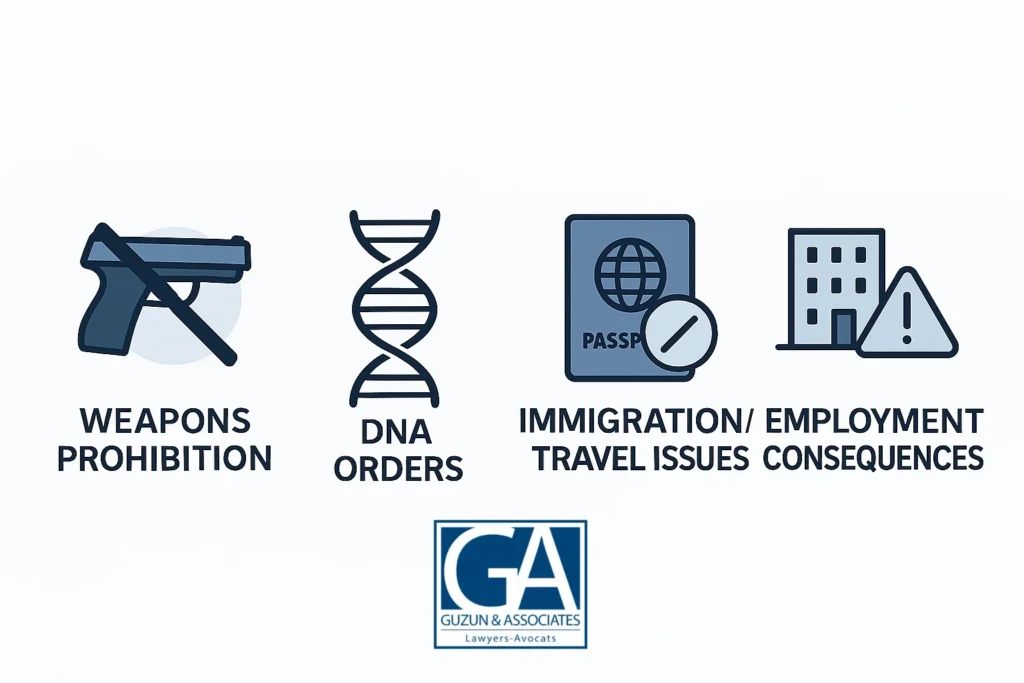
Convictions for assault may carry more than just a sentence. Courts can impose:
- Weapons prohibitions — bans on firearms or other weapons, ranging from several years to life.
- DNA orders — mandatory or discretionary, depending on the offence, resulting in a DNA profile being entered into the national databank.
- Immigration consequences — even permanent residents risk inadmissibility for certain convictions.
- Employment and travel restrictions — especially in jobs requiring security clearance or travel to the United States.
Domestic Violence and Quebec Practice
Quebec has created specialized courts for sexual and domestic violence cases. These courts emphasize victim protection, strict no-contact conditions, and tailored supervision. For accused individuals, this often results in tighter bail conditions and closer scrutiny of risk. At the same time, alternative resolutions such as peace bonds may still be offered when circumstances allow.
Paths to Resolution Beyond Trial
- Peace bond (Section 810): A promise to keep the peace and follow conditions for up to 12 months. It is preventive, not a finding of guilt. Breaching it is a separate criminal offence.
- Diversion or conditional discharges: Often available for first-time offenders charged with common assault. With counselling and demonstrated rehabilitation, it may be possible to resolve the case without a permanent criminal record.
Defence Strategies the Courts Actually See
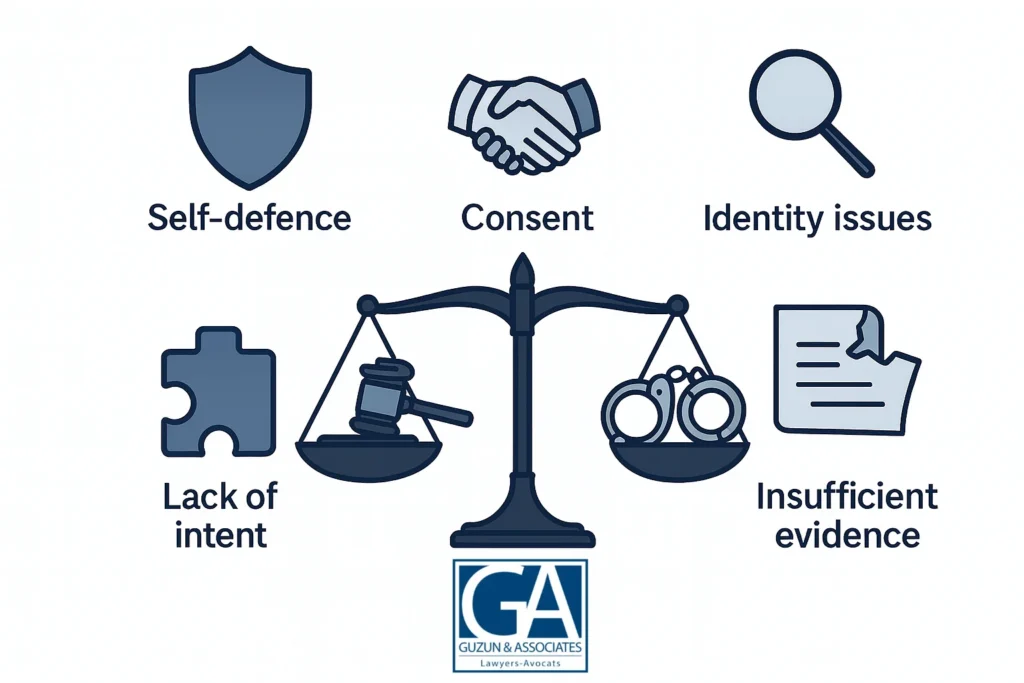
Not every assault charge leads to a conviction. The Crown must prove the offence beyond a reasonable doubt. Common defences include:
- Self-defence: Reasonable force may be used to protect oneself or others, provided it is proportionate.
- Consent: Physical contact may be lawful in contexts such as sports or agreed interactions.
- Lack of intent: Accidental contact is not assault.
- Identity issues: If evidence is unclear or inconsistent about who committed the act, the charge may fail.
- Insufficient evidence: Courts dismiss cases where the Crown’s evidence is contradictory, unreliable, or uncorroborated.
Practical note: In real cases, credibility often turns on objective evidence such as video footage, phone records, medical notes, 911 recordings, or independent witnesses.
Quick Reference: Defences vs. Typical Outcomes
| Defence | How It Works | Typical Outcome if Accepted |
| Self-defence | Reasonable, proportionate force used to protect oneself or others | Full acquittal or withdrawal of charges |
| Consent | Contact agreed to (sports, sparring, consensual interaction) | Acquittal if Crown cannot prove lack of consent |
| Lack of intent | Accidental contact without intent to apply force | Acquittal |
| Identity issues | Evidence does not prove the accused was the person involved | Acquittal or charges withdrawn |
| Insufficient evidence | Crown’s case relies on weak or contradictory testimony | Acquittal or peace bond if risk management still needed |
What to Expect Procedurally in Quebec
- Arrest and release decision: Police may release the accused on conditions or hold them for a bail hearing.
- First appearance and disclosure: The accused is brought before a judge, enters a plea of not guilty by default, and receives disclosure.
- Case screening and resolution talks: Defence and Crown explore possible diversion, discharges, or peace bonds.
- Pre-trial motions: Lawyers may bring Charter applications or challenge the admissibility of evidence.
- Trial or plea: If convicted, sentencing includes not only potential jail but also collateral orders such as weapons bans and DNA orders.
Sentencing Reality
Sentences vary widely depending on:
- The degree of harm.
- The accused’s prior criminal record.
- The presence of aggravating factors such as weapons, choking, or breaching court orders.
- The domestic or intimate-partner context.
Assault Jail Time: What Sentences Look Like in Practice
- Common assault (first offence):
- Discharge (absolute or conditional), fine, or probation;
- Short jail terms are possible where there is notable harm, prior breaches, or aggravating facts.
- Assault with a weapon or causing bodily harm:
- Probation to custody, with incarceration more likely where injuries, weapons, choking, or prior record are present.
- Aggravated assault:
- Custodial sentences are the norm, often lengthy, reflecting the gravity of wounding, maiming, disfigurement, or endangering life.
- Assaulting a peace officer:
- Courts often move up the range compared with the same conduct against a civilian, especially where there is injury, weapon use, or resistance to arrest.
Practical tip: Early steps like counselling, treatment, restitution (if applicable), and verified employment or schooling can materially influence whether a judge imposes a non-custodial sentence or the length of jail time.
How a Lawyer Can Change the Outcome
- Early case assessment: Identifying weaknesses in the Crown’s case and preserving favourable evidence.
- Bail strategy: Securing release under manageable conditions to avoid unnecessary pre-trial detention.
- Resolution pathways: Negotiating for lesser charges, diversions, or peace bonds that keep records clean.
- Trial advocacy: Challenging credibility, cross-examining witnesses, and presenting expert testimony where needed.
- Managing collateral orders: Arguing for the narrowest possible weapons bans or DNA orders, tailored to the facts.
Lawyer’s insight: Assault cases are often won or lost not on the label of the charge, but on the quality of preparation, evidence, and release planning. Courts look for consistency and realism both in the defence and in the proposed resolution.
Protecting Your Future
Assault charges in Quebec cover a wide spectrum, from minor disputes to life-threatening violence. The law is clear, but outcomes hinge on facts, credibility, and strong legal strategy. With timely legal advice, it is possible to reduce risks, challenge weak evidence, and find solutions that protect both rights and future opportunities.
At Guzun & Associates, we represent clients across Montreal and Quebec facing assault charges with precision, preparation, and a clear plan from arrest to resolution.
📞 Call us at +1 (514) 842-7414
📧 Email us at office@avocatguzun.com
📍 Visit us in Old Montreal or book a secure online consultation
With experienced defence, you can protect your rights and secure a stronger future.