
H&C Applications: Your Path from CUAET to Permanent Residence in Canada
H&C Applications: Your Path from CUAET to Permanent Residence in Canada
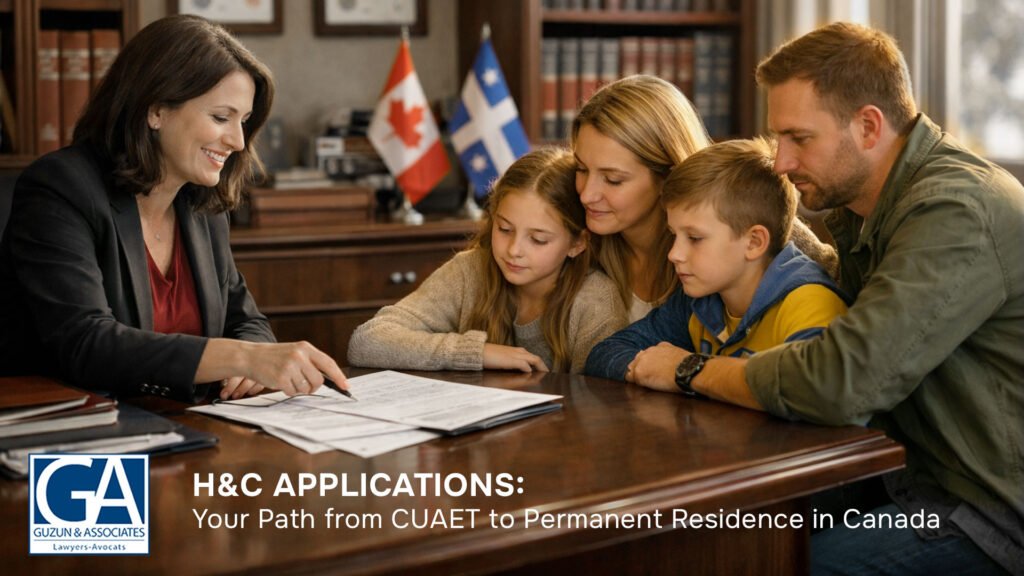
Many Ukrainian families came to Canada via CUAET to escape war and find safety. CUAET is temporary, and permits will soon expire for thousands. Families urgently ask, “How can we stay in Canada permanently and keep our children safe?”
A humanitarian and compassionate (H&C) application offers one legal path to permanent residence. This route is challenging but can be the only realistic option for vulnerable families. Guzun & Associates, Montreal-based lawyers, guides Ukrainian clients from CUAET to permanent residence and beyond.
This guide explains how H&C applications work for Ukrainian nationals in Canada, common mistakes to avoid, and strategies to improve your chances.

Understanding Humanitarian & Compassionate (H&C) Grounds
An H&C application allows individuals in Canada to apply for permanent residence even without qualifying under regular immigration programs. For many Ukrainians on CUAET work permits, this may become one of the main remaining options once temporary programs end. The legal basis for H&C relief is set out in the Immigration and Refugee Protection Act.
Federal data from early 2026 show tens of thousands of H&C applications received annually, with processing times that are often counted in years (frequently 18–36 months or more). Proactive planning is crucial. Applicants must prove their situation is truly exceptional, demonstrating hardship if forced to leave Canada.
H&C Grounds for Ukrainian Nationals in Canada
For Ukrainian families, H&C grounds may include ongoing war, destroyed homes, limited medical care in certain regions, or strong ties formed in Canada. Immigration officers assess the complete story: past life in Ukraine, current life in Canada, and risks of returning.
Evidence is vital. Country reports on Ukraine, medical and psychological letters, proof of lost property, and expert opinions strengthen your H&C file. Guzun & Associates helps organize this evidence into a clear legal argument.
H&C Permanent Residence for CUAET Holders
CUAET holders typically have temporary resident visas and open work permits, sometimes with study permits for children. An H&C permanent residence application asks IRCC to allow you to remain in Canada even after these documents expire.
You can submit an H&C case while CUAET status is still valid. This is often safer; if refused without status, you could face removal. A tailored legal strategy may combine H&C with other programs, like spousal sponsorship or provincial options, based on your specific situation.
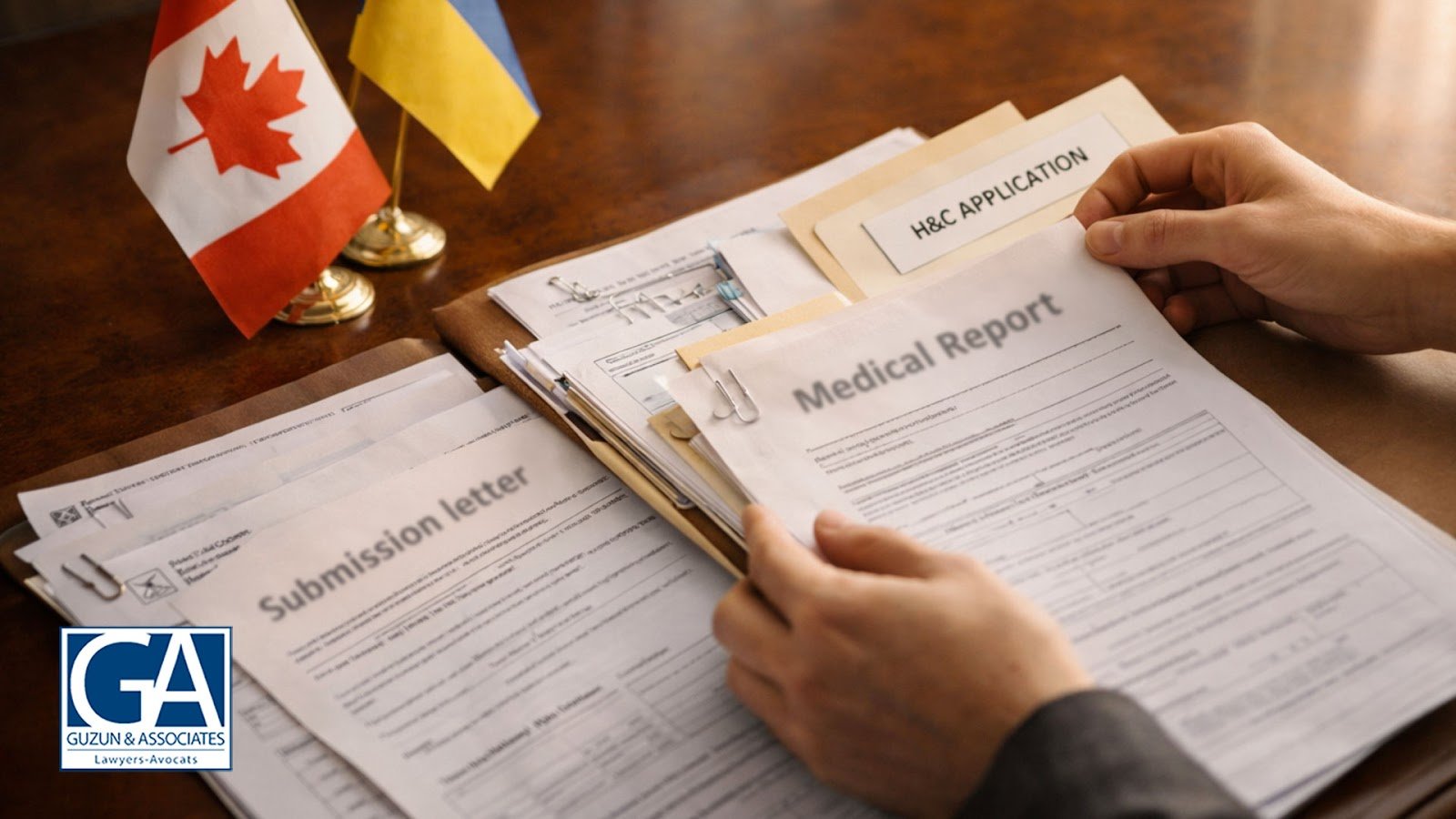
The Three Pillars of a Strong H&C Case
- Establishment in Canada: Proof that you work, pay taxes, volunteer, and have friends here.
- Hardship upon Return: Evidence that returning to Ukraine (or a third country) would endanger your safety or mental health.
- Best Interests of the Child (BIOC): How removal would harm your children’s development.
Comparison: CUAET vs H&C vs Regular PR Routes
| Option / Factor | CUAET (Temporary) | H&C Application for Ukrainians | Regular Economic / Family PR |
| Main purpose | Safe temporary stay, work, study | Exceptional relief, avoid hardship | Standard long-term immigration |
| Status length | Limited, tied to program dates | PR if approved (no fixed end date) | PR if approved |
| Who qualifies | Ukrainians & family meeting CUAET rules | People in Canada with compelling hardship | Depends on program (Express Entry, PNP, etc.) |
| Evidence focus | Identity, Ukrainian nationality | Best interests of child, hardship, ties | Points, education, language, job, sponsors |
| Processing time | Months | Often 18–36+ months | 6–24+ months (varies) |
| Risk of refusal | Lower if criteria met | Higher; fully discretionary | Depends on meeting fixed criteria |
| Can stay during processing? | Yes, if status valid | Often yes with maintained status or stays | Usually yes if inside Canada and compliant |
Prioritizing the Best Interests of the Child in H&C Cases
For Ukrainian families, the best interests of the child form a strong component of an H&C application. Canadian law mandates that officers give serious weight to how a decision impacts affected children.
If your children attend school in Montreal or elsewhere, speak French or English, and receive medical or psychological care in Canada, these facts require clear documentation. The officer must understand how removal from Canada would affect their education, health, language development, and emotional stability.
Our practice often includes school reports, letters from teachers, therapists, and pediatricians, plus proof of activities and friendships. A well-prepared file demonstrates the child’s integration and developing future in Canada.
Child-Centered Evidence for Ukrainian H&C Applications
Evidence concerning children must be specific, not generic. A general letter stating “the child is doing well in school” is insufficient. We seek reports detailing special needs, war trauma, or progress that would be disrupted by a return to Ukraine.
For instance, if a child is speaking again after experiencing bombings, or receiving specialized therapy unavailable in their home region, this significantly supports H&C relief. The file must clearly link these facts to the legal criteria the officer applies.
Demonstrating Hardship and Risks of Return to Ukraine
A central aspect of H&C for CUAET holders involves demonstrating hardship and risk if the family must return to Ukraine. This differs from a refugee claim, but the conflict context remains relevant.
You must explain, with supporting documents, why returning would create serious difficulties beyond what most people face. This may include destroyed housing, lack of family support, medical conditions, disability, or specific threats experienced by you or your relatives.

Proving Hardship for CUAET H&C Applicants
While country reports from the UN, NGOs, and the Canadian government illustrate the general situation in Ukraine, H&C law strictly requires demonstrating your personal circumstances. An officer will not approve an application based solely on the general conflict; they need to see how it specifically affects your family.
To build a compelling legal brief, Guzun & Associates helps you gather and organize highly specific evidence, such as:
- Medical and psychological evaluations: Documenting trauma, PTSD, or the need for ongoing care established in Canada.
- Proof of missed or unavailable treatments: Showing that vital healthcare is inaccessible in your home region.
- Property records and photos: Evidencing destroyed or inaccessible housing and loss of livelihood.
- Sworn statements (affidavits): Testimonies from family members abroad detailing the local dangers or lack of support network.
- Integration proof: Letters from Canadian employers, landlords, and community leaders showing your strong establishment and contribution to society.
A structured legal brief synthesizes these elements, ensuring the immigration officer considers all key facts that make your return to Ukraine an exceptional hardship.
We use National Documentation Packages and specific medical evidence to prove that your hardship is disproportionate.
Maintaining Status & Work During Your H&C Application
A primary concern for CUAET holders is: “Can I keep working and access healthcare while awaiting my H&C decision?”
Crucial Warning: Submitting an H&C application does not automatically grant you “maintained status” (implied status) or extend your right to work in Canada.
To legally remain and work in Canada while your H&C application is processing, you must take separate action:
- Extend your permits proactively: You must submit a separate application to extend your work permit, or change your status to a visitor (Visitor Record), before your current CUAET status expires.
- Maintained Status: Only by filing this extension application on time will you benefit from maintained status, allowing you to legally work under the same conditions until IRCC makes a decision on the extension.
Status strategies for Ukrainian H&C applicants
Losing your legal status significantly increases the risk of removal and strips away your safety net. For families residing in Montreal or elsewhere in the province, there is a critical Quebec-specific layer to the H&C process:
- The Double Approval (Federal & Provincial): H&C applications are evaluated federally by IRCC. However, if you intend to live in Quebec, the province must also select you. Once IRCC approves your H&C application in principle (Stage 1), you must apply to the Ministère de l’Immigration, de la Francisation et de l’Intégration (MIFI) to obtain a Certificat de sélection du Québec (CSQ) before the federal government can finalize your permanent residence.
- Protecting Your Social Benefits: Properly maintaining your temporary status is mandatory in Quebec to keep your RAMQ (Régie de l’assurance maladie du Québec) health coverage active, ensure your children can continue attending public school for free, and access other essential social services.
Guzun & Associates coordinates both the federal (IRCC) and provincial (MIFI) aspects of your application. We build a coordinated strategy to protect your family from status gaps, ensuring you remain legally safe while your permanent residence case progresses.

Integrating H&C with Other Immigration Pathways
H&C is powerful but discretionary and thus risky. Whenever feasible, we seek additional or alternative options for Ukrainian clients: family sponsorship, Quebec programs, or federal economic streams.
For example, if a Ukrainian CUAET holder marries or forms a common-law partnership with a Canadian citizen or permanent resident, inland spousal sponsorship might offer a more predictable route than solely relying on H&C grounds.
Integrated strategies for Ukrainian CUAET families
Often, a combination is the best solution: submit an H&C application to protect the family while also preparing for another program if it becomes available. This is particularly crucial when timelines are uncertain.
Guzun & Associates analyzes your complete profile: work history, language skills, family situation, and any criminal or immigration issues. We then devise a step-by-step plan that meets both federal and Quebec requirements, avoiding a generic approach.
2 Real Cases: How Guzun & Associates Helped Ukrainian Families Move From CUAET to Humanitarian (H&C) Options
Case 1: Single mother with two school-age children
A Ukrainian single mother arrived in Quebec under CUAET with two children traumatized by shelling. The older child suffered severe anxiety. With CUAET work permits expiring within a year, the mother feared returning to an unstable region.
We developed a detailed H&C application emphasizing the children’s best interests: school integration, French language progress, therapy records, and mental health evaluations. We also included expert country reports detailing the lack of specialized pediatric psychological care in their home region. The officer approved permanent residence on H&C grounds, providing the family long-term stability in Canada.
Case 2: Skilled worker injured in the war, rebuilding life in Montreal
A Ukrainian man arrived via CUAET, secured steady employment in Montreal, and supported his parents in a heavily affected area. He had a war-related injury requiring ongoing treatment not readily available back home. Regular economic programs were difficult due to language scores, and his temporary status was nearing expiration.
We prepared an H&C file highlighting his establishment in Canada, clean record, strong employment history, and medical reports. Letters from his employer and colleagues demonstrated his integration and value. While the case was pending, we helped maintain his work authorization. He ultimately obtained permanent residence, enabling him to continue supporting his family abroad from a safe, stable position.
FAQ
1. Can a CUAET holder apply for permanent residence through humanitarian and compassionate grounds?
Yes. If you are in Canada under CUAET and do not qualify for regular programs, you may request permanent residence based on humanitarian and compassionate grounds. You must prove serious hardship if forced to leave and demonstrate strong ties and establishment in Canada.
2. Is H&C guaranteed for Ukrainians?
No. It is a discretionary measure. Success depends on the strength of your evidence (Establishment + Hardship). It is not automatic.
3. Do Ukrainian children’s needs really affect an H&C decision?
Yes. The best interests of any child affected by the decision must be given substantial weight. For Ukrainian families, evidence about schooling, mental health, language integration, and trauma from the war can be very important in an H&C application.
4. Can I work while my H&C application is being processed as a CUAET holder?
Often yes, if you still have valid temporary status and a work permit, or if you qualify for an extension or another type of permit. Each case is different; seek legal advice before your permits expire to avoid status gaps.
5. Is an H&C application for Ukrainians the same as claiming refugee status?
No. H&C applications focus on establishment in Canada and hardship upon removal. Refugee claims focus on risk of persecution, torture, or cruel treatment. Some Ukrainians may consider one or both options, depending on their specific situation.
6. Can I apply for H&C if I am refused Asylum?
Generally, you cannot apply for H&C within 12 months of a failed refugee claim (the “12-month bar”). However, exceptions exist involving the Best Interests of the Child or medical risks.
7. Do I need a lawyer to apply for H&C from CUAET to permanent residence?
It is not legally required, but highly recommended. H&C applications are complex, discretionary, and evidence-heavy. An experienced immigration lawyer can help you organize a strong file, avoid common mistakes, and plan your status strategy while you wait.
8. Does an H&C application cover my family in Ukraine?
Typically, H&C is for people inside Canada. However, if approved, you can include immediate family members (spouse, children) in your PR application, even if they are abroad.
Secure Your Family’s Future in Canada
Don’t wait for your CUAET permit to expire. Guzun & Associates Lawyers can evaluate if you have a strong H&C case.
- Call: +1 (514) 842-7414
- Email: office@avocatguzun.com
- Visit: 105-1 rue McGill, Suite 15B, Montreal, Quebec
Start your new life in safety, dignity, and legal security with professional guidance from Guzun & Associates Lawyers. Whether you are a Ukrainian family on CUAET, a newcomer facing a refusal, or someone with complex family or criminal issues linked to your immigration status, our Montreal-based team can help you plan a realistic path to permanent residence.
Legal Disclaimer: The information provided in this article is for general informational purposes only and does not constitute legal advice. Immigration laws and policies, including those concerning CUAET and Humanitarian & Compassionate (H&C) applications, are complex and subject to change. Every case is unique. Reading this article does not create an attorney-client relationship. Please consult with a qualified Canadian immigration lawyer at Guzun & Associates to discuss your specific circumstances before taking any legal action.