
Quebec Immigration Challenges: When to Consult a Lawyer for IRCC, LMIA & Sponsorship
Quebec Immigration Challenges: When to Consult a Lawyer for IRCC, LMIA & Sponsorship
Immigrating to Quebec differs from other Canadian provinces. It involves IRCC rules, Quebec’s own selection programs (MIFI), and often dual federal and provincial decisions. A single error can lead to significant delays, refusals, or status loss.
An experienced Quebec immigration lawyer is essential for complex, time-sensitive, or problematic cases. Legal support proves critical for LMIA, family sponsorship, refusals, inadmissibility, or when family or criminal issues also arise.
Guzun & Associates Lawyers in Montreal protects your status and future in Canada. This guide explains when legal counsel is truly necessary.
IRCC & MIFI Applications: When Legal Counsel is Essential
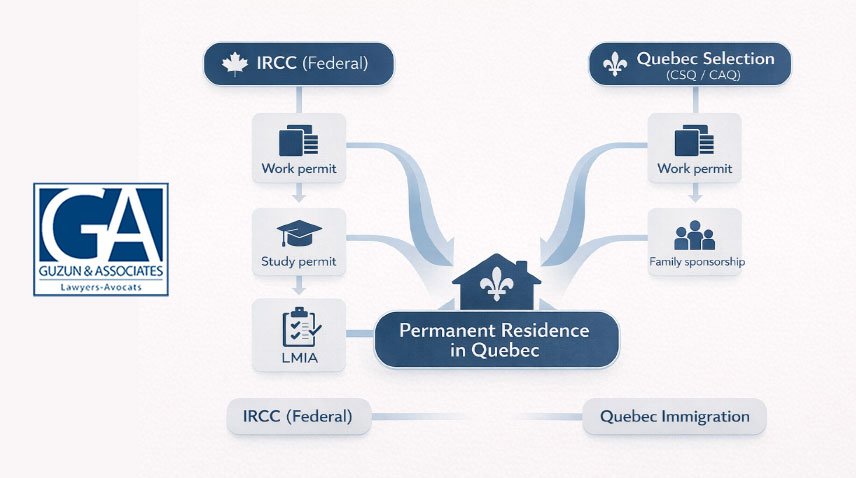
In 2026, IRCC noted persistent high volumes and backlogs. Quebec manages its own selection (CSQ, CAQ), while IRCC manages admission. This dual process increases the risk of conflicting information between provincial and federal forms if you are not careful. In 2026, IRCC noted persistent high volumes and backlogs for work permits, study permits, and family sponsorships.
Consider a lawyer if your IRCC application is complex, involves past refusals, or requires coordination with Quebec requirements like a Quebec Acceptance Certificate (CAQ) or CSQ under the Immigration and Refugee Protection Act. A lawyer can also identify misrepresentation risks and guide your response to IRCC document requests or interviews.

Work and Study Permits in Quebec: Addressing Complexities
Quebec study and work permit applications often require an additional step: a CAQ or an LMIA approved by ESDC. IRCC assesses your overall situation, including your study program, home country ties, financial support, and credibility.
Seek legal advice for previous visa refusals, educational or employment gaps, weak financial documentation, or past overstays in Canada or abroad. A lawyer can craft a clear explanation, organize evidence, and mitigate IRCC concerns about your intentions or compliance.
Permanent Residence and Quebec Selection Challenges
Permanent residence via Quebec typically involves two stages: provincial selection (e.g., a CSQ) followed by IRCC’s admissibility assessment. Each stage can present distinct challenges.
Legal support is crucial if IRCC questions your medical, criminal, or financial admissibility, or notes inconsistencies between Quebec and IRCC submissions. A lawyer helps prepare updated forms, affidavits, and legal submissions to ensure IRCC receives a consistent, truthful account.
Comparison: Self-Apply vs. Hiring a Lawyer
| Situation | You May Self‑Apply | You Truly Need a Lawyer |
| Study Permit | Clear history, strong finances. | Prior refusals, weak finances, gaps in study. |
| LMIA Work Permit | Standard job, no dependents. | LMIA exemptions, employer errors, compliance risks. |
| Family Sponsorship | First marriage, long cohabitation. | Complex history, previous divorce, inadmissibility. |
| Permanent Residence | CSQ holder with clean record. | Criminal charges, medical issues, status loss. |
| Refusals / Appeals | N/A | Almost always (strict deadlines apply). |
LMIA Processes in Quebec: Legal Support for Employers and Workers
A Labour Market Impact Assessment (LMIA) is often required for Quebec employers hiring foreign workers. ESDC administers the LMIA, but Quebec may impose additional requirements regarding language and labour standards. This involves extra forms, fees, and strict advertising rules for the employer. In some cases, Quebec offers facilitated LMIA streams for specific in‑demand occupations, but these still require careful compliance with both federal and provincial rules.

When to Involve a Lawyer for LMIA
Consider involving a lawyer in LMIA files in Quebec when you face:
- High‑stakes roles, such as hiring key executives or specialized talent where a refusal would seriously damage the business.
- Non‑standard positions or salaries that may not clearly fit typical wage or classification grids.
- Compliance concerns, where employers must show genuine recruitment and offer market wages, and need to ensure the Transition Plan meets Quebec standards.
- Work permit delays or expiring status, when a worker may need advice on implied status or restoration options while the LMIA is processing.
- Employers who are new to the LMIA process and/or unfamiliar with Quebec‑specific requirements and want to avoid errors that could block work permits and cause significant delays.
LMIA for Quebec: Employer Responsibilities and Worker Protection
To support an LMIA, Quebec employers must show genuine recruitment efforts, offer market-level wages, and respect provincial labour standards. They must also complete specific Quebec forms and often sign undertakings. Foreign workers depend entirely on the accuracy of these employer documents.
A lawyer assists both employers and workers in understanding requirements, preparing compliant job offers, and responding to ESDC and Quebec inquiries. Legal help is vital for past violations of labour or immigration rules, or when a worker’s spouse and children also require status via the LMIA.
Family Sponsorship in Quebec: Unique Requirements and Legal Guidance
Quebec family sponsorship differs from other provinces. While IRCC processes spousal and family sponsorships, sponsors must also sign a separate undertaking with the Quebec government and satisfy provincial financial criteria. Errors or misunderstandings can cause refusals or extended delays.
Sponsoring Spouses, Partners, and Children
Quebec sponsors must prove both relationship genuineness to IRCC and financial capacity to MIFI. A lawyer is vital for:
- Complex Relationships: Large age gaps, short courtships, or cultural differences that IRCC often flags as “non-genuine.”
- Financial Issues: If the sponsor has a history of social assistance or bankruptcy.
- Appeals: If a sponsorship is refused, representation at the Immigration Appeal Division (IAD) is complex, and having a lawyer greatly increases your chances of presenting a strong legal case.
- Past sponsorships: Sponsor with previous sponsorships or complex family history.
- For children, issues like custody and consent from the other parent may arise.
IRCC and Quebec often scrutinize these cases more closely.
A lawyer helps prepare robust relationship proof (messages, photos, travel records), organize financial documents, and draft detailed explanations addressing IRCC and Quebec concerns proactively. For “atypical” relationships, legal guidance can be pivotal for approval.
| Sponsorship Scenario in Quebec | Risk Level | How a Lawyer Helps |
| First marriage, similar age, long cohabitation | Lower | Check forms, organize basic documents |
| Large age gap or recent online marriage | Medium-High | Build detailed evidence, prepare interview strategy |
| Sponsor with low income / past aid | High | Analyze financial eligibility, plan supporting proof |
| Shared custody / child abroad | High | Manage consent, court orders, cross-border issues |
| Past misrepresentation / refusal | Very High | Draft legal submissions, address credibility issues |
Addressing Refusals and Inadmissibility in Quebec Immigration
A refusal or a finding of inadmissibility can affect all your future immigration plans. In Quebec, a refusal may come from IRCC, from Quebec authorities, or both. Each type of refusal has its own rules and timelines for review or appeal.
A refusal letter is not always the end. However, choosing the wrong path can waste time and money. Deadlines to challenge refusals or file for judicial review are very short and strictly enforced, so getting timely legal advice is critical.
You truly need a lawyer if:
- You don’t understand a refusal letter
- You are accused of Misrepresentation (5-year ban).
- You face Medical Inadmissibility (excessive demand on health services).
- You face Criminal or Security Inadmissibility
- You need to file for Judicial Review at the Federal Court. Only a lawyer can represent you there.
Navigating Options After an Immigration Refusal
Not every refusal should be appealed; sometimes a fresh, stronger application is better. Other times, especially when IRCC made a legal or procedural error, it is important to challenge the decision. Choosing the wrong path (re-applying vs. appealing) can waste time and money and even close doors forever.
A lawyer analyzes refusal reasons, documents, and application history, advising on appeals, reconsideration, judicial review, or a new application. For Quebec immigration, this assessment considers both federal and provincial rules, including CAQ, CSQ, and sponsorship undertakings.
Intersecting Legal Issues: Criminal and Family Matters in Quebec Immigration
Your immigration status in Quebec does not exist in a vacuum. Criminal charges, family disputes, or support obligations can directly affect your immigration file. Guzun & Associates is unique because we handle Immigration, Criminal Defence, and Family Law under one roof.
Urgently consult a lawyer if you are dealing with:
- Criminal Charges (e.g., DUI, assault, theft, fraud): A DUI or assault charge can seriously affect your immigration status and, in some cases, lead to removal proceedings, depending on the sentence and how the offence is characterized under immigration law. We defend you in criminal court with your immigration status in mind.
- Divorce & Custody: If a sponsorship breaks down due to separation, we handle the divorce while advising on the immigration impact.
or if support payments impact sponsorship obligations. IRCC considers these situations when assessing admissibility or relationship genuineness.
Integrated Legal Strategies for Newcomers in Quebec
For immigrants, criminal convictions or specific family court findings can lead to permanent residence refusal, status loss, or removal from Canada. Immigration stress can also exacerbate family conflicts or financial pressures.
A firm skilled in immigration, family, and criminal law can create a coordinated strategy. This includes criminal defense, safeguarding parenting rights and support obligations, and clear presentation to IRCC and Quebec immigration. This integrated approach protects your legal status, family, and long-term future in Quebec.
Real Cases in Quebec: From Problem to Solution
Case 1 – Spousal Sponsorship Saved from Refusal (Montreal)
Problem: IRCC refused a self-filed sponsorship, claiming the relationship was “non-genuine” due to a lack of photos and a short courtship.
Solution: We filed a comprehensive new application. We included affidavits from family, chat logs, and a legal submission explaining the cultural context of their rapid marriage.
Result: The application was approved without an interview. The spouse landed in Quebec as a Permanent Resident.
Case 2 – DUI Charge Threatening Work Permit (Quebec)
Problem: A temporary worker on an LMIA permit was charged with DUI. He feared losing his job and being deported.
Solution: Our criminal team negotiated a plea that avoided a “serious criminality” finding. Simultaneously, our immigration team extended his work permit with full disclosure.
Result: He kept his job, renewed his work permit, and eventually qualified for PR.
FAQ
1. Do I always need a lawyer for Quebec immigration?
No. For simple, first‑time applications with clear documents and no history of refusals, you may apply on your own. You truly need a lawyer when your case has complex LMIA, involves Quebec‑specific steps, or has previous problems (a refusal history, criminal charges).
2. When is a lawyer most important for LMIA applications in Quebec?
A lawyer is crucial when the employer is new to LMIA, when the position or salary is unusual, or when the worker’s future status and family depend on the LMIA being approved without issues.
3. Why is Quebec sponsorship harder?
It involves two governments. You must satisfy IRCC (relationship) and Quebec (finances). Quebec requires an extra sponsorship undertaking and applies its own financial and administrative rules, in addition to IRCC’s requirements, so errors or weak evidence can lead to delays or refusals at either level.
4. What should I do if IRCC refuses my Quebec immigration application?
Keep the refusal letter and all application documents, then consult a lawyer quickly to assess whether to reapply, ask for reconsideration, or challenge the decision through an appeal or judicial review.
5. Can a criminal record or family dispute affect my immigration to Quebec?
Yes. Criminal charges, convictions, or negative findings in family court can harm your admissibility, your sponsorship, or your permanent residence, so it is important to get coordinated legal advice covering immigration, criminal, and family law. We can assess whether Criminal Rehabilitation or a Temporary Resident Permit (TRP) is available in your situation and help you apply for these options where appropriate.
6. Can a consultant handle Federal Court appeals?
No. Only a lawyer (Barreau du Québec) can represent you in Federal Court for a Judicial Review of a refusal.
Secure Your Future in Quebec
Don’t gamble with your life in Canada. Contact Guzun & Associates Lawyers for a strategic assessment of your case. Our Montreal team protects your rights and future in Quebec, addressing IRCC applications, LMIA processes, Quebec sponsorship, or complex family and criminal law issues.
Free Orientation Call:
📞 Call us: +1 (514) 842-7414
✉️ Email: office@avocatguzun.com
📍 Visit: 105-1 rue McGill, Suite 15B, Montreal, Quebec
Disclaimer: This article provides general information only and does not constitute legal advice. Immigration laws and IRCC policies change frequently. For advice specific to your case, please consult with a qualified lawyer.