
Step-Parent Adoption vs. Tutorship (Tutelle) in Quebec: Your Guide to Legal Options
Step-Parent Adoption vs. Tutorship (Tutelle) in Quebec: Your Guide to Legal Options

Introduction
Raising a child who is not biologically yours often prompts a desire for legal security. In Quebec, two primary options exist: Step-Parent Adoption and Tutorship to a Minor (Tutelle). Both protect the child, but their legal effects, permanence, and processes differ significantly.
The choice impacts parental authority, contact with the biological parent, inheritance rights, and even the child’s surname. This guide clarifies the differences to help you decide what is best for your blended family.
Guzun & Associates Lawyers in Montreal assist step-parents and biological parents in navigating these complex procedures in Superior Court. Proper legal advice ensures the child’s future is secured while respecting everyone’s rights.
Understanding Step-Parent Adoption in Quebec
Step-parent adoption in Quebec establishes a permanent legal parent-child relationship. Unlike simple custody, it severs the legal tie (filiation) with one biological parent and replaces it with the step-parent.
As of 2026, these adoptions are strictly regulated by the Civil Code of Quebec and always require court approval.
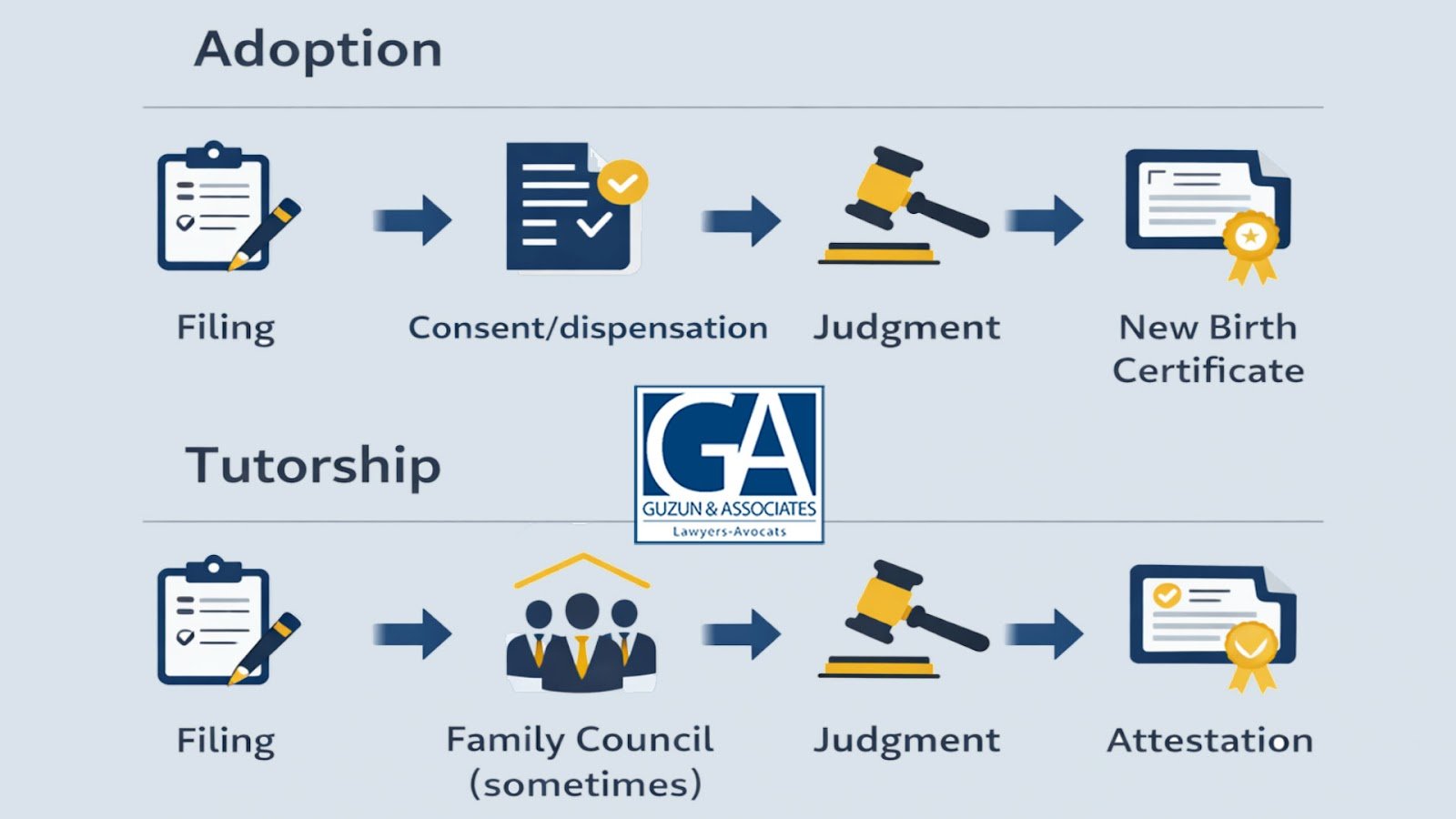
The Step-Parent Adoption Process
The process usually includes:
- Consent: The biological parent who is losing rights must consent (Special Consent). If they refuse, you must ask the court to dispense with their consenta high legal bar.
- Evaluation: Psychosocial assessment is often required to prove the adoption meets the child’s “best interests.”
- Motion (Requête): Filing a motion for adoption in the Superior Court of Quebec.
- Judgment: A judge reviews the file. If approved, the child’s birth certificate is permanently altered.

When Can You Bypass Parental Consent?
If the other biological parent refuses to sign, the court may dispense with their consent only in specific cases, such as:
- Clear abandonment of the child.
- Prolonged absence with no contact.
- Serious failure to fulfill parental duties (neglect, abuse).
Timelines and Costs for Step-Parent Adoption
Uncontested step-parent adoption files typically take 6 to 12 months from filing to judgment. This depends on the region, court delays, and assessment requirements. Contested cases often exceed a year and may involve multiple court dates.
Costs vary by complexity. They include court fees, lawyer’s professional fees, and occasional evaluation costs. A straightforward, uncontested file is less expensive than a high-conflict case with parental objections. Guzun & Associates clarifies fees upfront, helping estimate total costs based on your situation.
Understanding Tutorship (Tutelle) to a Minor
Tutorship (Tutelle) is a protective measure that grants an adult legal authority to care for a child without becoming their parent. It does not erase the biological parent’s status.
In Quebec law, we use the term “Tutor” rather than “Guardian.” A step-parent can be appointed as a Dative Tutor to share or take over responsibilities.
When is Tutorship Used?
- The biological parent is absent or ill but may return later.
- You want legal authority (for school, doctors, passports) without a permanent adoption.
- There is strong opposition to adoption from the biological family.
- You want protection without erasing the other parent’s legal status.
The tutor holds custody, manages the child’s property, and makes important decisions, always prioritizing the child’s best interests. Parents may retain some rights, depending on the court judgment. A court or family council can also supervise the tutor.
Timelines and Costs for Guardianship (Tutelle)
Tutelle files are often faster than adoption since they do not alter filiation. Uncontested applications typically take 3 to 9 months, depending on court schedules, notice requirements, and whether the request is contested.
Costs primarily include legal fees, court costs, and potentially notary or evaluation fees. As tutelle is more flexible and less final than adoption, it may be less expensive in complex family situations. However, each case requires individual evaluation by a family law professional.

Comparison: Adoption vs. Tutorship
| Aspect | Step-Parent Adoption | Tutorship (Tutelle) |
| Legal Effect on Filiation | New Filiation: Replaces one biological parent. | No Change: Biological links remain. |
| Permanence | Permanent and generally irreversible. | Reversible; can be ended by the court. |
| Parental Authority | Step-parent gains full parental rights. | Tutor manages care; parents may retain rights. |
| Other parent’s rights |
Often loses parental authority and rights | Keeps filiation; some rights may remain |
| Inheritance | Child inherits from step-parent automatically. | No automatic inheritance (needs a Will). |
| Typical Timeline | ~6–12 months (longer if contested). | Often 3–9 months, depending on complexity |
| Typical use case |
Long-term, stable blended family | Temporary or protective solution |
Key Takeaways: Adoption vs Tutelle
- Adoption = permanent new parent (inheritance, immigration equality)
- Tutelle = flexible care authority (biological links preserved)
- Quebec courts prioritize child’s best interests in both processes
Comparing Legal Effects on the Child
The core distinction between step-parent adoption and tutelle lies in their legal effect on the child’s status. Adoption alters the child’s filiation; tutelle merely arranges for the child’s care.
Impact on Child’s Identity, Name, and Documents
Adoption: The child receives a new birth certificate. You can apply to change the child’s surname to match the step-parent’s. The child may adopt the step-parent’s surname or a combination, following Quebec naming rules and the judge’s decision. An adopted child gains legal equality with a biological child for immigration sponsorship and inheritance.
Tutorship: The birth certificate is unchanged. The tutor receives an “Attestation of Tutorship” to show schools and hospitals. Under tutelle, the child’s identity documents remain linked to their original parents. The tutor’s name appears as a legal representative, not a parent. This permits the tutor to sign school forms, medical authorizations, and administrative documents, but the child’s filiation remains unchanged.
Inheritance and Financial Implications
An adopted step-child inherits from the adoptive parent as a legal child under Quebec succession law. This establishes mutual inheritance rights between the step-parent and child, subject to wills and Civil Code rules.
Tutelle does not create an automatic inheritance relationship between the tutor and child. Inheritance rights remain with biological or legal parents. To leave assets, a tutor must use a Last Will and Testament to ensure the child is provided for. Tutelle also imposes duties for managing the child’s property and may require reports and accountability.
Reversibility
Tutorship is flexible. If a biological parent recovers from illness or addiction and can resume parenting, the tutorship can be modified. Adoption is final; it cuts the bond with the biological family (including grandparents) permanently.
Deciding on Step-Parent Adoption
Deciding between adoption and tutelle is a strategic choice. It hinges on relationship stability, the other parent’s role, and the desired future for the child.
When Step-Parent Adoption is Preferable
Step-parent adoption often makes sense when:
- The step-parent has acted as a parent for many years.
- The other biological parent is absent, has no contact, or clearly abandoned the child.
- You want the child to have the same legal status as other children in the home.
- You want long-term security for immigration, inheritance, and decision-making.
In 2026, Quebec courts prioritize the child’s best interests. Judges consider emotional bonds, relationship duration, couple stability, and the child’s wishes, particularly for older children. A well-prepared file with clear evidence helps the court approve adoption.
Emotional and Practical Considerations of Adoption
Adoption can be emotionally powerful, reinforcing a sense of belonging in blended families. However, it may sever legal ties with one parent’s family, including grandparents. Before proceeding, discuss future contact with that family side and document current relationships and the child’s needs.
Deciding on Tutorship (Tutelle)
Tutelle may be preferable when you need protection and legal authority, but cannot or do not wish to break existing filiation. It offers a flexible solution for fragile or evolving family situations.
When Tutorship (Tutelle) is Preferable
Tutelle may be the right choice when:
- The other parent is alive and somewhat involved, but cannot fully assume parental duties.
- There is a hope that the parent’s situation will improve in the future.
- You want the child to keep the full legal link to both biological parents.
- Immigration or international issues make adoption harder or riskier.
Tutelle suits cases with strong adoption opposition from the other parent or family, yet consensus exists on the child needing a stable adult with legal authority. Courts can customize tutelle orders to the child’s situation, including limitations on the tutor’s powers.
Flexibility, Modification, and Termination of Tutelle
Unlike adoption, tutelle can be modified or terminated if circumstances change. If a biological parent regains full parental capacity, they can petition the court to revise or end the tutelle. The court re-examines the child’s best interests before any alteration.
As tutelle is reversible, some families use it as a temporary solution. Others maintain it long-term to respect the biological parent’s role while ensuring child stability. Guzun & Associates helps clients choose the option offering maximum protection with minimal conflict.
Real Cases: Strategic Choices
Case 1: The “Absent Father” (Adoption)
Scenario: A 10-year-old girl had no contact with her biological father for seven years. Her step-father was the only “dad” she knew.
Strategy: We filed for adoption. We gathered school records proving the step-father’s role and the bio-father’s absence.
Result: The court dispensed with the biological father’s consent due to abandonment. The adoption was granted, and the child took the step-father’s surname.
Case 2: The “Sick Mother” (Tutorship)
Scenario: An uncle cared for his niece because the mother had severe health issues but visited when able. Adoption would have crushed the mother.
Strategy: We filed for Dative Tutorship. This gave the uncle legal power to sign medical forms and manage the child’s money.
Result: Approved in 5 months. The mother kept her title as “mom,” but the uncle had the legal tools to protect the child daily.
FAQ
1. What is the main difference between step-parent adoption and tutorship (tutelle) in Quebec?
Step-parent adoption creates a new, permanent legal parent-child relationship, typically replacing one biological parent. Tutelle, however, only grants authority to care for the child and manage decisions without altering filiation.
2. How long does step-parent adoption vs. tutelle usually take in Quebec?
Uncontested step-parent adoption typically takes 6–12 months, while tutelle often takes 3–9 months. Delays vary by court, region, and whether the case is contested or requires expert assessments.
3. Does adoption affect the child support I receive?
Yes. If a step-parent adopts the child, the biological parent who lost rights is usually no longer obligated to pay child support. The step-parent assumes this financial duty.
4. Is step-parent adoption more expensive than tutorship (tutelle)?
Step-parent adoption is generally more complex and potentially more expensive, especially with parental objections. Tutelle may cost less as it avoids filiation modification. Both, however, incur legal and court fees.
5. How much does step-parent adoption cost in Quebec?
Costs vary based on complexity (e.g., if the other parent contests). Uncontested files are cheaper. Costs include court filing fees (~$200-$300), notification fees, and lawyer’s fees. Contact us for a specific estimate. Guzun & Associates clarifies fees upfront.
6. Can the other biological parent stop a step-parent adoption in Quebec?
The other parent can oppose adoption, and their consent is usually required. However, the court may dispense with consent if the parent abandoned the child or seriously failed parental duties. This requires strong evidence and legal representation.
7. Can a child over 10 refuse adoption?
Yes. In Quebec, a child 10 years or older must consent to their own adoption. Their voice is central to the court’s decision.
8. How do I know if adoption or tutelle is better for my family?
Consider your relationship’s stability, the other parent’s involvement, the child’s emotional bonds, and long-term goals like inheritance and immigration. A family lawyer at Guzun & Associates can review your situation and recommend the safest option.
9. Is it “Guardianship” or “Tutorship” in Quebec?
In Quebec Civil Law, the correct English term is Tutorship (or Tutelle in French). The term “Legal Guardian” is often used in other provinces or common law contexts.
Secure Your Child’s Future Today
Every family is unique. Whether you need the permanence of adoption or the flexibility of tutorship, Guzun & Associates provides the strategic guidance you need in Montreal Superior Court.
- Call us: +1 (514) 842-7414
- Email: office@avocatguzun.com
- Visit: 105-1 rue McGill, Suite 15B, Montreal, Quebec
Disclaimer: This guide provides general information about Quebec family law as of 2026 and does not constitute legal advice. Adoption and tutorship cases are highly fact-specific. For guidance tailored to your family’s situation, contact Guzun & Associates Lawyers for a confidential consultation.