
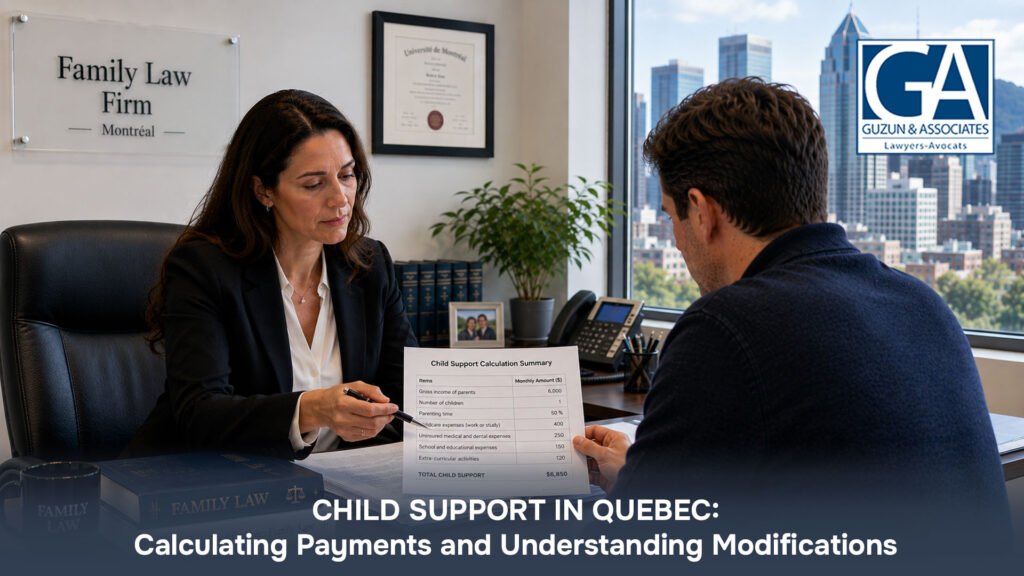
Child support in Quebec ensures a child's daily needs are met after separation or divorce. Parents often need to know the payment amount and how future income or parenting time changes might affect it.
Quebec's child support model uses a specific calculation. The amount is determined by parents’ income, the number of children, custody arrangements, and certain child-related expenses.
This guide explains Quebec child support simply. You will learn how calculations work, when payments can be modified, and practical steps for payers and recipients.

Understanding Child Support Calculations in Quebec
The Quebec child support determination model is typically used in family law cases. This framework promotes fairness and consistency in support calculations.
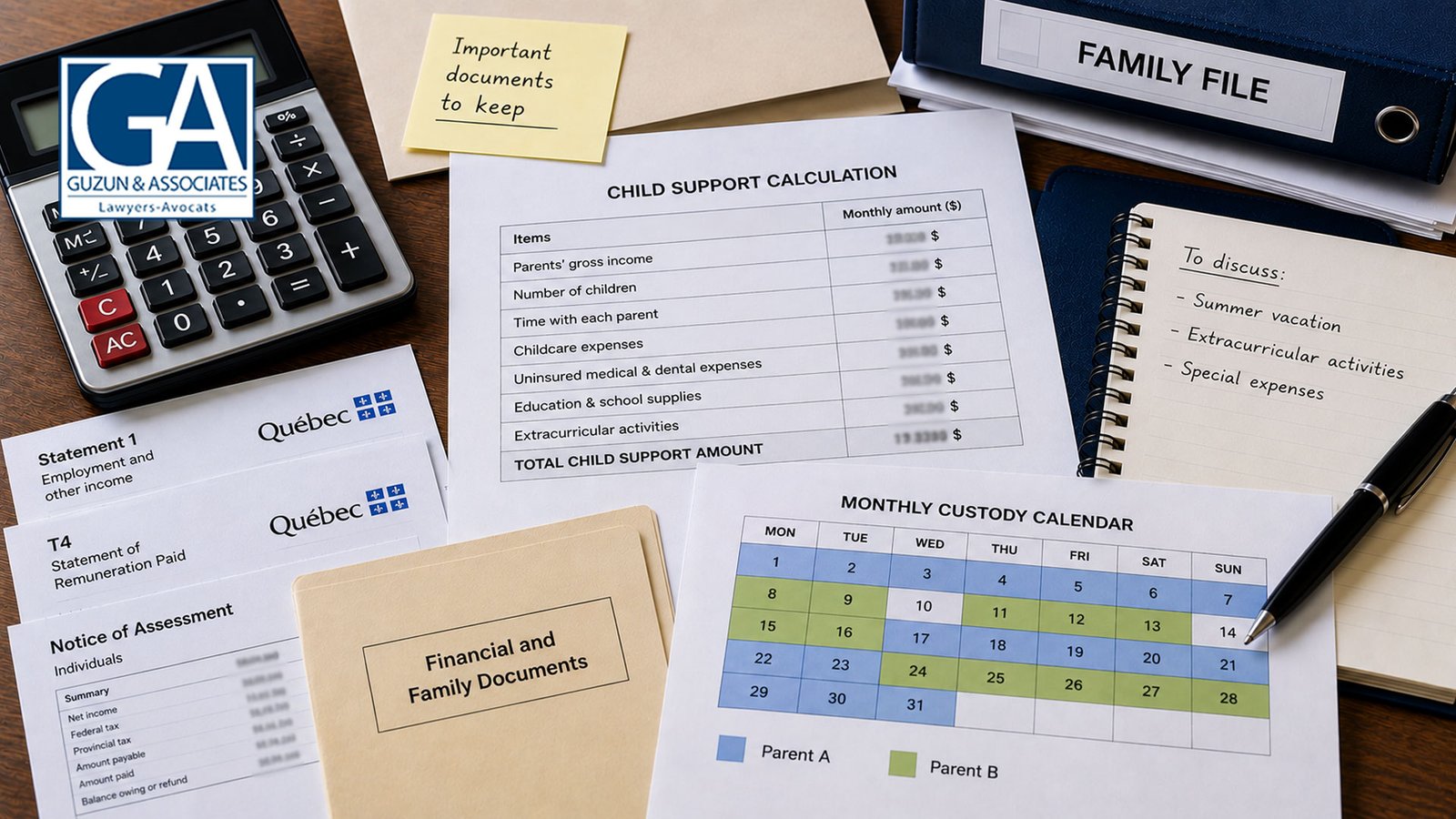
The calculation begins with both parents’ gross annual income. It considers the number of children and the custody schedule. Some special expenses are also factored in, such as daycare, school fees, health costs, and justified extracurricular activities.
Accurate calculation is crucial. Small errors in income or custody percentages can significantly alter the monthly payment.
Quebec Child Support Table Basics
The Quebec child support table estimates the basic parental contribution for a child’s ordinary needs, like housing, food, clothing, and transportation.
This contribution is divided between parents based on their incomes. If one parent has primary custody, the other usually pays support. Shared custody arrangements may lead to adjusted payment amounts.
| Factor | What It Means | Why It Matters |
| Parent income | Gross annual earnings of both parents | Forms the strict mathematical basis of the calculation |
| Custody arrangement | Sole, primary, split, or shared custody | Directly increases or reduces the support amount |
| Special expenses | Daycare, health, school, activities | Added on top of the base child support |
Shared Custody and Its Impact on Child Support
Shared custody, generally refers to arrangements where each parent has the child for a significant portion of time, often around 40% or more, which can affect the support calculation. However, support obligations do not automatically end in shared parenting scenarios.
The court assesses each parent’s income and the child’s care costs. The aim is to ensure the child experiences a similar standard of living in both households. If one parent earns significantly more, they will likely still pay child support despite a 50/50 time split.
Quebec's Split Custody Rules
Split custody occurs with multiple children when each parent has primary custody of at least one child. Support calculation differs in these situations as each parent is primarily responsible for a child.
This arrangement may result in one parent paying the other or a reduction in the total support payable. These cases can be complex.
Parenting Time and Its Relation to Support
Parenting schedules influence living costs. A parent with more time may incur higher day-to-day expenses. However, the law prioritizes the child’s best interests.
Accurate records are vital for disputes over parenting time. Courts may look at the actual parenting schedule, not just what the agreement says, when determining child support.
Family Law Income Disclosure Requirements
Accurate income disclosure is critical for child support cases. Failure to provide truthful financial information can lead to negative court findings or imputed income.
Imputed income means the court assigns an income figure if the declared amount is not credible. This is used when income is underreported, paid in cash, or a parent is voluntarily unemployed.
Understanding Imputed Income in Quebec
Imputed income means the court assigns an income figure to a parent when the declared amount is not credible, for example if income is underreported, paid in cash, or the parent is voluntarily unemployed or underemployed. It may also apply to self-employed individuals who mix personal and business expenses.
The court carefully reviews all evidence. The goal is to ensure fairness to the child, not to penalize a parent.
Sharing Special or Extraordinary Expenses (Section 7)
Certain child-related expenses are added to the base support amount. These include daycare required for work or study, uninsured medical/dental costs, tutoring, and specific competitive sports or arts programs.
These costs are typically shared proportionally to the parents’ respective incomes, not simply split 50/50. Parents must keep receipts and discuss significant expenses beforehand.
| Expense Type | Usually Included? | Notes |
| Basic food and housing | Yes | Already covered by base child support |
| Daycare for work or study | Often yes | Usually shared proportionally based on income |
| Private school or major activities | Sometimes | Usually require strong justification and may depend on the child’s needs and the parents’ circumstances |
How to Modify Child Support Payments
Child support can be modified when there is a material and meaningful change in circumstances. This legal basis is required to ask a court to review an order or agreement.
Such changes include significant income shifts (job loss, promotion), new custody arrangements, or altered child needs.
Quebec's Simplified Modification Tools: If both parents agree to the change, If both parents agree, Quebec may offer streamlined processes such as the Service d’aide à l’homologation (SAH), and in certain income-only situations SARPA may be available. Eligibility depends on the nature of the change and the current file.
Reviewing Support Due to Income Changes
A substantial increase or decrease in a parent’s income may make the current support amount unfair. This applies if a parent returns to work, retires, or experiences a business income decline.
Prompt action is advised. Delays can create payment arrears or imbalances that are difficult to rectify.
Retroactive Child Support Claims
Courts may order retroactive support adjustments in some cases, especially where income was not disclosed or where a parent delayed seeking a change. This can occur if a parent failed to disclose income changes or delayed updating support payments.
Retroactive claims can have serious financial implications. Seek legal advice promptly if you identify such a problem.

Child Support Enforcement Procedures in Quebec
In Quebec, child support collection is highly regulated. It is automatically managed by Revenu Québec through the Programme de perception des pensions alimentaires.
This mandatory program ensures payments are collected securely. Failure to pay can trigger enforcement measures such as wage deductions, seizure of certain funds, and interception of tax refunds.
Never stop paying support simply because you lost your job or your ex-partner denied you visitation. The existing order remains valid and arrears will accumulate until the order is officially modified by a judge or homologated agreement.
Separation Agreements and Support Obligations
Separation agreements may include child support terms, but they must comply with Quebec family law. Parents cannot waive a child’s right to adequate financial support.
If an agreement no longer reflects current circumstances, it may require legal revision or court approval.
2 Real Cases from Guzun & Associates
Case 1: Income change after separation
A client lost stable employment and quickly fell behind on child support, facing aggressive collection from Revenu Québec. We assisted in gathering updated financials, clearly proving the involuntary income change, and filing an urgent modification request. This led to a revised, affordable payment aligned with the client’s current situation and halted the accumulating arrears.
Case 2: Shared custody dispute
A client believed child support should end completely because the parents moved to a 50/50 shared custody schedule. Our review of the schedule, incomes, and special expenses confirmed an ongoing support obligation under Quebec rules (because our client earned significantly more), albeit at a reduced amount. We drafted a corrected arrangement, reflecting the shared custody reality while protecting the child's standard of living.
FAQ
How is child support calculated in Quebec?
It is calculated using a mandatory provincial formula based on both parents’ gross annual incomes, the number of children, the exact custody percentage, and specific special expenses (like daycare or tuition).
Can child support be changed after divorce or separation?
Yes, but only if there’s a significant change in circumstances, such as a major shift in income, a change in the custody schedule, or a change in the child’s needs.
Does shared custody mean no child support in Quebec?
No. Shared custody (40% to 60% time) adjusts and often reduces support, but it doesn't automatically eliminate it, especially if there is an income disparity between the parents.
What if the other parent hides their income?
Courts can demand full financial disclosure. If declared figures lack credibility, a judge can "impute" income, meaning they will calculate support based on what the parent should or could be earning.
Can unpaid child support be enforced in Quebec?
Yes, very strictly. Revenu Québec manages collection and can recover arrears through wage deductions, seizing tax refunds, and freezing bank accounts.
Secure Your Family's Financial Future
Book Your Free Orientation Call: Unsure if your child support calculation is fair, or need to modify an existing order? Start with a brief, no-obligation orientation call to understand your options and the documents required to move forward.
📞 Call us: +1 (514) 842-7414
📧 Email: office@avocatguzun.com
📍 Visit: 105-1 rue McGill, Suite 15B, Montreal, Quebec
Start your new chapter with safety, dignity, and legal security. Get professional legal guidance from Guzun & Associates Lawyers today.
Legal Disclaimer: This article is provided for general informational and educational purposes only and does not constitute legal advice. Family law, including child support calculations, retroactive claims, and Revenu Québec enforcement rules, is highly complex and depends on the specific financial facts of each family. Reading this article does not create a lawyer-client relationship. For advice regarding your unique situation, please consult directly with a qualified family lawyer at Guzun & Associates.