

Separation is difficult enough without daily child-related arguments. In Quebec, a clear, written parenting plan reduces confusion, protects the child’s routine, and helps parents avoid costly conflict.
A good plan explains where the child lives, how decisions are made, how expenses are handled, and what happens during holidays and emergencies. Clear terms drastically reduce the likelihood of future court disputes.
If you are facing child custody, parenting time, or child support issues in Quebec, planning early is crucial. While you can consult official government resources for templates, below we detail exactly what to include in a 2026 parenting plan, how Quebec applies the "best interests of the child" standard, and how legal guidance ensures your agreement is truly enforceable.
Child Custody in Quebec Parenting Plans: Key Legal Elements
In Quebec, courts prioritize the "best interests of the child" above all else. A parenting plan must show how each parent supports the child’s stability, education, health, and emotional needs.
It is important to understand the terminology used in your plan, which depends on your marital status:
- If you are married and divorcing: The federal Divorce Act applies. Your plan will outline "decision-making responsibility" (formerly custody) and "parenting time."
- If you are unmarried (common-law): The Civil Code of Québec applies. The terms used are "custody" (garde) and "access rights" (droits d'accès).
Conflict often arises when parents leave important details undefined. Vague plans can lead to disputes over pickup times, holidays, and medical decisions. A detailed plan prevents this.
Parenting Time Schedule Details
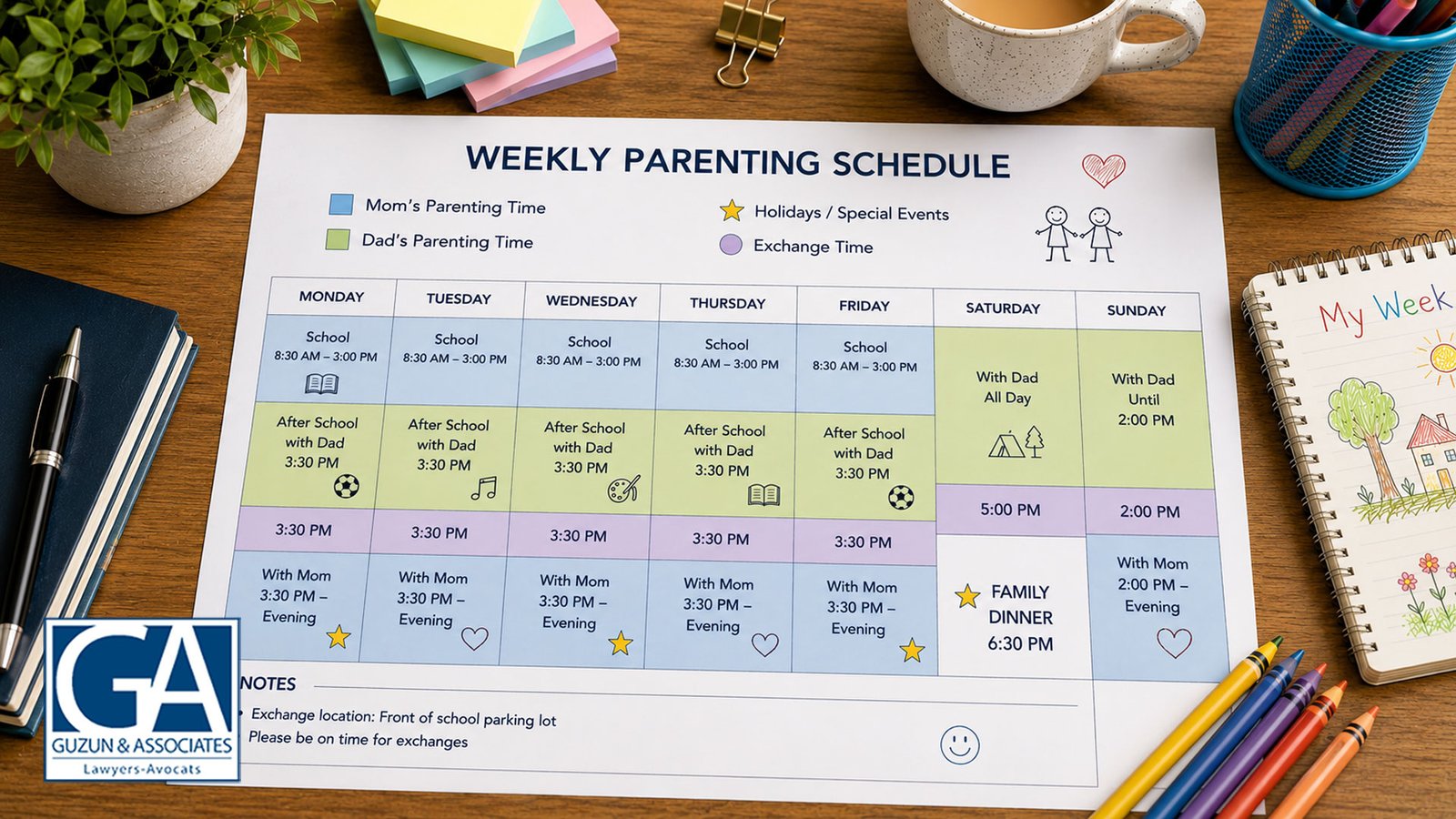
Outline the regular weekly schedule, including weekdays, weekends, exchange times, and exactly who handles transportation. If a parent works shifts, address how schedule changes will be managed.
Decision-Making Responsibility Clarified
State how major decisions about schooling, healthcare, religion, and extracurricular activities will be made. Parents typically share this parental authority, but setting clear rules on how to communicate these decisions minimizes future arguments.
| Parenting plan issue | What to include | Why it helps prevent conflict |
| Weekly schedule | Days, specific times, exchange locations | Reduces daily misunderstandings and late pickups |
| Major decisions | Schooling, health, therapies, activities | Clarifies how joint parental authority is exercised |
| Transportation | Who drives, drop-off rules, delays | Avoids repeated logistical disputes and tension |
Parenting Time & Schedule Considerations (2026)
A parenting plan should reflect the child's actual life, not just theoretical fairness. Quebec courts do not apply a single rigid model to all families. The best schedule depends on the child’s age, needs, school location, and parental work availability.
For young children, frequent contact supports attachment. For teenagers, school, sports, and social life may dictate the structure. A plan that matches the child’s daily reality is much easier to follow.
Holiday and Vacation Arrangements
Include school breaks, major holidays (Christmas, New Year, March Break), summer vacations, birthdays, and special family events. Specify if certain holidays will be alternated year by year.
Handling Changes and Missed Time
Explain procedures for requesting schedule changes and the required notice period. Also, state what happens if a visit is missed due to illness, weather, or travel issues. This prevents minor logistical issues from escalating into major fights.

Child Support & Expenses in Your Parenting Plan
A parenting plan must integrate seamlessly with child support arrangements. Quebec calculates basic child support provincially under the mandatory Quebec model for the determination of child support payments, and the amount of parenting time directly influences the final financial amount.
Parents must also address "Section 7" or special expenses. These include daycare, private school fees, tutoring, sports, orthodontics, and special needs therapy. Disputes frequently arise if the sharing of these costs isn't clearly defined.
Addressing Special or Extraordinary Expenses
List the types of expenses requiring joint approval before the money is spent. Set clear deadlines for submitting receipts to the other parent and making reimbursement payments.
Updating Financial Information
Include a clause about when financial documents (like tax assessments) will be exchanged annually. Annual updates help prevent disputes, avoid retroactive claims, and maintain fairness as incomes change.
| Expense category | Common example | Planning point |
| Basic support | Monthly child support payments | Calculated strictly via Quebec rules |
| Shared extras | Daycare, private school, competitive sports | Define each parent’s percentage share in advance |
| Medical costs | Dental care, therapy, prescription medication | Set explicit approval and repayment rules |
Separation Agreement Impact and Mobility Rules
Many parents incorporate the parenting plan directly into a broader separation agreement. This connects parenting terms with spousal support, division of the family home, and property. A formal written agreement, reviewed by a lawyer, carries significant legal weight.
Effective separation agreements use clear language, avoid accusations, and focus on practical solutions. Parents should understand the document's requirements long after signing.
Parent Communication Protocols
Establish rules for how parents communicate about the child. Using email or dedicated parenting apps can reduce emotional tension and provide a written record. Specify that text messages or phone calls should be reserved strictly for emergencies.
Mobility and Relocation Guidelines (Crucial for 2026)
You must include rules for moving within Canada, out-of-province, or internationally. Relocation rules depend on your legal context: for married couples divorcing under the federal Divorce Act, notice requirements apply and must be followed carefully; for unmarried (common-law) parents in Quebec, the court evaluates relocation based on the child’s best interests and any existing orders.
Your parenting plan should address:
- Required notice periods (if any) for moves that significantly affect parenting time,
- Passport handling and consent letters for cross-border travel,
- Procedures for objecting to or approving a proposed move.
In many cases, written notice is required or strongly recommended; the exact rules can depend on your marital status, existing court orders, and whether the move substantially changes the child’s living arrangements.

Family Law Advice for Quebec Parenting Plans
Trying to draft a complex parenting plan using free online templates often leaves dangerous legal loopholes. A Quebec family lawyer drafts realistic, enforceable terms focused on the child’s best interests. This is vital in high-conflict separations, relocation cases, or situations involving a breakdown in communication.
If negotiations stall, your lawyer can guide you toward Quebec’s family mediation resources, which may include free or low-cost mediation services for parents with dependent children. Specific benefits, such as hours covered or eligibility criteria, depend on current program rules and your situation.
When to Review the Parenting Plan
A parenting plan should be reviewed following significant changes. Common triggers include a new school, relocation, altered work hours, remarriage, or the child's evolving medical or educational needs.
When Court Involvement May Be Necessary
If safety concerns exist, breaches are repeated, or serious disagreement about the child's welfare arises, court intervention may be required. The priority remains protecting the child and minimizing conflict.
| Situation | Review informally or go to Court? | Reason |
| New school schedule | Review | The child’s daily routine has naturally evolved |
| Parent moving away | Review or Court | Parenting time and access rights will be heavily affected |
| Safety concerns / Abuse | Court | Child protection and immediate safety come first |
2 Real Cases from Guzun & Associates:
Case 1: Holiday conflict after separation
A Montreal parent sought our help after enduring years of recurring arguments over Christmas and summer vacations. Their initial, self-drafted plan only stated "reasonable access," which caused yearly chaos. We drafted a detailed addendum with a fixed calendar, strict travel notice rules, and written communication boundaries. This immediately reduced the conflict and prevented unnecessary court appearances.
Case 2: Dispute over school and medical decisions
In another Quebec case, unmarried parents agreed on a 50/50 parenting schedule but constantly fought over therapy appointments and school choices. Our office revised the parenting plan to clearly define how joint parental authority is exercised, who has emergency care authority, and set strict 48-hour deadlines for sharing medical information. The clearer structure forced better cooperation for the child's benefit.
FAQ
1. What should a parenting plan include in Quebec?
A strong Quebec parenting plan details the child’s weekly schedule, holiday rotation, decision-making rules (parental authority), communication methods, transportation logistics, and procedures for emergencies or future relocations.
2. Is a parenting plan legally binding in Quebec?
A parenting plan is most easily enforceable when it is incorporated into a formal separation agreement and, where appropriate, formalized into a court order. In Quebec, this often involves having the agreement homologated (approved) by a judge, which converts it into an enforceable judicial decision. Lawyer-assisted drafting helps ensure the plan is clear, realistic, and structured in a way the court can accept for formalization.
3. How does child custody work in Quebec after separation?
Whether you use the term "custody" or "decision-making responsibility," Quebec courts prioritize the child’s best interests. They look at the child's stability, routine, and each parent’s ability to foster a healthy relationship with the ex-partner.
4. Can parents change a parenting plan later?
Yes. Plans can and should be updated due to changing circumstances, such as a child entering high school, a parent relocating, or new work schedules. If parents cannot agree on the changes, mediation or court intervention may be necessary.
5. Does child support need to be mentioned in a parenting plan?
Yes. While child support is calculated using a strict provincial formula, the parenting plan dictates the percentage of time the child spends with each parent, which directly alters that calculation. Shared expenses should also be detailed in the plan.
Ready to Secure Your Child's Future with a Clear Plan?
Book Your Free Orientation Call: Unsure where to start with your parenting plan? Start with a brief, no-obligation orientation call. We will listen to your situation, explain the legal steps, and let you know exactly what documents you need to protect your family.
📞 Call us: +1 (514) 842-7414
✉️ Email: office@avocatguzun.com
📍 Visit: 105-1 rue McGill, Suite 15B, Montreal, Quebec
Begin your new chapter with safety, dignity, and legal security. The family law team at Guzun & Associates Lawyers is here to help you build an agreement that protects your children and your peace of mind.
Legal Disclaimer: The information provided in this guide is for general informational and educational purposes only and does not constitute legal advice. Family law in Quebec, including child custody, support, and relocation rules, is complex and highly dependent on the unique facts of your family's situation, your marital status (married vs. common-law), and any existing court orders. Timelines, notice requirements, and enforceability of parenting arrangements can vary. Reading this article does not create an attorney-client relationship. For advice specific to drafting your parenting plan and evaluating your legal options, please consult directly with a qualified family lawyer at Guzun & Associates.