
Criminal inadmissibility to Canada can create immediate immigration problems, often at the worst possible time. Some people first discover the issue at the airport. Others face delays in a work permit, study permit, sponsorship, visitor visa, or permanent residence application because of an old charge, conviction, or police record from another country.
A common misunderstanding is that the problem only begins if someone served jail time. In reality, criminal inadmissibility can also arise from other outcomes, depending on the offence and the record.
This guide explains the main legal issues in clear, practical language. It is intended to help you understand what may happen at the border, during an immigration application, or while planning travel to Canada. If you are concerned about a refusal, a sponsorship delay, a permit issue, or whether an older offence still matters, early legal advice can help you assess the risk before you travel or apply.

Understanding Criminal Inadmissibility to Canada
Criminal inadmissibility is a common reason for visa and entry problems in Canada. Under the Immigration and Refugee Protection Act (IRPA), a person may be refused if an offence committed in Canada or abroad is considered equivalent to a Canadian crime. This is set out in section 36 of the IRPA.
Border and immigration decisions often involve a detailed review of court documents, police certificates, biometric information, travel history, and records shared between authorities. The process can vary from case to case, but it is guided by immigration law, legal equivalency analysis, and officer policies.
Foreign Offence Equivalency
A foreign conviction does not need to match Canadian law word for word. Immigration authorities compare the legal elements of the foreign offence to Canadian criminal law through a detailed legal analysis to determine whether the person is inadmissible.
Serious Criminality Concerns
Canadian immigration law separates two categories under the Act: simple criminality (for example, a single less serious offence) and serious criminality. Both can lead to inadmissibility, but they follow different rules for appeal rights, detention risk, and how a person may later overcome the issue.
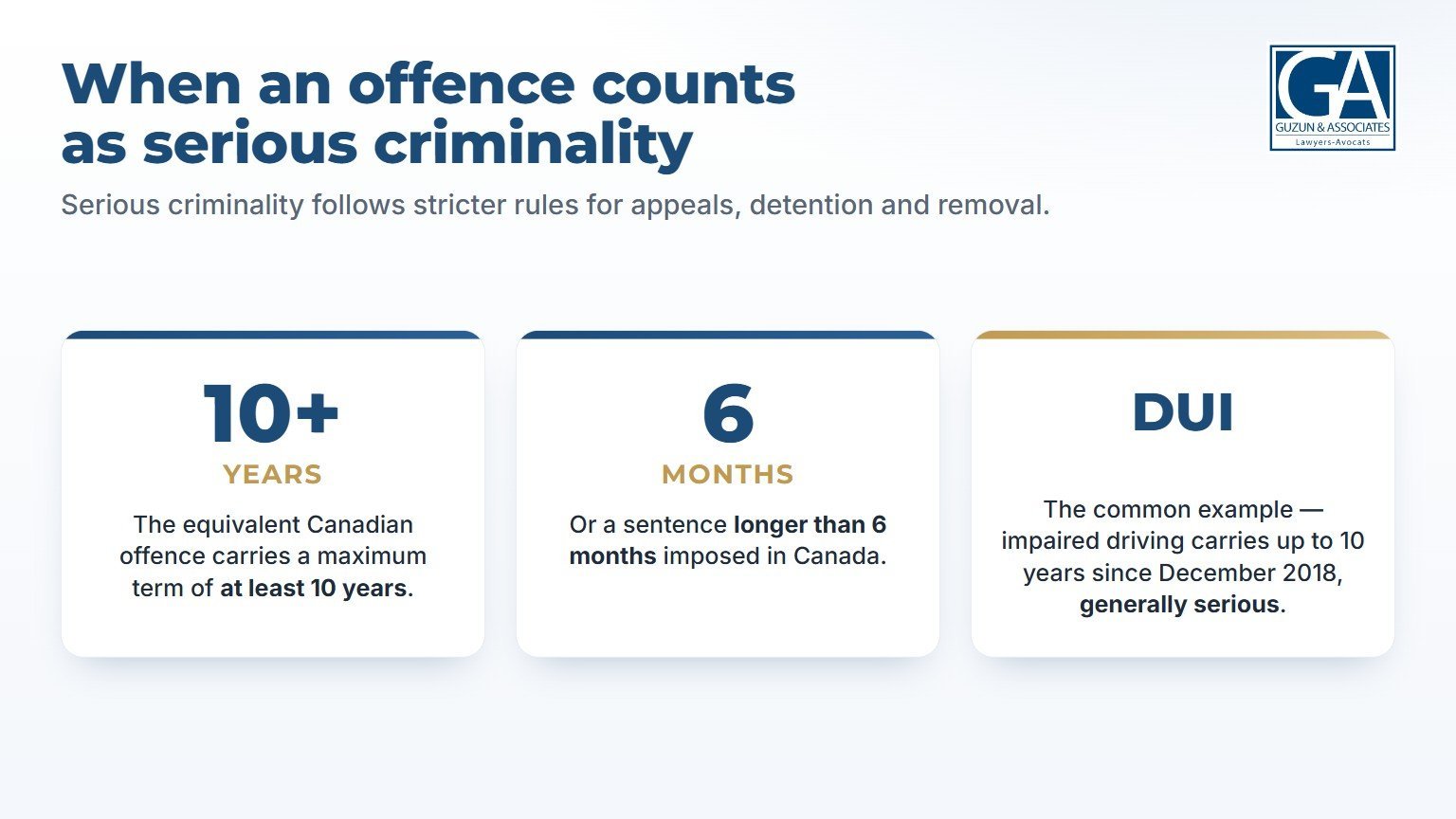
Serious criminality applies where the equivalent Canadian offence carries a maximum prison term of at least 10 years, or where a sentence of more than 6 months was imposed in Canada. This category can affect appeals, detention risk, and removal proceedings.
Since December 2018, impaired driving offences in Canada carry a maximum penalty of up to 10 years. As a result, DUI convictions are generally treated as serious criminality under this test, depending on the exact date and circumstances.
| Record Issue | Immigration Concern | Possible Legal Response |
| Foreign conviction | Offence equivalency review | Legal opinion and court records |
| Pending charge | Admissibility uncertainty | Disclosure and timing strategy |
| Old police record | Border delay or refusal | Rehabilitation analysis |
Criminal Record Checks, Police Certificates, and Disclosure
Criminal record checks can become important during permanent residence applications, citizenship processes, sponsorship files, and port-of-entry screening. The review is not limited to Canadian records. Immigration officers may also assess foreign police certificates for disclosure and possible Canadian equivalency, along with other database information.
A clean record in one country does not automatically resolve the issue. If an applicant failed to disclose an arrest, withdrawn charge, or conviction elsewhere, the case may also raise misrepresentation concerns. In practice, non-disclosure, missing documents, incomplete explanations, or inconsistent answers across applications can create serious immigration consequences beyond the offence itself.
Police Certificates and Disclosure Requirements
Applicants often need police certificates from countries where they lived for a significant period. If a certificate shows an offence, immigration officers will assess the nature of the incident, the outcome, and whether a Canadian equivalency analysis may lead to inadmissibility.
Handling Withdrawn Charges and Stayed Matters
Not every charge leads to inadmissibility. If a matter was stayed, withdrawn, or dismissed, there may be no conviction, but officers may still require documents and explanations to assess the outcome and any immigration impact.
Common Mistakes That Worsen Criminal Inadmissibility Cases
Some immigration problems become more serious because of avoidable mistakes. A person may have a legal solution available, but the file often becomes harder when the facts are incomplete or inconsistent.
Common examples include:
- failing to disclose an arrest, charge, or conviction because it was old or happened outside Canada
- submitting incomplete court records or unclear proof showing when the sentence was fully completed
- assuming a pardon, expungement, dismissal, or similar foreign process automatically resolves Canadian immigration inadmissibility
- travelling to Canada before confirming whether a temporary resident permit or criminal rehabilitation may be needed
- giving different facts in a visa application, permanent residence file, sponsorship matter, or at the border
These mistakes can lead to delays, refusals, or concerns about credibility. In many cases, it is safer to review the record carefully before filing an application or making travel plans.
Deemed Rehabilitation and Criminal Inadmissibility
Deemed rehabilitation can help some people overcome criminal inadmissibility automatically after enough time has passed. However, it only applies in specific cases, and many travellers mistakenly assume they qualify when they do not.
The waiting period usually depends on the type of offence, the sentence completion date, and whether the offence is considered serious. Time does not start from the arrest date. It usually starts after all parts of the sentence are completed, including fines, probation, and licence suspensions.
When Deemed Rehabilitation May Apply
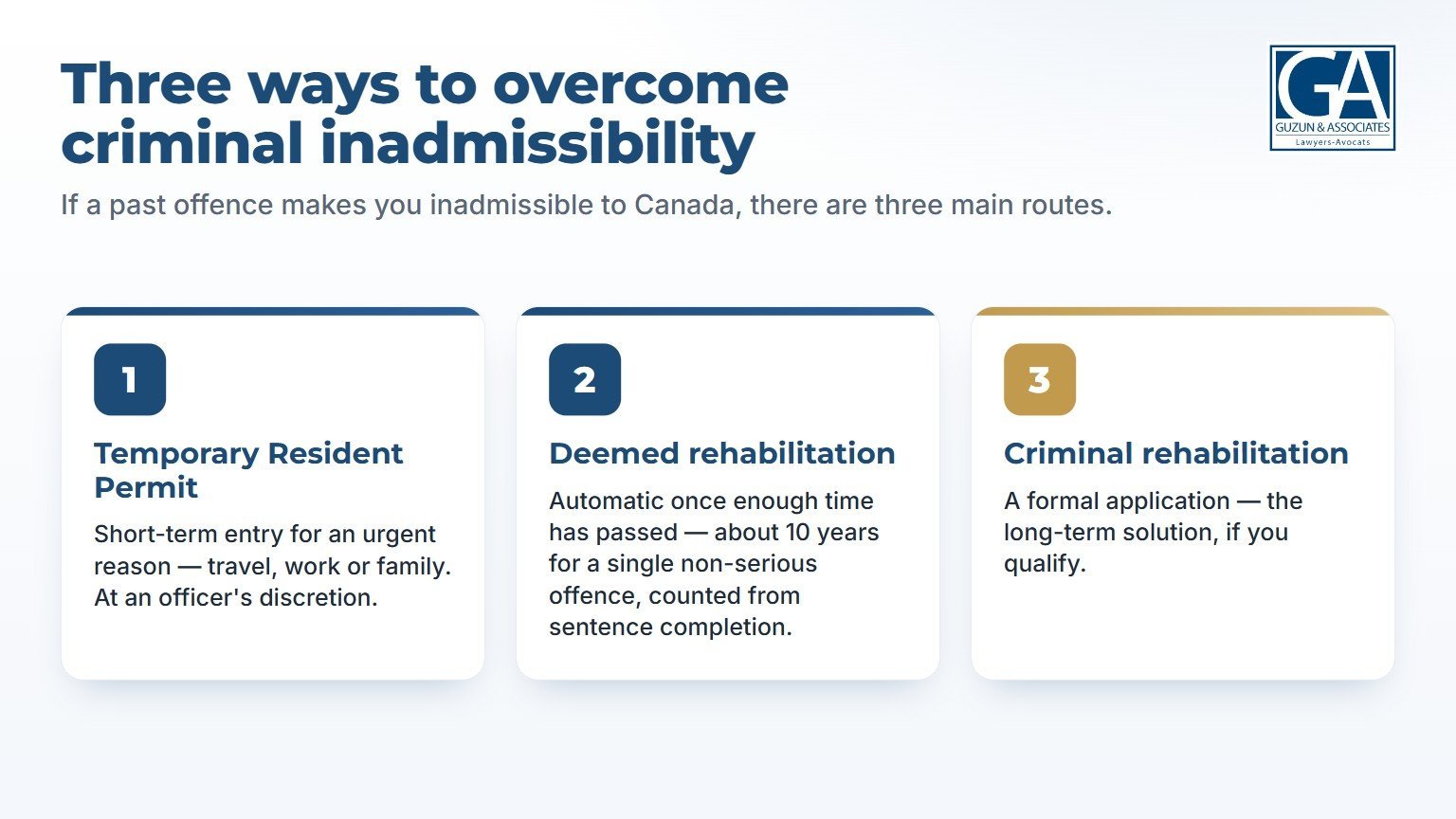
A person may qualify if enough years have passed since sentence completion and the offence is not too serious under Canadian law. For a single non-serious offence, deemed rehabilitation generally applies after about 10 years have passed since the sentence was completed. More serious offences, or multiple convictions, generally do not qualify this way and may require a formal rehabilitation application instead. The exact analysis depends on the record, the number of offences, and how Canadian law classifies the conduct.
Why Timing is Crucial for Rehabilitation
If you apply too early, your application may fail. If you wait too long without proper advice, you may face border refusals, permit problems, or family sponsorship delays that could have been addressed earlier.
| Situation | Main Risk | Practical Step |
| One old conviction | Possible admissibility bar | Check rehabilitation eligibility |
| Multiple convictions | Harder approval path | Full legal assessment |
| Incomplete sentence | Not yet eligible | Confirm end of all conditions |
Temporary Resident Permit for Criminal Inadmissibility
A temporary resident permit, often called a TRP, may allow an inadmissible person to enter or stay in Canada for a limited reason and time. This option can be relevant when there is urgent travel, a work need, a family matter, or a strong humanitarian reason.
A TRP is discretionary. Officers weigh the person’s need to enter Canada against possible risk to the public. Strong documents, honest disclosure, and a clear explanation are essential.
Who May Need a Temporary Resident Permit
People with recent convictions, unresolved admissibility issues, or rehabilitation periods not yet met may use this route. It is common in business travel, family emergencies, and cross-border employment situations.
Evidence Supporting TRP Approval
Useful documents may include court records, proof of sentence completion, letters from employers, family evidence, the purpose of travel, and signs of rehabilitation. A well-prepared package can make a meaningful difference in how the request is presented.
Quebec and Montreal Entry Issues: Local Legal Support
For many people, the issue becomes urgent when they plan to enter Canada through Montreal or when their immigration plans are tied to Quebec. This can affect travellers arriving at Montréal-Trudeau Airport, people applying for work or study options connected to Quebec, and families dealing with sponsorship or permanent residence while living in Montreal or elsewhere in the province.
In these situations, local legal help can be useful for practical reasons. A file may require the fast collection of court records, certified translations, proof of sentence completion, and review of both foreign documents and any related Canadian or Quebec records. This is especially important when there are past driving offences, criminal charges, or document inconsistencies that could affect travel or an ongoing immigration application.
Admissibility is governed by federal immigration law, but Quebec-based legal support can still help make the process more organized and efficient. A local lawyer can review the record, coordinate documents, and prepare a clearer file before travel, before a border interview, or before submitting a permit, sponsorship, or permanent residence application.
Criminal Rehabilitation Application Process
A criminal rehabilitation application is often the most durable long-term solution for people who are inadmissible because of past offences. If approved, it may resolve the inadmissibility linked to those offences, depending on the full record and whether there are any other immigration concerns.
This process is detailed and document-heavy. Immigration authorities usually require court records, police certificates, identity documents, evidence of sentence completion, and proof showing the person is stable and unlikely to reoffend.

Common Errors in Rehabilitation Applications
Many applicants submit incomplete court papers or misunderstand the exact offence of conviction. Others fail to explain sentence completion clearly, especially when fines, probation, or driving prohibitions were involved.
Benefits of Legal Guidance for Rehabilitation
A lawyer can assess offence equivalency, identify whether serious criminality applies, prepare legal arguments, and organize evidence in the format immigration officers expect. This is especially important when the offence happened abroad or involved translation issues.
Real Case Examples
Case 1: A foreign national applying for permanent residence had an older impaired driving conviction from outside Canada. The main issue was not only the conviction itself, but also incomplete proof showing when all parts of the sentence had ended. Guzun & Associates reviewed the foreign judgment, identified the documents missing from the file, clarified the sentence completion timeline, and prepared a rehabilitation strategy based on the Canadian legal equivalency analysis. With a more complete package, the client was able to continue the immigration process with clearer documentation on the admissibility issues.
Case 2: A traveller planning entry to Canada was stopped because an older assault-related record had not been explained consistently in earlier immigration history. Guzun & Associates obtained the court materials, reviewed the exact procedural outcome, compared the foreign offence to Canadian law, and prepared a detailed admissibility submission to address both the record and the disclosure issue. This gave the client a clearer legal plan for future travel and helped avoid repeating the same border problems without proper documentation.
FAQ
1. Can I be refused entry to Canada because of a criminal charge without a conviction?
Yes, sometimes. A charge alone does not always create inadmissibility, but officers may delay entry, ask additional questions, or request documents while they review the case.
2. Does a DUI make me criminally inadmissible to Canada?
It can. Impaired driving is treated seriously in Canada, and since December 2018 it carries a maximum penalty of up to 10 years, so even one conviction may create criminal inadmissibility depending on the date, sentence, and legal equivalency.
3. Can a pardoned or expunged record still affect immigration to Canada?
Possibly. Canadian immigration law may still require a legal analysis of the offence, the pardon process, and whether the person must disclose the record.
4. How long do I have to wait before I can apply for criminal rehabilitation?
It depends on the offence and sentence completion. In many cases, at least 5 years may need to pass after all parts of the sentence are finished, but eligibility depends on the exact record and legal classification.
5. What is better: a temporary resident permit or criminal rehabilitation?
It depends on your timing and purpose. A temporary resident permit is a short-term option for urgent travel, while criminal rehabilitation is usually the more durable option if you qualify.
Concerned a Criminal Record Could Affect Your Entry to Canada?
If you are dealing with a border refusal, a permit delay, a sponsorship problem, or an urgent travel issue linked to a criminal record, Guzun & Associates can review your file and explain the options that may be available.
Book Your Free Orientation Call:
Not sure whether an old conviction, a foreign record, or a pending charge could affect your admissibility to Canada? Start with a brief, no-obligation orientation call to understand your situation and your next steps.
📞 Call us: +1 (514) 842-7414
📧 Email: office@avocatguzun.com
📍 Visit: 105-1 rue McGill, Suite 15B, Montreal, Quebec
This article is provided for general informational and educational purposes only and does not constitute legal advice. Reading this article does not create a lawyer-client relationship with Guzun & Associates. Eligibility for a temporary resident permit, criminal rehabilitation, or deemed rehabilitation depends on the exact offence, the sentence imposed, and the date every part of that sentence was completed. Foreign convictions must be compared to Canadian law, and outcomes vary based on the specific facts of each case. Immigration laws, policies, and officer practices can also change over time. Before travelling to Canada or filing an immigration application, obtain legal advice based on your own record and documents.