
Financial disclosure can affect almost every part of a Quebec family law case. If you are dealing with divorce, child support, spousal support, property division, or a separation agreement, the financial details matter. If income information is incomplete, support may be assessed unfairly. If documents are missing, negotiations can stall. If one person believes assets are being hidden, the case may become more difficult, more expensive, and harder to resolve.
For many people, the challenge is knowing where to start. Pay records may be in one place, bank statements in another, and it may be unclear what needs to be shared. That kind of confusion can lead to delays, extra legal steps, and avoidable conflict.
This guide explains the documents you will usually need, why they matter, and how proper preparation can help support your position in Quebec family law. If you are looking for practical help in Montreal or elsewhere in Quebec, this overview can help you understand what to gather before speaking with a lawyer.

Understanding Financial Disclosure
In Quebec family law matters, clear financial information is often essential when the parties are dealing with child support, family patrimony, or other property-related issues. Financial disclosure helps both sides understand the real financial picture and, where necessary, helps the court assess the case using reliable information.
In simple terms, financial disclosure means giving the other party, and sometimes the court, a complete and accurate picture of your finances. This usually includes proof of income, tax returns, bank statements, debts, business interests, and major household expenses. The purpose is to allow decisions and negotiations to be based on facts rather than assumptions.
If important information is missing or incomplete, the court may — depending on the circumstances — require further disclosure, delay certain steps, or decide based on the evidence available at the time, under the rules set out in the Quebec Code of Civil Procedure.
Core Financial Documents Required
The exact records depend on your case, but they generally fall into three groups.
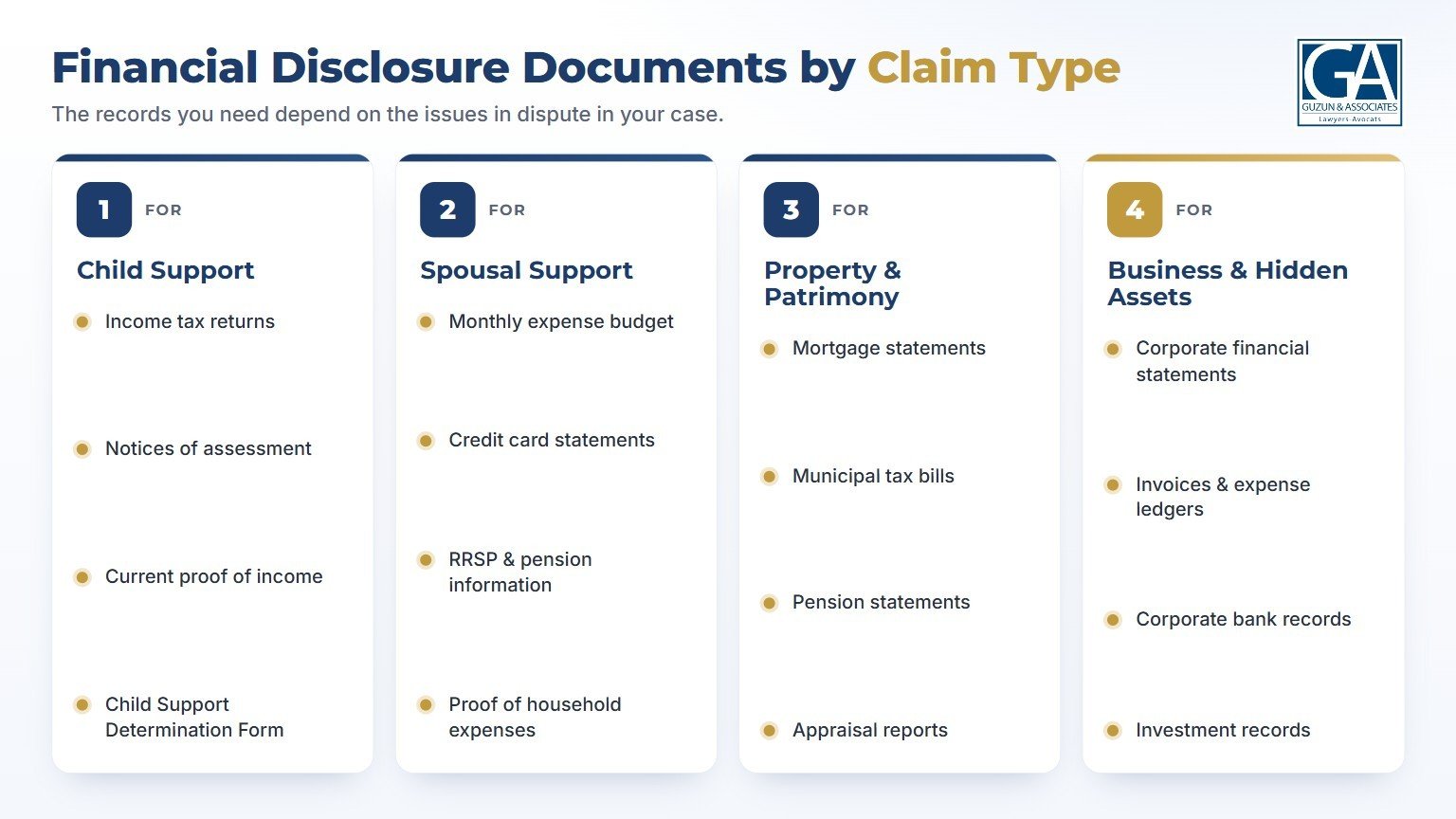
- Routinely required for child support: recent income tax returns, notices of assessment, current proof of earnings, and the Child Support Determination Form. Depending on the circumstances, bank statements, employment records, or additional income documents may also be requested.
- Commonly requested for spousal support: the documents above, plus a monthly expense budget, credit card statements, RRSP and pension information, and proof of living expenses tied to the household.
- Additional documents for property, business, or hidden-asset disputes: mortgage documents, investment records, insurance policies, corporate financial statements, and other records specific to the assets or business interests in dispute.
If children are involved, school, daycare, and medical expense records may also be relevant, regardless of which group applies.
The Principle of Full and Frank Disclosure
In Quebec family law, parties are generally expected to provide full and honest financial information when support, property, or other financial issues are in dispute. In practice, this means your disclosure should be accurate, complete, and updated if your situation changes during negotiations or court proceedings.
Do not guess at amounts or leave out accounts because they seem minor. A missing account, an outdated statement, or an unexplained gap in income can create problems if the other side argues that the disclosure is incomplete or misleading.
Disclosure is not always a one-time step. If your income changes, a property is sold, a new debt appears, or updated records become available, you may need to provide revised information depending on the stage of the case and the issues involved.
| Document Type | Why It Matters | Common Examples |
| Income records | Helps calculate support | Pay stubs, T4 slips, tax returns |
| Asset records | Shows property and savings | Bank statements, RRSPs, home value |
| Debt records | Gives a full financial picture | Loans, credit cards, line of credit |
Quebec Financial Statement Forms and Their Application
In many Quebec family law files, financial disclosure is provided through required forms and supporting documents, depending on the type of claim and procedure.
For child support, the key document is Quebec’s Child Support Determination Form (Schedule I / Annexe I), which is used to help calculate support based on the parties’ financial information. It can be completed jointly or separately by the parents, or established by the court, and feeds into the calculation described below under how child support is calculated in Quebec.
In proceedings involving spousal support or other financial claims, Form III — the sworn statement of income, expenditures and balance sheet — may also be required under the applicable court rules. It is not the same form used for child support, and the two should not be confused; a single file can require both.
Because procedure can vary from one case to another, it is best to get case-specific legal advice on what must be filed, exchanged, or updated in your own Quebec family law matter. A lawyer can help you determine which financial statement and supporting documents are needed and whether anything is missing before it causes delay.
Child Support and Financial Disclosure
Child support is closely tied to accurate financial information. Quebec uses its own child support determination model, which takes into account the income of both parents, the number of children, the custody arrangements in place, and certain additional expenses such as child care, post-secondary education, and other special expenses. You can read more about the Québec model for determining child support. If income is unclear, support calculations may be challenged or delayed.
For salaried employees, disclosure often includes recent pay slips, tax documents, and employer confirmation. For self-employed parents, the process can be more complex because income may come from several sources, and personal and business expenses may overlap.
Parents should also keep records of special expenses. These may include daycare, school-related costs, health expenses, and extracurricular activities. Clear proof can help reduce conflict and support fair cost-sharing.
Proving Income for Self-Employed Individuals
If you run a business, expect closer review — you may need business tax returns, financial statements, invoices, expense ledgers, shareholder documents, and corporate bank records. Courts look beyond the amount you choose to pay yourself, and if income appears understated, they may examine business benefits, retained earnings, or personal expenses paid through the company.
Documentation for Special Expenses
Extra costs for children should be supported by documents — receipts, contracts, invoices, and proof of payment. Without these records, it can be harder to claim reimbursement or justify a proposed support amount.
Basic Child-Support Disclosure Checklist
- Québec income tax return for the last fiscal year
- Québec notice of assessment
- Recent pay records or proof of current income
- Child Support Determination Form
- Supporting documents for daycare, education, and other claimed expenses
- Business financial statements for self-employed parents, where applicable

Spousal Support and Financial Disclosure Requirements
Spousal support also depends heavily on accurate financial records. The court may review the length of the relationship, each spouse’s financial needs, earning capacity, and the standard of living during the marriage or civil union.
One point matters in Quebec before you gather documents: spousal support is generally available to married and civil-union spouses. De facto (common-law) spouses do not have a right to spousal support for their own maintenance, and the parental union regime introduced in 2025 did not change this — that regime deals with certain property, not spousal support. De facto partners may still have other financial claims in some situations, such as a claim based on unjust enrichment, which a lawyer can assess based on the facts.
This means both parties may need to show not only income, but also monthly expenses and liabilities. A person asking for support should be ready to prove need. A person responding should be ready to show ability to pay and any relevant financial pressures.
When disclosure is incomplete, settlement discussions can become more difficult. Proper records make negotiation more realistic and can help avoid unnecessary court appearances.
Preparing an Accurate Income and Expense Statement
Prepare a detailed monthly budget covering housing, food, transportation, child-related costs, insurance, debt payments, and medical expenses. Match the amounts to your bank and credit card records as closely as possible — inconsistencies can weaken your credibility.
Addressing Concerns About Hidden Assets
Sometimes one spouse suspects the other is hiding money, undervaluing a business, or transferring property. In these situations, a lawyer may request additional records or seek court orders for production.
Early legal advice is important if you believe assets are missing. Delays can make tracing funds more difficult.
| Issue | Disclosure Needed | Risk if Missing |
| Spousal support claim | Income, budget, debts | Unfair support amount |
| Property division | Asset and liability proof | Hidden or undervalued property |
| Business ownership | Corporate and accounting records | Income imputation or sanctions |
Family Patrimony and Property Division in Quebec
Family patrimony generally applies to married or civil-union spouses. Certain assets — the family residence, household furnishings, vehicles used for the family, and some retirement benefits — form part of it, and its net value (market value minus related debts) is normally divided equally between the spouses, subject to the applicable rules and exceptions governing partition of the family patrimony. The rules of the couple’s matrimonial or civil-union regime then apply separately to any remaining property.
For some de facto (common-law) spouses, a different regime may also affect which property records are relevant. As of June 30, 2025, Quebec’s parental union regime may apply to certain de facto spouses who become parents of a common child and live together as a couple, subject to the rules governing opt-outs, modifications, and the scope of the patrimony. This regime creates a parental union patrimony — typically the family residence, its furniture, and family vehicles. If the union ends, the net value of this patrimony is normally divided equally, unless the spouses have modified or withdrawn from the parental union patrimony in accordance with the applicable notarial requirements.
To address this properly, you need documents showing ownership, purchase dates, loan balances, and current values. If there is a home, gather mortgage statements, municipal tax bills, insurance papers, and any appraisal reports.

Property division may also involve other assets outside the family patrimony, depending on your matrimonial regime and the facts of your case. These records can also matter when the parties negotiate a separation agreement dealing with property and financial obligations, where accurate values affect the amount one party receives.
Professional Valuation of Assets
Some assets are easy to value, like a bank account. Others are more difficult, such as real estate, pensions, or a privately owned business.
In complex files, professional valuations may be needed. A lawyer can help determine when expert evidence is worth the cost.
Documenting Debts and Liabilities
Debts are part of the financial picture too. Provide statements for mortgages, personal loans, tax debts, lines of credit, and credit cards, and expect closer scrutiny if a debt is disputed — the court may look at who incurred the debt, when it was taken on, and whether it served the family’s interests.
Common Mistakes That Make Disclosure Costly
Many disclosure problems do not begin with bad faith. They often start with poor organization.
Common examples include missing bank statements, incomplete tax records, unreadable screenshots, mixed personal and business expenses, and documents that are already out of date by the time they are exchanged. Another frequent problem is providing only part of the file, then having to go back and collect the rest later.
These mistakes can increase legal fees because they may lead to repeated requests, follow-up letters, extra meetings, and sometimes additional court steps. They can also delay settlement because the other side may refuse to negotiate until the financial picture is clearer.
Early organization can reduce conflict and cost. When your records are complete, dated, and easy to review, your lawyer can assess the case faster and respond more effectively to support, patrimony, or property issues.
Guidance from a Divorce Lawyer
A divorce lawyer can help you identify which documents are required, prepare your financial statement, and respond to requests from the other side. This is especially important when the file involves self-employment, multiple properties, foreign assets, cash income, or a history of non-cooperation.
At Guzun & Associates Lawyers, we assist clients in Montreal and across Quebec with divorce, child support, spousal support, separation agreements, and related family law issues. We focus on clear advice and practical solutions so clients can move forward with a better understanding of their next steps.
Good legal guidance can also help you steer clear of the mistakes described above — and catch the ones that are easy to miss, like forgetting to update your file after a job change or a new source of income.
What Documents to Bring to Your First Lawyer Meeting
Before your initial consultation, gathering core documents gives your lawyer a clear picture of your financial situation, saves time, and reduces early delays. While the exact list depends on whether your case involves child support, property division, or a separation agreement, starting with the essentials is crucial.
Please bring:
- Income Proof: Recent income tax returns, notices of assessment, and pay stubs.
- Banking & Debt: Bank statements, credit card statements, mortgage or lease documents, and records of recurring expenses.
- Business Records (if self-employed): Business financial statements, invoices, accounting ledgers, and corporate bank documents.
- Child-Related Costs: Receipts for daycare, school fees, extracurricular activities, and medical or dental expenses.
- Major Assets: Documents showing ownership, current value, and outstanding balances for houses, vehicles, pensions, and investment accounts.
Pro Tip: Create a simple timeline of major financial events (date of marriage, separation, job changes, home purchases, or starting a business). Even if a document seems minor, it helps your lawyer spot gaps, confirm dates, and identify what must be requested from the other side.
Court Consequences of Incomplete Financial Disclosure
Failure to disclose can harm your case, and the consequences may vary depending on the facts and the stage of the proceeding. Depending on the facts, a court may order the production of additional documents, draw an adverse inference from missing information, impute income to a party who has not provided reliable proof of earnings, award legal costs, or — in some cases — allow an agreement or judgment to be challenged or reopened if it was based on inaccurate financial information.
In serious cases, non-disclosure can damage settlement credibility and increase the risk of a contested hearing. Being transparent from the start is often the safest approach, but the exact consequences depend on the circumstances of the case and the procedural history.
Real Case Examples
Case 1: Self-employed parent with incomplete business records
A Montreal parent involved in a child support dispute contacted Guzun & Associates after the other side argued that the declared income did not reflect the real financial situation. The problem was not limited to the tax return. The file was also missing invoices, business account statements, and clear records showing which expenses were personal and which were business-related.
This created a real risk that the income picture would be challenged more aggressively and that support discussions would become harder to manage. We worked with the client to organize the business records, gather supporting banking documents, and present a clearer explanation of the income flow. Once the disclosure was more complete, the negotiations became more focused, and the support issues could be addressed on a more reliable basis.
Case 2: Divorce file delayed by missing property and debt documents
In a divorce matter involving the family home, retirement savings, and household debt, one spouse did not have updated records for the mortgage balance, pension information, and several credit accounts. As a result, the parties could not properly assess the patrimony and related division issues.
The legal risk was simple but serious: without current documents, the file could continue to stall and each side could take positions based on incomplete numbers. Our firm helped the client obtain updated statements, identify the missing records, and organize the documents in a way that could be reviewed more efficiently. With better disclosure in place, the parties were in a better position to evaluate settlement options and reduce further delay.
FAQ
1. What is financial disclosure in Quebec family law?
It is the process of sharing complete financial information with the other party and sometimes the court in a family law case. This usually includes income, assets, debts, and relevant expenses.
2. Which documents are usually required?
Common documents include tax returns, notices of assessment, pay stubs, bank statements, debt statements, property records, and proof of expenses. The exact list can depend on the issues in dispute.
3. Why does financial disclosure matter in divorce?
It helps the parties and, where necessary, the court assess child support, spousal support, and property division using more accurate information. Incomplete disclosure can delay negotiations and create disputes.
4. What happens if someone hides financial information?
The court may order more disclosure, impose costs, draw negative conclusions, or reconsider decisions based on false or incomplete information. The outcome can depend on the facts and the stage of the case.
5. Do I need a lawyer for financial disclosure?
Not in every case, but legal help is strongly recommended when the finances are complex, disputed, or involve business income or significant assets. A lawyer can also help you determine what should be exchanged or updated.
6. Does financial disclosure include business records in Quebec?
Yes. If one parent or spouse is self-employed or owns a business, financial disclosure may include business tax returns, financial statements, invoices, accounting ledgers, corporate bank records, and other documents needed to show the real financial picture. Courts may look beyond the income reported on a personal tax return if business income or expenses appear incomplete or unclear.
Take Control of Your Financial Future
Book Your Free Orientation Call:
Unsure what documents you need to gather or suspect your ex-partner is hiding assets? Start with a brief, no-obligation orientation call. We will listen to your situation and explain how we can protect your financial interests.
We help clients in Montreal and across Quebec organize their records, understand what may be required, and better prepare for family law matters.
📞 Call us: +1 (514) 842-7414
📧 Email: office@avocatguzun.com
📍 Visit: 105-1 rue McGill, Suite 15B, Montreal, Quebec
Start your new chapter with safety, dignity, and legal security. Contact Guzun & Associates Lawyers today.
Legal Disclaimer: This article is provided for general informational and educational purposes only and does not constitute legal advice. Quebec family law, including the rules governing financial disclosure, the family patrimony, and the new parental union regime (effective June 2025), is highly complex. The outcome of any financial dispute depends heavily on the specific documents and facts of your case. Reading this article does not create a lawyer-client relationship. Please consult directly with a qualified family lawyer at Guzun & Associates regarding your specific financial situation.