A sponsorship refusal in Canada can leave families shocked, frustrated, and unsure of what to do next. After months of waiting, receiving a refusal letter often leads to one immediate question: should we appeal, go to court, or file a new application?
That choice matters. Moving too quickly in the wrong direction may cost more time, create inconsistencies in the record, and make the case harder to address later.
In some situations, an appeal may be worth considering. In others, a carefully prepared reapplication may be the more practical path. The right next step often depends on the refusal reasons, the evidence already on file, and whether there may have been a legal or procedural problem.
This guide is intended to help you assess those options more clearly. It explains common refusal reasons, possible appeal routes, and when a stronger reapplication may be the better approach. If your family sponsorship case was refused, an early legal review can help you avoid losing time and repeating the same problems.

Common reasons for spousal sponsorship refusal
Family reunification is a cornerstone of Canada’s immigration system, yet sponsorship refusals still happen regularly. Spousal and partner cases are often refused because officers are not satisfied that the relationship is genuine or that the documents clearly establish eligibility.
A refusal letter usually gives only a brief explanation, but the real issue may be buried in officer notes, interview concerns, or gaps in the evidence. Before taking action, it is important to identify the exact refusal ground.
Genuine relationship concerns
One of the most common refusal reasons is that the officer doubts the marriage or partnership is genuine. This can happen if there are:
- Inconsistencies in application forms
- Unusually short courtships before marriage
- Unexplained cultural or age differences
- Previous failed sponsorships
- Limited proof of ongoing contact and financial support
Incomplete or weak evidence
Some applications fail because important supporting documents were missing or not persuasive enough. To establish a genuine relationship, officers expect to see:
- Photos with family and friends
- Travel records (stamps, boarding passes)
- Chat logs and call histories
- Shared financial records (joint accounts, leases)
- Sworn letters of support from family members
| Refusal Reason | What It Means | Possible Response |
| Relationship not genuine | Officer doubts the marriage or partnership | Appeal with stronger proof, or reapply |
| Missing documents | Application lacked key evidence | May reapply with a more complete package |
| Misrepresentation concerns | Officer believes information was false or omitted | Seek legal guidance before any next step |
Understanding appeal rights after a sponsorship refusal
A sponsorship appeal may be available if a family class application was refused outside Canada. In practice, IAD appeal rights are generally available for outland family class refusals. Inland spousal sponsorship refusals usually do not have a right of appeal to the IAD, which is why judicial review may be considered instead in some cases.
In some cases, the sponsor may be able to appeal to the Immigration Appeal Division (IAD) under section 63 of the Immigration and Refugee Protection Act, but appeal rights do not apply in every refusal.
An appeal can be helpful if there is a reasonable argument that the officer misunderstood the evidence, made questionable credibility findings, or did not properly consider important facts. However, some cases may be better handled through reapplication rather than a longer appeal process.
Who may be able to appeal
In many spousal, child, parent, or other family class refusals, the sponsor in Canada may have a right of appeal. This depends on the sponsorship category, the refusal reason, and the legal framework that applies to the case.
When appeal rights may be limited
Some refusals involving criminality, misrepresentation, or other inadmissibility or eligibility issues may significantly restrict appeal rights or leave no appeal right at all. For example, serious criminality generally removes the right of appeal. Misrepresentation can also remove appeal rights, except in certain family cases where the sponsored person is the sponsor’s spouse, common-law partner, or child under the Immigration and Refugee Protection Act. Because this depends on the refusal basis and the file, it is important to review the decision carefully before assuming an appeal is available.
Appeal, judicial review, or reapplication: how to choose the right next step
After a refusal, many families naturally want to act as quickly as possible. While that urgency is completely understandable, it is often more helpful to pause and ask what makes the most sense based on the specific details of the refusal.
Not every refusal is the same. A missing-document refusal, a credibility-based refusal, a misrepresentation concern, an inadmissibility issue, and a Quebec undertaking problem may require very different strategies. Treating all refusals the same way is one of the most common mistakes after a sponsorship refusal.
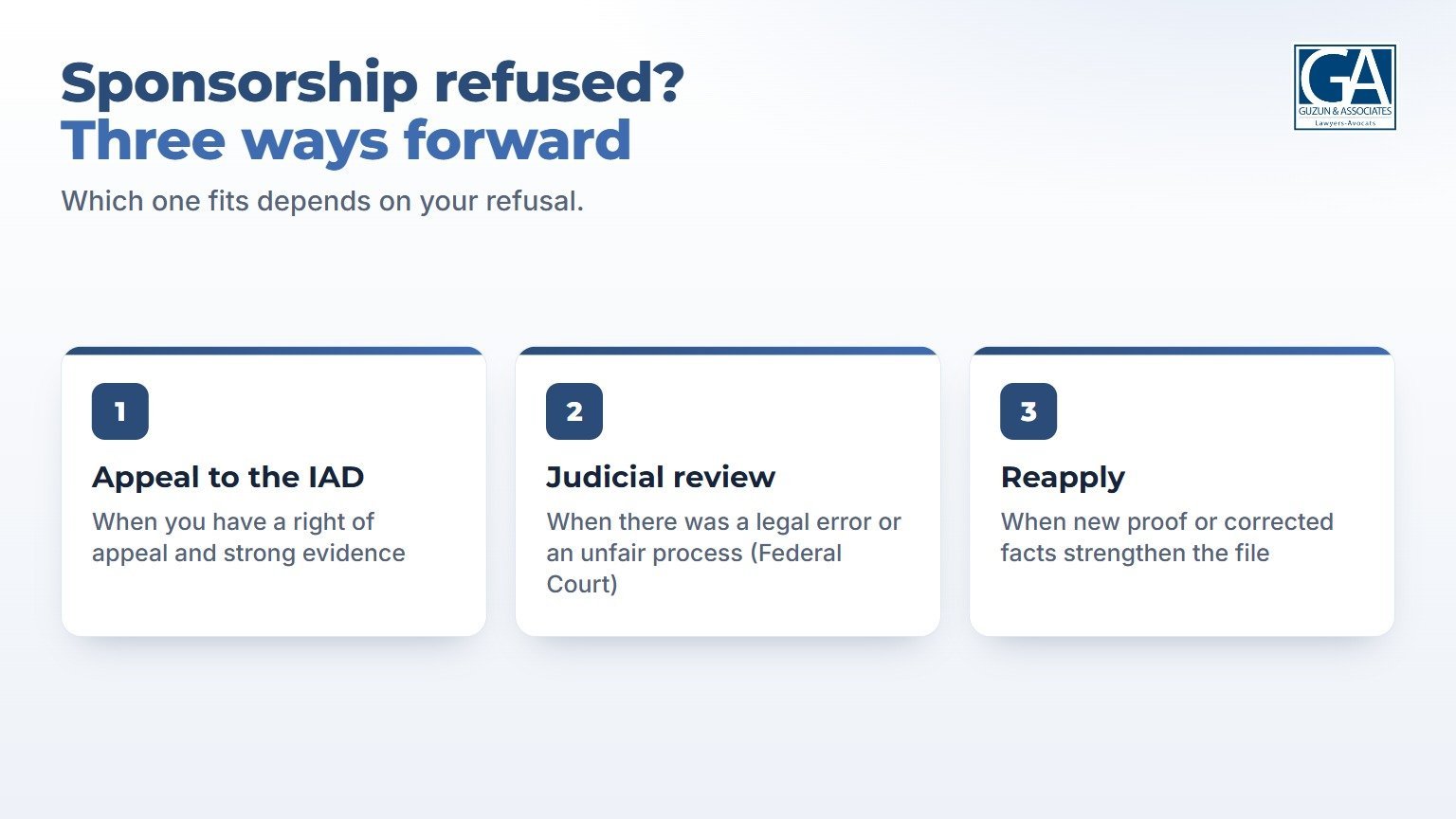
A weak evidence package may sometimes be corrected through a stronger reapplication. A credibility finding may require a more careful appeal strategy or a detailed explanation supported by new evidence. A procedural fairness issue may point toward judicial review. For Quebec sponsors, MIFI-related issues may also need to be analyzed separately from the federal IRCC refusal.
When an appeal may be stronger than reapplying
An appeal may be worth considering when there may be grounds to challenge credibility findings, the way the evidence was assessed, or concerns that may not have been fairly addressed. It may also be useful when the existing record is already strong and the problem is not simply missing documents.
When reapplying may be faster or more practical
Reapplying might be a more practical route if the first file was incomplete, difficult to follow, weakly documented, or missing key explanations. If the refusal can be addressed with better evidence, corrected forms, proper translations, and a clearer timeline, a new application may be more practical than a long contested process.
When judicial review may be considered
In some situations, judicial review may be considered if there was a legal error, an unreasonable decision, or a procedural fairness problem. This route goes to the Federal Court, requires leave to proceed, and follows technical procedures — it is not the same as an IAD appeal. Whether it is appropriate depends on the record, the refusal basis, and the available remedies.
The risk of choosing the wrong path
A rushed decision can lead to months of additional delays. Reapplying too early may repeat the same weaknesses. Appealing a case that would have been better addressed through a new application can also create delay. Before acting, it is usually important to review the refusal reasons, the full file, and GCMS notes.
A refusal based on missing documents is not the same as a refusal based on credibility, misrepresentation, inadmissibility, or a Quebec undertaking issue. The legal strategy should match the reason for refusal. Reapplying may fix a weak evidence package, but it may not solve a credibility finding unless the inconsistency is clearly addressed.
Reading Your IRCC Refusal Letter
The refusal letter is the starting point, not the full story. It often contains broad statements, but a proper legal review should also consider GCMS notes, supporting documents, interview records, and procedural fairness issues.
Understanding the refusal letter helps determine whether the problem was legal, factual, or evidentiary. That distinction is important when choosing between appeal and reapplication.
Officer notes and evidence gaps
GCMS notes can show what the officer believed was inconsistent, weak, or missing. These notes often reveal concerns about credibility, timelines, past immigration history, or undeclared family members.
Procedural fairness issues
If the officer had concerns and the applicant may not have had a fair chance to respond, there may be an argument for appeal or judicial review, depending on the procedure followed and the full record. Procedural fairness is a key legal principle in Canadian immigration law.
| Option | Best Used When | Main Consideration |
| Appeal to IAD | Sponsor has a right of appeal and strong evidence | Can take time to reach a hearing |
| Judicial review | Legal error or unfair process | Federal Court rules apply; leave to proceed is required |
| Reapplication | Missing proof or updated facts improve the case | Should directly address the original weaknesses |
Deadlines, delays, and common mistakes after a sponsorship refusal
The days and weeks following a refusal can be stressful, which is often when avoidable mistakes happen. Many people either wait too long or act too quickly.
Do not ignore deadlines
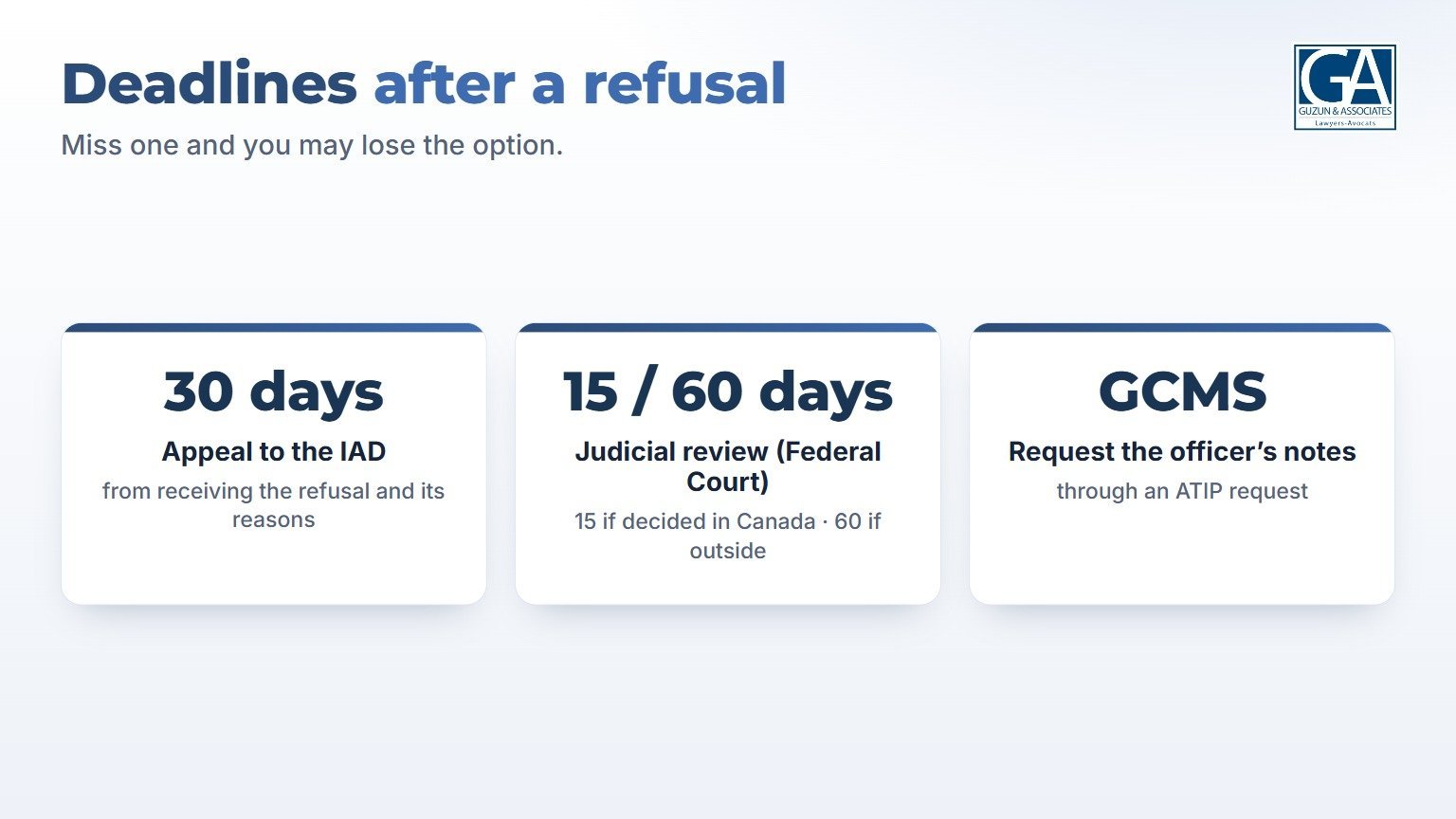
If an appeal or court remedy may be available, deadlines can be strict. A sponsorship appeal to the IAD must generally be filed within 30 days of receiving the refusal letter and written reasons. Missing this deadline can jeopardize your right to appeal.
A Federal Court judicial review is generally subject to a 15-day deadline when the decision was made in Canada, and 60 days when it was made outside Canada. Missing a deadline may limit your options, so it is worth confirming the exact timeline for your own case early.
Do not reapply before understanding the refusal
It is usually best to avoid filing a second application blindly. If you do not understand why the first case failed, the same problem may appear again in the new file.
Do not create inconsistent explanations
One common mistake is giving a new version of events in the second application without properly addressing what was said in the first one. Inconsistent explanations about the relationship, travel history, family facts, or documents can potentially damage credibility.
Preserve your records and supporting proof
Keep refusal letters, emails, interview notices, travel records, photos, chat history, money transfer proof, civil status documents, and translations. If documents are not in English or French, proper translation support may be important. Preserving records well can make appeal preparation or reapplication much stronger.

How an Immigration Lawyer Can Help
An immigration lawyer can help assess whether the refusal was reasonable and which remedy may be the most appropriate. Not every case should go straight to appeal. In some situations, a faster and stronger reapplication may be the more practical move.
At Guzun & Associates Lawyers in Montreal, Quebec, we help clients review refusal decisions, gather evidence, prepare appeal records, and rebuild applications after family sponsorship refusals. A clear legal strategy can help you avoid missteps and save valuable time.
Evidence review and case strategy
A legal review can identify contradictions, translation issues, missing civil documents, weak relationship proof, and eligibility concerns. This helps clients avoid repeating the same mistakes.
Representation at appeal
If an appeal is available, legal representation can help with disclosure, witness preparation, document filing, and submissions before the Immigration Appeal Division. Careful preparation is an important part of the appeal process.
Sponsorship Refusal for Quebec Residents: MIFI, CSQ, and Undertaking Issues
Family sponsorship is processed federally by IRCC, but Quebec adds its own layer. For Quebec-resident sponsors, the process often includes a provincial undertaking application with MIFI. If the undertaking is accepted, MIFI issues the Certificat de sélection du Québec (CSQ) for the sponsored person and transmits its decision to IRCC. However, IRCC may still refuse permanent residence even after Quebec accepts the undertaking.
A refusal can therefore arise on the federal side or the Quebec side, and the available remedy differs depending on which decision is involved — which is one reason local legal guidance matters.
As of July 2026, Quebec sponsors must also pay close attention to MIFI intake rules for family reunification undertakings. New rules apply from July 2, 2026 to June 30, 2028, with category-specific caps for undertaking applications. This means that, for Quebec residents, a reapplication strategy should consider not only IRCC’s refusal reasons, but also the timing and admissibility of the Quebec undertaking application.
A Quebec-based immigration lawyer can also help review documents in French or English, identify translation problems, and coordinate certified translations where needed. This is especially useful when the refusal involves overseas documents, civil status records, or evidence from different countries.
Local representation can also help Quebec sponsors deal more effectively with overseas visa office refusals. In many cases, the practical work after a refusal includes organizing evidence, preparing affidavits, reviewing interview concerns, and getting the file ready for appeal or reapplication.
At Guzun & Associates Lawyers, we assist clients in Montreal and across Quebec with refusal review, evidence preparation, and strategy planning. Even though the legal framework is federal, local guidance can help sponsors stay organized, meet deadlines, and present a clearer case.
Reapplying After a Sponsorship Refusal
Reapplying after a refusal is often possible, but it should rarely be done by simply resubmitting the same package. A stronger reapplication should aim to directly address the concerns raised in the refusal decision.
The new application should be clearer, better organized, and better documented. If the first file had inconsistencies, the second file should aim to explain them clearly and provide credible proof to support that explanation.
Red flags before reapplying after a sponsorship refusal
A reapplication may be possible, but some files require extra caution before anything new is submitted. Red flags include a previous misrepresentation concern, an undeclared or missing family member, inconsistent relationship timelines, unexplained prior immigration refusals, divorce or civil status documents that do not clearly match the relationship history, and translation inconsistencies between the original file and the new evidence.
These issues should be reviewed carefully before reapplying. If the new application gives a different version of events without properly explaining the earlier record, it may create new credibility concerns instead of solving the original refusal. In higher-risk cases, legal advice can help determine whether the better path is a reapplication, an appeal, judicial review, or a more targeted evidence strategy.
Building a stronger file
A better application may include updated relationship evidence, sworn statements, corrected forms, complete travel history, proof of visits, communication records, and explanations for cultural or age differences. The goal is to make the officer’s concerns easier to assess.
Avoiding repeated refusal
If there was a possible finding of misrepresentation, an omission, or an inadmissibility issue, legal advice is essential before reapplying. Repeating a weak or inaccurate file may lead to more serious immigration issues.
Checklist: What to do in the first 7 days after refusal
- Do not submit a new application immediately.
- Calendar the IAD and Federal Court deadlines.
- Save the refusal letter and all submitted documents.
- Request GCMS notes or officer notes where appropriate.
- Review whether the refusal was evidentiary, credibility-based, legal, or procedural.
- Decide between appeal, judicial review, and reapplication only after reviewing the record.
Real Case Examples
Case 1: Spousal sponsorship refused for genuineness concerns
A Montreal sponsor contacted Guzun & Associates after a spousal sponsorship application was refused by a visa office abroad. The refusal focused on a short relationship timeline, an age difference, and concerns about whether the couple had provided enough proof of ongoing contact.
Our office reviewed the refusal letter and supporting record, then identified gaps in how the relationship history had been presented. We helped organize communication records, travel proof, family statements, and a clearer chronology of the relationship. We also worked on explaining cultural and personal context that had not been presented clearly in the original file. This allowed us to prepare the next steps around the actual refusal reasons rather than a general response, giving the client a clearer legal strategy for moving forward.
Case 2: Sponsorship refusal after document concerns
In another matter, a sponsorship application was refused after the officer raised concerns about civil status documents, background information, and inconsistencies in the file history. The client was unsure whether to appeal or submit a new application.
After reviewing the record, our office identified translation issues, missing supporting documents, and timeline inconsistencies that could be corrected more directly through a stronger new submission. We helped clarify the documentary record, obtain proper translations, organize the evidence, and prepare explanations that matched the existing file instead of contradicting it. This approach supported a reapplication strategy aimed at addressing the officer’s concerns more clearly and reducing the risk of repeating past mistakes.
FAQ
1. Can I appeal a sponsorship refusal in Canada?
In many family class cases, this may be an option. The sponsor may be able to appeal to the Immigration Appeal Division, depending on the refusal reason and legal eligibility. The refusal letter and full file should be reviewed before assuming that appeal rights apply.
2. Can I appeal an inland spousal sponsorship refusal?
Usually, inland spousal or common-law sponsorship refusals do not have the same IAD appeal right as many outland family class refusals. Depending on the facts, judicial review before the Federal Court or a stronger new application may still be possible.
3. Does a Quebec sponsorship refusal involve MIFI or IRCC?
It can involve IRCC, MIFI, or both. IRCC handles the federal process, while Quebec sponsors must also complete the undertaking process with MIFI. The right next step depends on which authority made the decision and why the file was refused. As of July 2026, MIFI intake rules may also affect the timing of a new Quebec undertaking application.
4. How long does a sponsorship appeal take?
Timelines vary. Some cases resolve through settlement discussions, while others take much longer if a full hearing is needed. The process can depend on the type of case, the issues raised, and the applicable procedure.
5. Is it better to appeal or reapply after refusal?
It depends on the refusal reason. If the officer may have made an unfair or unreasonable decision, an appeal may help. If the file was weak, incomplete, or poorly documented, reapplication may be faster or more practical.
6. What are the most common reasons for spousal sponsorship refusal?
Common reasons include doubts about a genuine relationship, inconsistent evidence, missing documents, interview problems, and possible misrepresentation concerns. In many cases, the officer’s detailed concerns become clearer after reviewing the notes on file.
7. Should I request GCMS notes after a refusal?
Yes, in many cases. GCMS notes are obtained through an Access to Information and Privacy (ATIP) request and can help reveal the officer’s detailed concerns, supporting a more informed decision about whether to appeal, seek judicial review, or reapply. If the sponsored person is outside Canada, the request may need to be made through an eligible person in Canada or through a representative with proper consent.
Facing a Sponsorship Refusal? Understand Your Next Step
A sponsorship refusal is not the end of the road, but the right next step depends on the specific details of your case. Book a brief, no-obligation orientation call to talk through your options with our team.
Book Your Free Orientation Call:
📞 Call us: +1 (514) 842-7414
📧 Email: office@avocatguzun.com
📍 Visit: 105-1 rue McGill, Suite 15B, Montreal, Quebec
Start your new chapter with safety, dignity, and legal security. Contact Guzun & Associates Lawyers today.
This article is provided for general informational and educational purposes only and does not constitute legal advice. Immigration outcomes depend on IRCC policies, IAD tribunal procedures, and Quebec MIFI regulations, which may change over time. Reading this article does not create a lawyer-client relationship between you and Guzun & Associates Lawyers. For advice about your specific refusal, deadlines, and immigration strategy, please consult directly with our licensed immigration lawyers.