The Programme de l’expérience québécoise (PEQ), Quebec’s pathway to permanent selection for graduates and temporary workers, has reopened. Applications are being accepted through Arrima, Quebec’s online immigration portal, from July 2, 2026, until October 31, 2026.
The reopening itself runs for two years, but this intake window does not: no further intake window has been announced for the period that follows.
Here is the part that trips people up: this window is not open to everyone who wants to apply. It is only open to people who already met the PEQ’s eligibility requirements before the program closed on November 19, 2025.
If your diploma or your qualifying work experience came after that date, this particular window is not for you, no matter how strong your file looks today. We will walk through exactly what that cutoff means, who it applies to, and what your options are if it does not include you.
What Is the PEQ, and Why Is It Open Again?
The PEQ lets certain Quebec graduates and temporary foreign workers apply for a Certificat de sélection du Québec (CSQ), the provincial selection certificate that is a required step toward permanent residence.
It has existed for years, was closed to new applications on November 19, 2025, and has now been reopened for a defined two-year period, from July 2, 2026, to July 2, 2028. Within that broader reopening, the first intake window runs from July 2, 2026, at 8:30 a.m. Montreal time, until October 31, 2026.
There is no cap on the number of applications Quebec will accept in this window. You are not racing other applicants for a limited number of spots the way you might in a points-based invitation system; you either meet the conditions or you do not.
This is a temporary reopening under the PEQ’s existing framework — not a new program and not a full redesign. Quebec has indicated that the selection conditions that applied before the program closure generally continue to apply, with one important adjustment for the graduate stream: the requirement to have completed an eligible study program in French, or three years of full-time secondary or post-secondary studies in French, has been removed. The main change is that Quebec is accepting applications again from people who already met the reception criteria by the November 19, 2025 cutoff.
Who Can Apply in This Window: The November 19, 2025 Cutoff
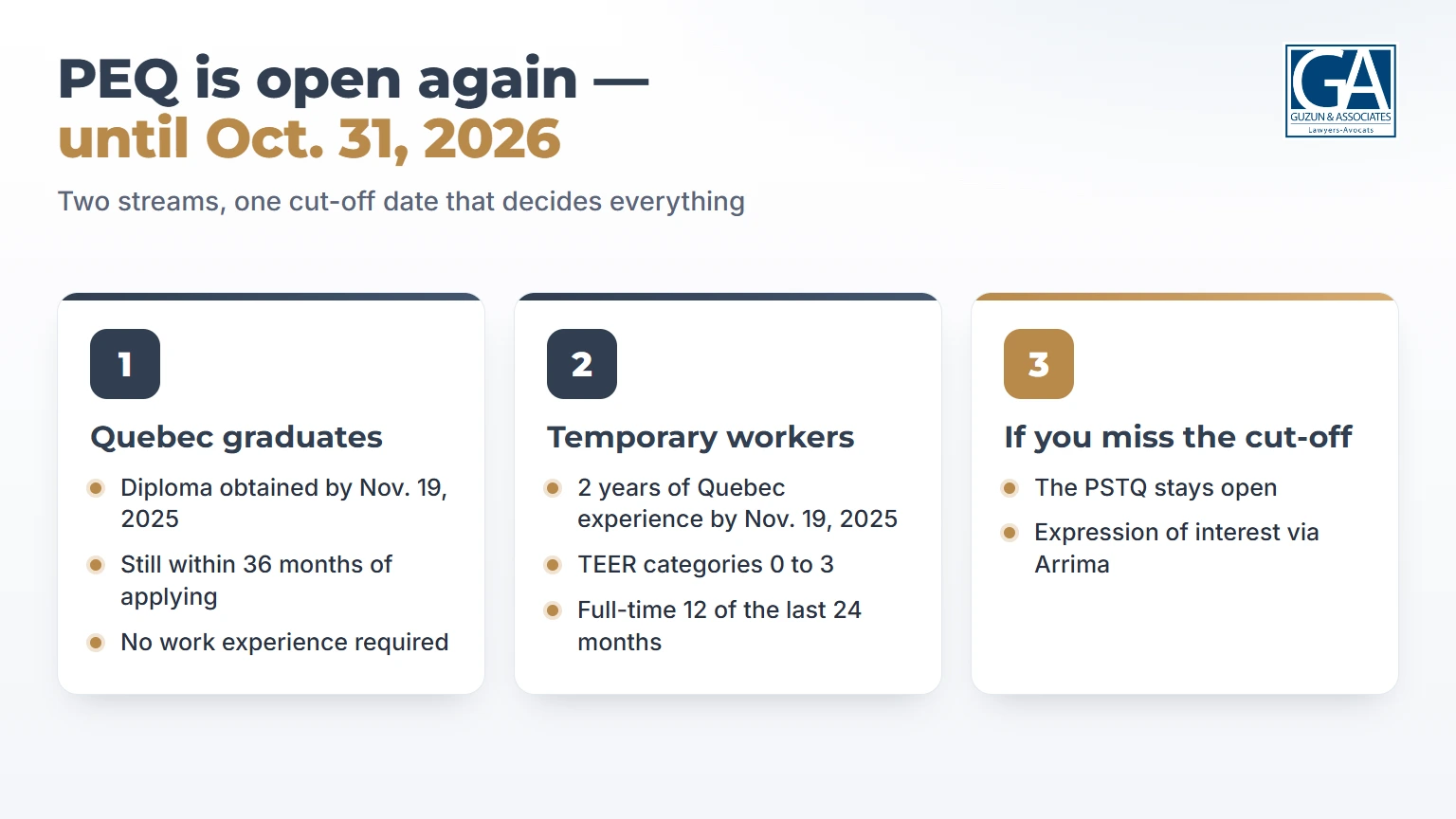
This is the single most important fact in this article, so it is worth stating a few different ways. To apply in this window, you must have already met the PEQ’s eligibility conditions on or before November 19, 2025 — the date the program closed. Quebec is not offering a fresh opportunity to build eligibility between now and October 31, 2026. It is offering a chance to submit an application for people whose eligibility already existed when the program shut down. Concretely, that means one of the following had to be true for you by November 19, 2025:
- Graduate stream (Diplômés du Québec): you had already obtained your diploma.
- Temporary worker stream (Travailleurs étrangers temporaires): you had already accumulated at least two years of qualifying work experience in Quebec, in TEER categories 0, 1, 2, or 3 of the National Occupational Classification.
TEER stands for Training, Education, Experience and Responsibilities — FÉER in Quebec’s French-language documents. Categories 0 through 3 cover management, professional, technical and skilled-trade occupations; categories 4 and 5 do not count for this stream.
If you are unsure where your job sits, check the code for your occupation before assuming you qualify. If your diploma was issued after November 19, 2025, or your two years of qualifying experience were only completed after that date, this intake window is not available to you, even though the program is technically open right now.
That distinction matters, and it is easy to miss if you are only skimming headlines about the PEQ “reopening.” Misreading a date like this is one of the most common and most costly immigration mistakes we see.
If this sounds like it might exclude you, keep reading — the section on PSTQ below covers the main alternative path. If you are not sure exactly where your file stands, having it reviewed by an immigration lawyer is a practical way to find out well before the window closes.
What If You Became Eligible After November 19, 2025?
If you obtained your diploma or completed your two years of qualifying Quebec work experience only after November 19, 2025, this PEQ intake window is generally not available to you. The next step is usually to assess whether the PSTQ, another Quebec pathway, or a temporary-status strategy may fit your situation.
Eligibility for the Graduate Stream
Meeting the November 19, 2025 cutoff is the first gate, not the only one. If you are applying under the graduate stream, several additional conditions apply:
- You must be at least 18 years old.
- Your diploma must have been obtained within the 36 months preceding your application — this is a separate timing rule from the November 2025 cutoff, and both need to be satisfied.
- You must have studied full-time in Quebec for at least half of your program’s duration.
- You must be legally staying in Quebec at the time you apply.
- You must intend to settle in Quebec and take up employment you are genuinely capable of performing. Unlike the worker stream, this stream does not require you to have work experience.
- You must be able to meet your essential needs for the first three months after obtaining permanent residence.
Qualifying diplomas include a bachelor’s degree, a master’s degree (including an MBA), a doctorate, a Diplôme d’études collégiales (DEC) in a technical program, or a Diplôme d’études professionnelles (DEP) of at least 1,800 hours, taken alone or combined with an Attestation de spécialisation professionnelle (ASP).

Eligibility for the Temporary Worker Stream
The conditions above apply to graduates. If you are applying as a temporary foreign worker, the requirements are built around your work history rather than a diploma:
- You must have accumulated at least two years of work experience in Quebec in TEER categories 0, 1, 2, or 3 — counted as at November 19, 2025, as explained above.
- You must have worked full-time in Quebec for at least 12 of the 24 months preceding your application.
- You must be holding an eligible job in Quebec at the time you apply — the position you hold now has to qualify, not only the experience you have already accumulated.
- You must demonstrate oral French at level 7 or higher.
- You must be in Quebec as a temporary foreign worker, or under an equivalent program.
The 12-of-24-months rule is easy to overlook, because it works differently from the cutoff: the two years of experience are measured as at November 19, 2025, while the full-time requirement is measured backward from the day you actually apply. Both need to hold at the same time.

French-Language Requirements: The Québec Scale, Not the Federal One
Both PEQ streams require proof of French proficiency, and this is a place where people often mix up two different measurement systems. Quebec uses its own scale, the échelle québécoise, to assess French proficiency for the PEQ. This is not the same as the federal Canadian Language Benchmarks (CLB) or Niveaux de compétence linguistique canadiens (NCLC), which you may have encountered if you have researched other federal immigration programs. Do not assume a score on one scale translates directly to the other — check which scale a given requirement uses before you draw conclusions about your own file. Under the Quebec scale:
- Graduate stream: oral proficiency at level 7 or higher, and written proficiency at level 5 or higher.
- Temporary worker stream: oral proficiency at level 7 or higher.
- Accompanying spouse: oral proficiency at level 4 or higher, if a spouse is included in the application.
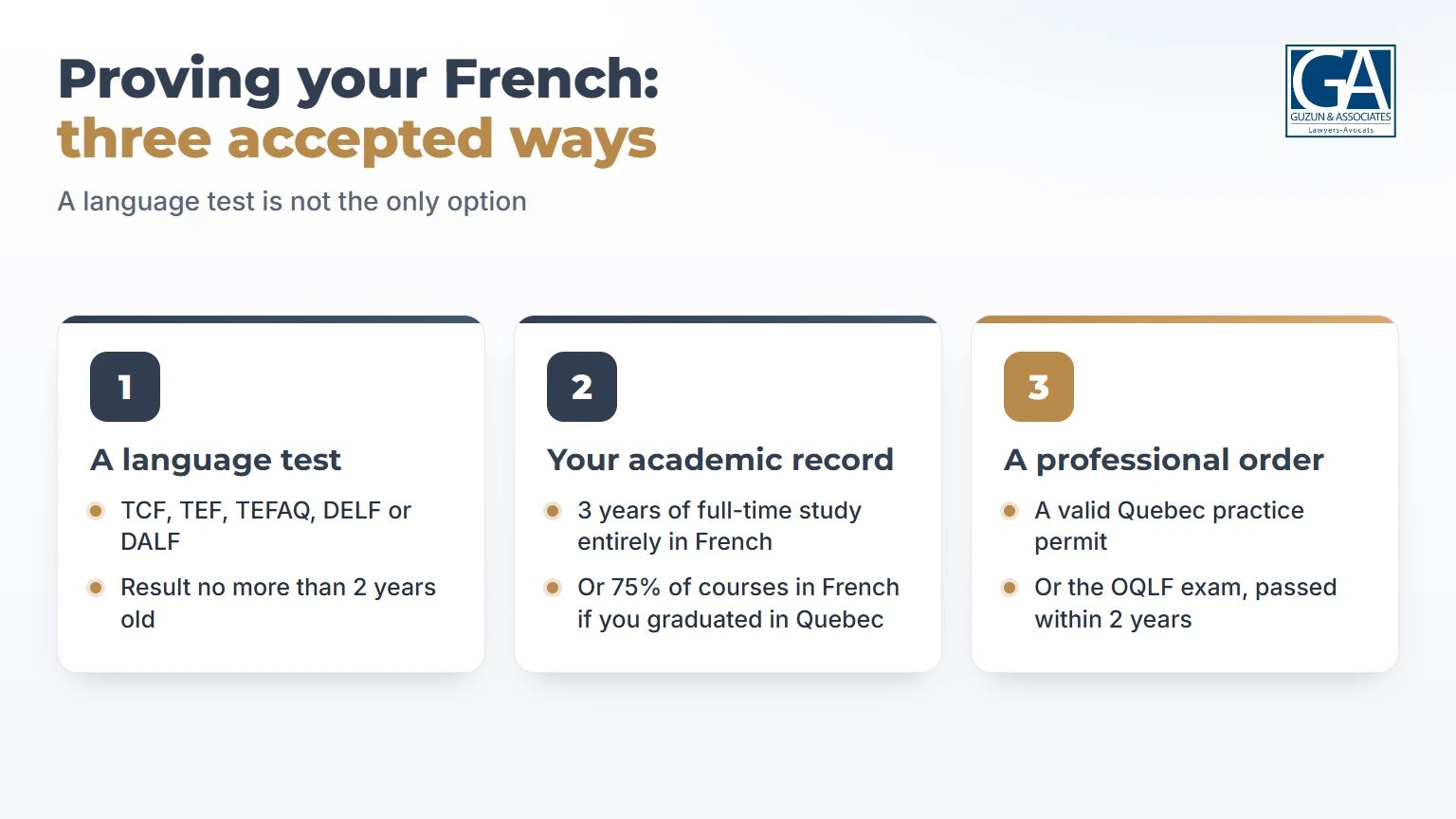
Accepted tests include TCF-Québec, TCF-Canada, and TCF; DELF and DALF; and TEFAQ, TEF-Canada, and TEF. A test result must not be more than two years old at the time you apply, and an electronic version is accepted provided the test was taken at an accredited centre.
A test is not the only accepted proof, and this matters most to the very people this window is aimed at. Quebec also accepts academic records in place of a test result: a final transcript showing at least three years of full-time study completed entirely in French, at the secondary or post-secondary level, in Quebec or abroad.
For Quebec graduates specifically, transcripts showing that at least 75% of your courses — or credits, at university level — were completed in French can serve the same purpose. Documents from a professional order also count in some cases: a Quebec professional practice permit that is valid — or that expired less than two years ago — or proof of passing the Office québécois de la langue française exam within the last two years.
If you studied in French, check this before you book and pay for a test you may not need. The exact conditions are set out on Quebec’s French-language requirements page linked above.
PEQ Streams Side by Side
| Requirement | Graduate Stream (Diplômés) | Temporary Worker Stream |
| Required by Nov. 19, 2025 | Diploma obtained | At least 2 years of qualifying Quebec work experience |
| French — oral | Level 7+ (échelle québécoise) | Level 7+ (échelle québécoise) |
| French — written | Level 5+ (échelle québécoise) | Not specified as a separate requirement |
| Work experience required | No | Yes — TEER categories 0, 1, 2, or 3 |
| Job at time of application | Not required, but you must intend to work in Quebec | Yes — you must hold an eligible job |
| Extra timing rule | Diploma obtained within the previous 36 months | Full-time work in Quebec for 12 of the previous 24 months |
Before You Apply: What to Confirm
Everything below is drawn from the conditions above. Work through it before you start the form:
- Your diploma date, or your two years of experience, falls on or before November 19, 2025.
- Graduates: your diploma is still within the 36-month rule on the day you apply.
- Workers: you hold an eligible job now, and you worked full-time in Quebec for 12 of the last 24 months.
- You can document French at the required level — by test, by transcript, or through a professional order.
- You are legally staying in Quebec at the time you apply.
- You can cover your essential needs for the first three months after permanent residence.
How Long Processing Could Take
Quebec has previously targeted processing PEQ applications within about six months. That target has not been reinstated for this reopening window. Quebec’s own announcement notes that, given the anticipated volume of applications, processing times could run longer than that historical benchmark. We say this so you can plan realistically. If you are counting on a specific date for your CSQ, treat any estimate as exactly that: an estimate, not a guarantee. Nobody, including your lawyer, can promise you a processing timeline that the government itself has declined to commit to.
If You Don’t Meet the Cutoff: PSTQ and the Arrima Expression of Interest
Falling outside the November 19, 2025 cutoff closes this PEQ window — but it does not close Quebec’s permanent selection to you. The Programme de sélection des travailleurs qualifiés (PSTQ), Quebec’s skilled worker selection program, has been operating since November 29, 2024, and continues to run in parallel with the PEQ reopening. It is not new, and it is not connected to the PEQ cutoff — it is simply the standing route for skilled workers who fall outside the PEQ’s grandfathered eligibility.
The PSTQ has four streams: highly skilled workers, workers with intermediate and manual skills, regulated professions, and exceptional talent. Instead of a direct application, you submit an expression of interest through Arrima. If your profile is invited, you then proceed to a full application.
An expression of interest stays active in Arrima for 12 months and is not automatically renewed. If that period passes without an invitation, you can submit a new declaration at no cost, and your existing information carries over.
Keep your Arrima profile current while you wait, so that it reflects your situation as it stands: a promotion, a new diploma or an updated French result should be added as they happen, rather than at the moment an invitation round arrives.
Two Levels of Approval: Quebec and Ottawa
Whichever stream eventually applies to you, remember that Quebec immigration happens in two separate stages, run by two separate governments. Quebec — through the Ministère de l’Immigration, de la Francisation et de l’Intégration (MIFI) — selects candidates and issues the Certificat de sélection du Québec (CSQ). This is Quebec’s decision, based on Quebec’s criteria, and it is a required step before you can apply for permanent residence.
The actual application for permanent residence is then submitted separately to Immigration, Refugees and Citizenship Canada (IRCC), the federal department. IRCC handles the medical exam, security and criminal background checks, and the final decision on permanent residence itself. A CSQ does not, on its own, make you a permanent resident — it makes you eligible to apply for that status federally.
One more distinction worth flagging: a CAQ, or Certificat d’acceptation du Québec, is a different document altogether. It relates to study or work authorization in Quebec, not to permanent selection. Do not confuse it with the CSQ.
Real Case Examples
Case 1.
Amina, a former international student, completed a bachelor’s degree at a Montreal university in September 2025 and studied full-time in Quebec for the entire program. Her diploma date falls before the November 19, 2025 cutoff, so she may be a candidate for the graduate stream in this window.
She would still need to confirm two things on the day she applies: that her diploma is within the 36-month rule, and that her French is documented in a form Quebec accepts — a current test result, or, if her program was taught in French, the academic record accepted in its place. If the other conditions above also hold, she would submit through Arrima before October 31, 2026.
Case 2.
Diego arrived in Quebec on a work permit in early 2024 and has been working continuously in a skilled trade since then. By November 19, 2025, he had accumulated roughly 22 months of experience — short of the two-year threshold.
Because he had not yet reached two years by the cutoff, the PEQ reopening does not apply to his file, even though he now has well over two years of experience today. His more realistic path is an expression of interest under the PSTQ, where his current experience and French proficiency can be assessed under that program’s own criteria.
These examples are illustrations of how the dates interact, not predictions of how any particular file will be assessed.
Frequently Asked Questions
1. I received my diploma in December 2025. Does that count for this PEQ window?
Based on the published cutoff, diplomas need to have been obtained by November 19, 2025, to qualify for this reopening under the graduate stream. A diploma dated after that would generally fall outside this specific intake. If your situation is close to that line, it is worth having your file reviewed by a lawyer rather than assuming either way.
2. My French test result is from more than two years ago. Can I still use it?
Test results are only accepted if they are no more than two years old on the day you apply, so an expired result cannot be used on its own. Before you book a retake, check whether one of the other accepted proofs covers you — a final transcript showing at least three years of full-time study entirely in French, transcripts showing at least 75% of your courses or credits in French if you graduated in Quebec, or documents from a Quebec professional order. Many people who studied in French do not need a test at all.
3. Do I need a job offer to apply under the graduate stream?
The published conditions for the graduate stream do not list a job offer among the requirements. What they do require is that you intend to settle in Quebec and take up employment you are genuinely capable of performing; work experience is not required for this stream either. That is different from the temporary worker stream, where holding an eligible job at the time of application is a condition.
4. Can I have an active PSTQ expression of interest and also apply through this PEQ window?
This is a question that depends on the specifics of your file and is worth confirming with a lawyer before you submit anything, since the interaction between an active PSTQ declaration and a PEQ application has not been clearly addressed for every scenario. Don’t assume one automatically cancels or conflicts with the other without checking first.
5. What happens after October 31, 2026?
Based on the current announcement, the intake window for this round of PEQ applications closes on October 31, 2026. The broader reopening period runs until July 2, 2028, but whether additional intake windows will open within that period, and on what terms, has not been detailed yet. If you do not qualify for this window and do not have another route available, the PSTQ expression of interest remains the standing option to keep pursuing selection.
This article is provided for general informational and educational purposes only and does not constitute legal advice. Reading this article does not create a lawyer-client relationship. Quebec’s immigration rules, intake windows, and processing commitments change frequently, and the PEQ reopening described here is subject to further updates from Quebec and IRCC — always confirm current conditions and deadlines before you submit an application, or speak with a lawyer about your specific situation.
Wondering Whether You Qualify Before the Window Closes?
The November 19, 2025 cutoff is unforgiving, but figuring out exactly where your file stands does not have to be something you sort out alone. A short orientation call can help you understand which stream, if any, applies to you and what to prepare before October 31, 2026. Book Your Free Orientation Call:
📞 Call us: +1 (514) 842-7414
📧 Email: office@avocatguzun.com
📍 Visit: 105-1 rue McGill, Suite 15B, Montreal, Quebec