
Can you simply move to another city with your child after a separation in Quebec? Rarely without consequences. In most cases, you need either the other parent’s agreement or a court’s authorization, and moving without one can put your existing parenting arrangement at risk. What you need to do next depends not only on whether you were married, but also on which legal framework governs your current parenting arrangement: the federal Divorce Act or Quebec’s Civil Code.
In general, parents who are divorcing or already have a parenting order under the Divorce Act must follow the federal notice and relocation rules. Parents who were never married — and some separated parents whose parenting issues are not being dealt with under the Divorce Act — may instead be governed by Quebec’s Civil Code, where the process is less formal but still serious.
Mixing up the two is one of the most common mistakes parents make when planning a move. This guide walks through both tracks, what a court actually weighs when a move is contested, and what happens if you relocate before sorting any of this out.
What the Law Considers a “Relocation”
Not every address change counts as a “relocation” — but under the Divorce Act, every change of a parent’s or child’s place of residence still calls for written notice to anyone with parenting time, decision-making responsibility, or contact. That basic notice sets out the date of the change and the new address and contact information.
Only a move likely to have a significant impact on the child’s relationship with the other parent triggers the stricter 60-day relocation process.
Under the federal Divorce Act, a “relocation” is a change in the child’s residence likely to have a significant impact on the child’s relationship with a parent — or anyone else — who has parenting time (the time a child actually spends in a parent’s care), decision-making responsibility (authority over major decisions about health, education, and wellbeing), or a contact order.
Moving a few blocks away rarely counts. Moving across the province, to another province, or out of the country almost always does, because it disrupts the existing schedule and the other parent’s ability to stay involved.
There is no equivalent statutory relocation definition for parents whose situation is not governed by the Divorce Act. However, under Quebec’s parental authority rules, both parents generally remain involved in important decisions affecting the child, including the child’s place of residence. In practice, a move that meaningfully changes how much time a child spends with each parent can be treated as a significant decision and may be challenged in Superior Court.
Can You Move With Your Child Without the Other Parent’s Consent in Quebec?
In most cases, moving with a child after separation should not be treated as a simple personal decision. If the move affects the child’s schedule, school, travel time, or relationship with the other parent, you may need the other parent’s agreement or a court decision before relocating.
If You Are Divorcing or Already Divorced: The Federal Notice Rules
If you were married and are divorcing, or already divorced under a court order, the Divorce Act sets out a formal process.
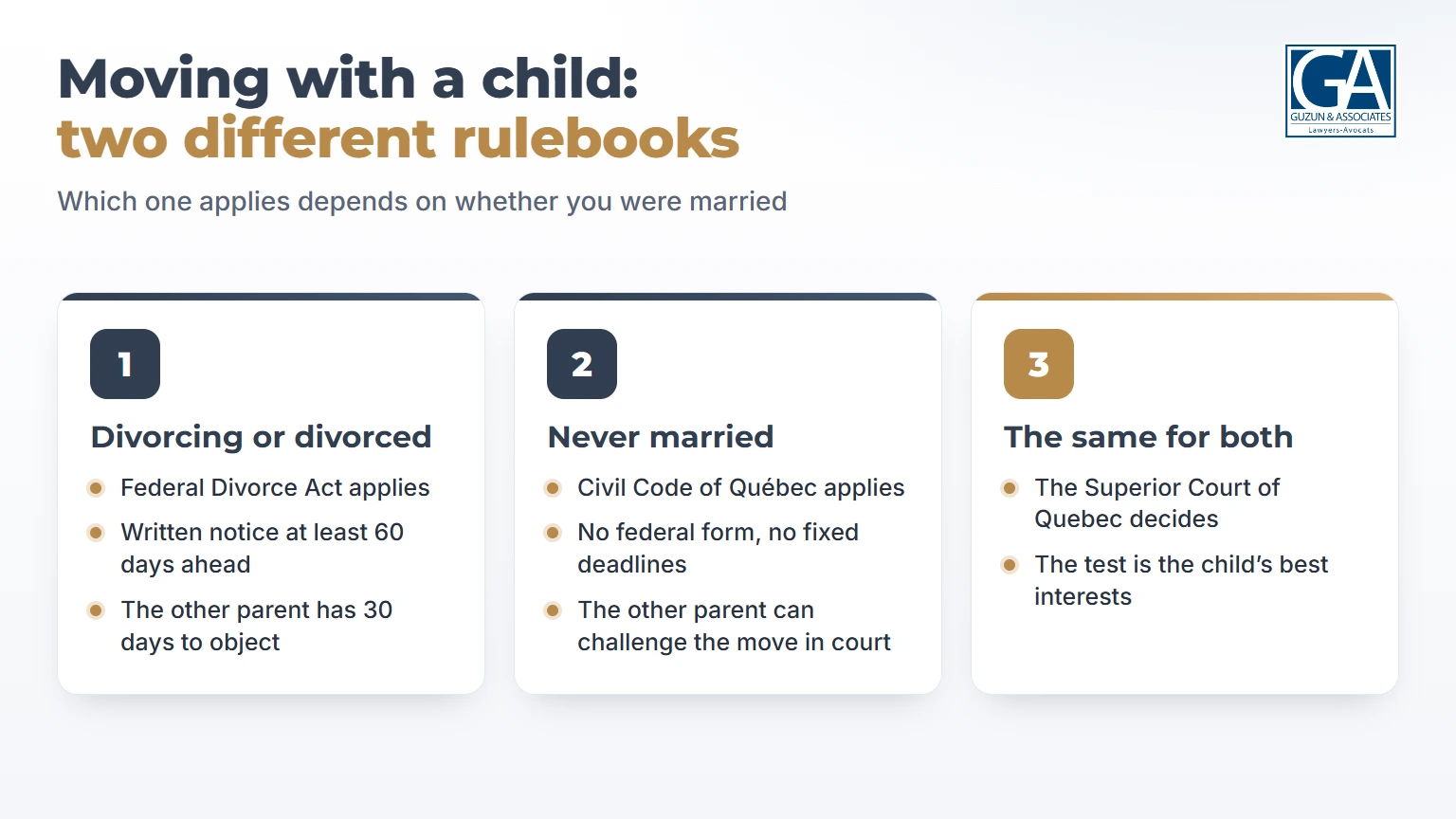
Before moving, the parent who wants to relocate must give the other parent — and anyone else with parenting time, decision-making responsibility, or contact under a contact order — written notice at least 60 days before the planned move date, using the federal Notice of Relocation form.
The notice must include the date of the intended move, the new address and contact information, and a proposal for how parenting time and decision-making will work afterward.
The other parent then has 30 days from receiving the notice to object, either by completing the “Objection to Relocation” form or by applying directly to the court. If no objection is filed within that window and no court order prohibits the move, the relocation can generally proceed as proposed.
If an objection is filed on time, the move cannot go ahead unless a court authorizes it. Relocating anyway, while an objection is on the record, is one of the riskiest steps a parent can take in this area.
There is an important exception for safety: a court can be asked to change or lift the notice requirement altogether, including where there is a risk of family violence. If disclosing your new address would put you or your child at risk, raise this with a lawyer before sending any notice.
When a relocation is contested, and the parents are substantially following an existing order, arbitral award, or agreement about parenting time, the Divorce Act assigns the burden of proof based on how that time is shared:
- If the child spends substantially equal time with both parents, the parent who wants to move must prove the relocation is in the child’s best interests.
- If the child spends the vast majority of time with the parent who wants to move, the parent who objects must prove the relocation is not in the child’s best interests.
- In all other cases — including where the parents are not substantially following any existing arrangement — both parents share the burden of showing what is, or isn’t, in the child’s best interests.
Which scenario applies can shape the entire case, so it’s worth having a clear picture of the current schedule before assuming how a dispute will unfold.
If You Were Never Married: The Civil Code of Québec Approach
If you and your child’s other parent were never married, the federal notice rules above do not apply to you at all.
The relocation provisions sit in the Divorce Act, which governs married spouses who are divorcing or already divorced — Éducaloi puts it plainly: these rules do not apply to common-law couples.
Instead, your situation is governed by the Civil Code of Québec and the concept of parental authority. The parent with custody may usually manage the child’s day-to-day residence and routine, but both parents generally continue to exercise parental authority and should consult each other on important decisions affecting the child, including major changes to the child’s place of residence. In practice, a move that would substantially alter the parenting arrangement can therefore become a court issue.
There is no dedicated form, no fixed 60-day notice period, and no statutory 30-day objection window for never-married parents; those timelines exist only inside the Divorce Act.
If the other parent disagrees with a proposed move, the usual route is to apply to the Superior Court of Quebec and ask a judge to decide under the general best-interests-of-the-child standard.
Fewer formal deadlines doesn’t mean fewer risks. A move that ignores the other parent’s access rights can still be challenged in court, and can still shape how a judge views your judgment as a co-parent going forward.
One point of confusion worth clearing up: Quebec’s parental union regime, in force since June 30, 2025, applies to unmarried parents but deals with property — the family home, furniture, and vehicles. It does not change the rules on parental authority, custody, or relocation.
What the Court Weighs: Best Interests and the “Double-Bind” Question
Whether a case falls under the Divorce Act or the Civil Code, judges are ultimately guided by what’s best for the child, not by what’s most convenient for either parent. Under the Divorce Act, the listed factors include:
- the reason for the move
- the impact on the child
- how much time and involvement each parent currently has
- whether the moving parent respected the duty to give notice
- any geographic restrictions already written into an existing agreement or order
- how reasonable the proposal is for preserving the child’s relationship with the other parent
- how likely each parent is to comply going forward
One Divorce Act rule surprises many parents: the court is not allowed to consider whether the parent seeking to move would relocate anyway, without the child, if the move were refused.
Known informally as the double-bind question, this protects parents from being forced into an impossible choice, or from having that choice held against them during the case.
Courts applying the Civil Code’s best-interests standard for never-married parents generally weigh a similar mix of practical factors, even though the Civil Code frames the best-interests test in general terms rather than listing relocation-specific factors.

Moving Abroad: The Hague Convention and Wrongful Removal
International moves add another layer. Canada is a party to the 1980 Hague Convention on the Civil Aspects of International Child Abduction, which helps secure the return of a child wrongfully removed to, or retained in, another participating country.
In Quebec, the Ministère de la Justice du Québec acts as the province’s Central Authority for these cases: locating children, processing return applications, and liaising with authorities elsewhere.
Under the Convention, a removal or retention is “wrongful” when it breaches custody rights under the law of the child’s habitual residence, and those rights were actually being exercised at the time. In plain terms, taking a child abroad without the authorization of a parent who holds custody rights, or without a court order, can trigger an international return process.
“Custody rights” here is the Convention’s own concept: rights allocated by a Quebec order on garde, and rights over the child’s place of residence flowing from a Divorce Act order on decision-making responsibility, can both qualify. Access rights are protected differently — the return mechanism is built around custody rights, while a parent whose access is disrupted has a separate route under the Convention.
One important limit: the Convention only applies between countries that have signed on to it. It doesn’t create a universal right to have a child returned from anywhere in the world — whether it applies to a specific destination depends on whether Canada and that country are actually bound to each other under the Convention, and for more recent members, that also requires Canada to have accepted their accession. Worth confirming before any international move.

Mediation and Written Agreements: Settling Without a Trial
Court is not the only path, and for most families it should not be the first one.
Quebec’s family mediation program provides a free information session on parenting after separation and covers a set number of hours with an accredited family mediator: up to 5 free hours for parents in a separation process, or 2.5 free hours when an existing agreement or judgment is being reviewed.
Beyond the free hours, the mediator’s government-set rate is $130 per hour as of 2026, so it is worth checking the current rate before booking. The program is available to both married and never-married parents with dependent children.
If mediation, or direct negotiation, produces an agreement both parents can live with, it’s worth putting it in writing. A signed agreement is a valid contract, but it doesn’t carry the weight of a court order until a judge reviews and approves it — a step called homologation.
Once homologated, the agreement can be enforced the same way a judgment can, which matters if circumstances change and one parent later needs to go back to court.
Before You Commit to a Move: A Practical Checklist
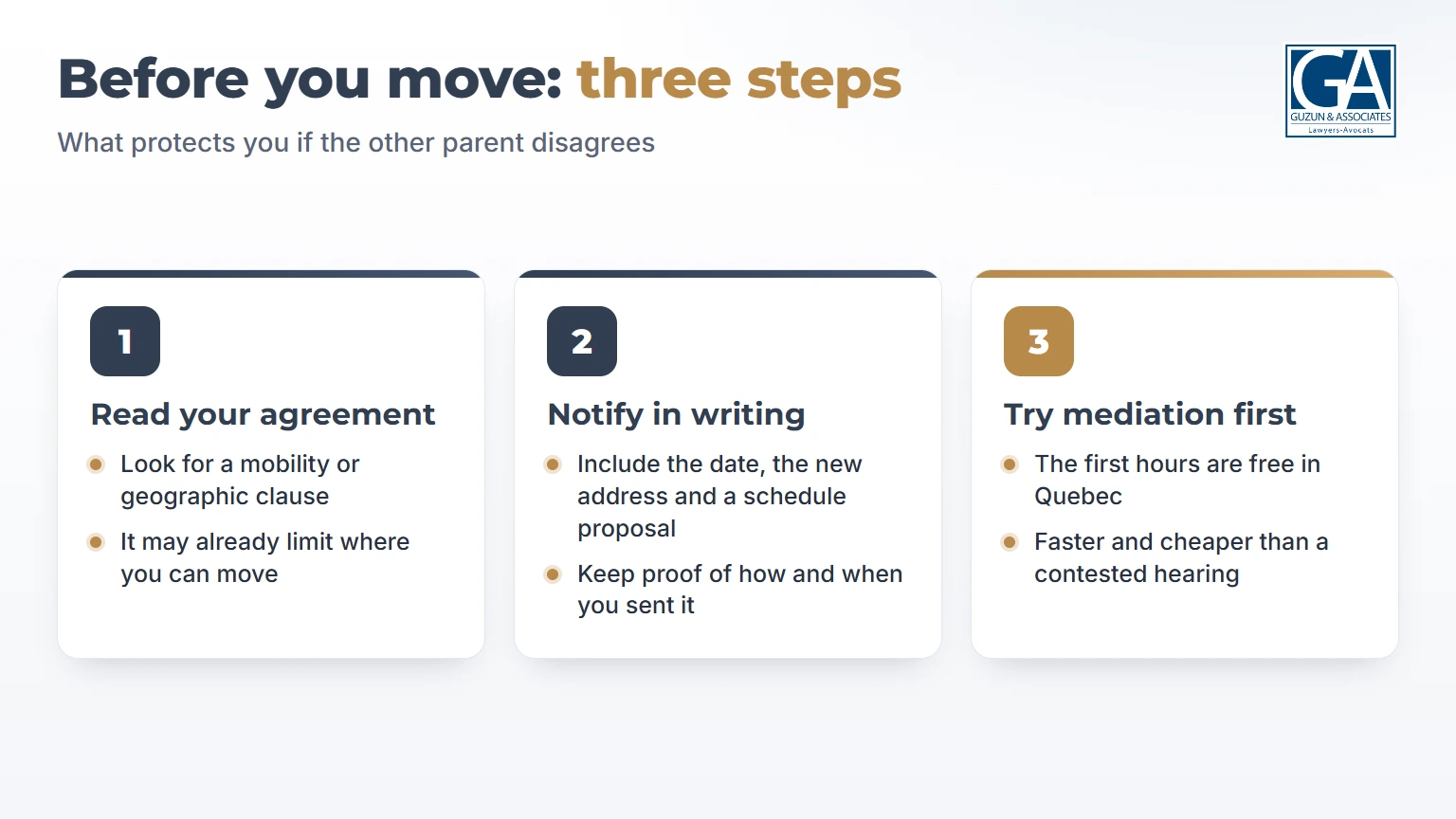
- Check your existing agreement or court order for any geographic or mobility clause.
- Identify which regime applies to you — divorcing or divorced under the Divorce Act, or never married under the Civil Code.
- Prepare a concrete proposal for how the child will keep time and contact with the other parent after the move.
- Give written notice and keep proof of when and how it was delivered — on the federal form if the Divorce Act applies to you, and in a plain written letter if it doesn’t. Courts look at whether you informed the other parent before deciding, not after.
- Try mediation before court — it is usually faster and cheaper, and the first hours are free.
What Happens If You Move Without Consent or a Court Order
Relocating before resolving the issue with the other parent, or before a judge decides a contested move, carries real risk for married and never-married parents alike.
A move made without agreement or authorization can be treated as a material change in circumstances, opening the door for the other parent to ask for a review of custody, decision-making responsibility, or parenting time.
It can also work against you later: a judge reviewing a relocation dispute after the fact may weigh the unilateral move itself when assessing your judgment as a co-parent, separate from whether the destination was reasonable.
Checking any geographic or mobility clauses already built into your parenting plan before committing to a move can save considerable stress later.
If a move has already happened, don’t wait for the other parent to act first — talking to a family lawyer early can put you in a better position than staying silent.
Married vs. Never Married: Relocation Rules at a Glance
The table below sets the two regimes side by side.
| Factor | Divorcing or divorced (Divorce Act) | Never married (Civil Code) |
| Governing law | Federal Divorce Act | Civil Code of Québec |
| Formal notice required | Yes, using the federal notice form | No statutory form; written notice to the other parent still strongly advised |
| Notice period | At least 60 days before the move | Not fixed by statute |
| How to object | “Objection to Relocation” form or court application, within 30 days | Application to the Superior Court of Quebec |
| Court that decides | Superior Court of Quebec | Superior Court of Quebec |
| Standard applied | Best interests, with burden of proof shifting by parenting-time split | General best-interests-of-the-child test |
Real Case Examples
Case 1 — Formal Notice Under the Divorce Act.
After their divorce, Sophie and Marc shared roughly equal parenting time with their two children in Montreal. When Sophie was offered a position in Quebec City, she sent Marc written notice 65 days before her intended move, including the new address and a proposed revised schedule.
Marc objected within the 30-day window and applied to the court. Because the children’s time was substantially equal between the parents, the burden fell on Sophie to show the move was in the children’s best interests, including how she planned to preserve their relationship with Marc.
Case 2 — Civil Code Standard for Never-Married Parents.
Amina and David were never married and had one daughter together. Amina held custody, and when she planned to move from Laval to Gatineau to be closer to family, David objected, arguing the move would sharply cut into his access rights.
Because no federal notice form or 60-day deadline applied to their situation, David applied directly to the Superior Court of Quebec, which reviewed the proposed move under the general best-interests-of-the-child standard rather than the Divorce Act’s notice-and-burden framework.
Frequently Asked Questions
1. Can I move with my child without the other parent’s consent in Quebec?
In many cases, you should not move without either the other parent’s agreement or a court’s authorization, especially if the move would affect the child’s schedule or relationship with the other parent. The exact process depends on whether the Divorce Act or the Civil Code of Québec applies.
2. Do I need to give formal notice if I’m just moving within Montreal or to a nearby suburb?
Probably not as a “relocation” — but if the Divorce Act applies to you, written notice is still expected for any change of address, with the date and your new contact information. The stricter 60-day relocation notice is reserved for moves likely to have a significant impact on the child’s relationship with the other parent. A short-distance move that changes schools or the parenting schedule can still cross that line, so when in doubt, confirm before assuming a move is minor.
3. What happens if the other parent doesn’t respond to my notice?
Silence is not the same as documented consent. Keep written proof of when and how the notice was delivered, since the 30-day objection window runs from the date the other parent actually received it, not the date you sent it. If that deadline passes and no court order prohibits the move, the relocation can generally proceed as proposed.
4. Do I need the other parent’s consent to take my child on vacation outside Quebec?
A temporary trip is generally treated differently from a relocation, since the child’s residence isn’t changing. Many parenting agreements and orders still include their own travel-consent requirements, though, and some destinations or airlines ask for a signed consent letter regardless. Check your existing agreement or order rather than assuming a vacation is automatically exempt.
5. What if the move already happened before we sorted out the legal side?
It’s not too late to address it, and doing so sooner is almost always better than waiting. Depending on whether you were married or never married, the process runs through the Divorce Act framework or through the Civil Code’s general best-interests test — in both cases before the Superior Court of Quebec. Either way, a court can review a move after the fact and adjust the existing custody or parenting arrangement if needed.
6. How long does it take for a court to decide a contested relocation?
There’s no fixed timeline. It depends on how contested the case is, whether mediation is attempted first, and each court’s schedule. Because relocation disputes often run against a real deadline — a job start date, a lease, a school year — it’s generally worth raising the issue with a lawyer as early as possible rather than waiting until the move is imminent.
Disclaimer: This article is provided for general informational and educational purposes only and does not constitute legal advice. Reading it does not create a lawyer-client relationship with Guzun & Associates. Quebec family law applies different rules to married and never-married parents, and how a relocation dispute is resolved depends on the specific facts of your case, including your existing parenting arrangement and the countries or provinces involved. For advice about your own situation, consult a family lawyer.
Thinking About a Move? Talk It Through First
Relocating with a child is rarely just a logistics question, and getting the process right from the start can spare months of conflict later. If you’re weighing a move, or responding to a notice from the other parent, a short conversation can help you understand where you stand. Book Your Free Orientation Call:
📞 Call us: +1 (514) 842-7414
📧 Email: office@avocatguzun.com
📍 Visit: 105-1 rue McGill, Suite 15B, Montreal, Quebec