
If you or someone close to you has been charged with a crime in Quebec since mid-July 2026, the rules around bail and sentencing are not quite what they were a few months ago. If the charge was laid before that date, the picture is less clear-cut — see the first question in the FAQ.
Bill C-14, the Bail and Sentencing Reform Act, received Royal Assent on June 15, 2026. Its main provisions took effect on July 15, 2026.
The short version: for a defined list of serious and violent offences, it is now harder to be released while your case is pending. On sentencing, some penalties must be served one after another instead of at the same time.
None of this means the system has flipped against you. The presumption of innocence still applies, your right to a lawyer has not changed, and the structure of a bail hearing in Quebec is the same. What changed is which cases carry a reverse onus, and what a judge must weigh.

What Is Bill C-14 and When Did It Take Effect
Bill C-14 is a federal law making more than 80 targeted amendments to the Criminal Code, the Youth Criminal Justice Act and the National Defence Act.
Per the Department of Justice’s Bill C-14 summary, its central bail and sentencing measures came into force on July 15, 2026 — 30 days after Royal Assent.
A smaller set of Youth Criminal Justice Act changes will come into force later through a separate order in council. These include changes related to youth records, urgent publication of identifying information in limited public-safety situations, how certain youth custody time is calculated, and related administration of youth justice files. No specific date for that second wave has been announced yet.
When this article was reviewed in August 2026, some consolidated legislative materials were still catching up to the new amendments. For that reason, this article explains the changes in practical terms and relies on the Department of Justice’s Bill C-14 summary rather than treating every consolidated section reference as fully updated.
Bail Decisions After Bill C-14: Reverse Onus Explained
“Reverse onus” is not new — it applied to some serious charges before Bill C-14. Normally the Crown must convince a judge that you should stay in custody; under reverse onus, you have to convince the judge why you should be released.
Bill C-14 did not invent this tool. Per the Department of Justice summary, it expanded the list of charges it applies to:
- Violent or organized-crime-linked vehicle theft
- Break-and-enter into a home (sometimes called home invasion)
- Trafficking in persons and human smuggling
- Assaults and sexual assaults involving choking, suffocating or strangulation
- Extortion involving violence
- Serious violent offences where the accused has two or more prior convictions for similar offences
- Offences where violence was used, threatened or attempted with a weapon — here the reverse onus looks back at prior convictions from the last ten years instead of the last five
The law also names two things a court must weigh expressly at bail: the number or seriousness of any outstanding charges you already have — part of the public confidence analysis — and whether you are charged with an offence involving random, unprovoked violence.
If your charge falls into a reverse onus category, bail is not off the table. It means the hearing looks different: your lawyer builds a release plan — a surety (someone who agrees to supervise you and to pledge money if you breach your conditions), a stable address, conditions you can realistically keep — instead of simply poking holes in the Crown’s case.
If you are facing charges such as assault, theft, fraud or impaired driving, our criminal defence law services page sets out how we approach a file from the first meeting.
What Reverse Onus Means for a Bail Hearing in Quebec
In a reverse onus bail hearing, preparation becomes especially important. The accused should be ready to present a realistic release plan, including a stable address, a suitable surety where appropriate, and conditions that directly address the court’s concerns. The goal is not to prove innocence at this stage, but to show that release can be managed safely while the case is pending.
What Changed in Sentencing
A few sentencing changes matter most in the situations we see most often. They are not the whole of the bill, but they are the parts most likely to affect an individual case.
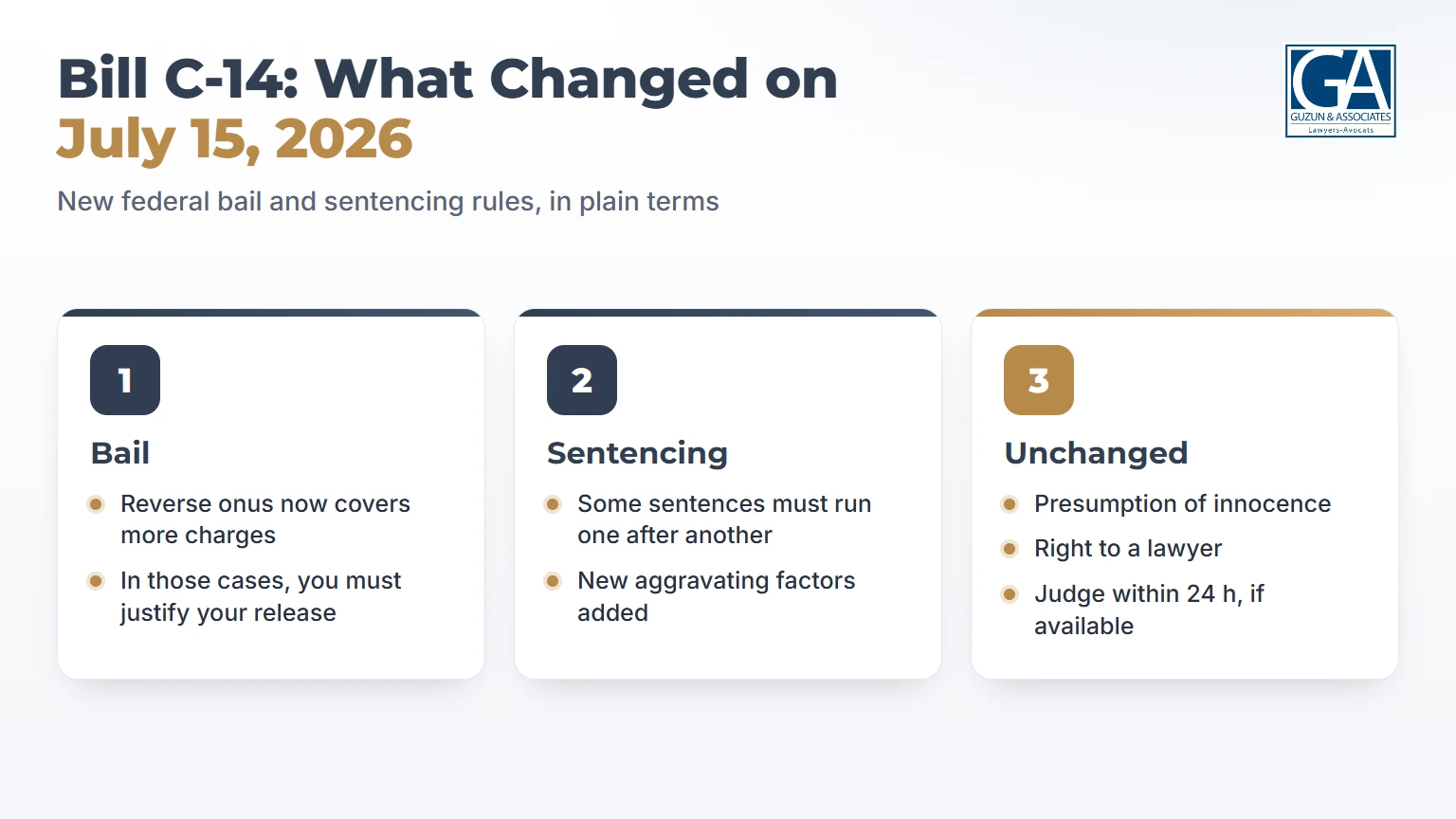
First, two combinations must now be served consecutively rather than concurrently: extortion with arson, and violent or organized vehicle theft with a home break-in. For other repeat violent offences, the court must at least consider consecutive sentences.
Second, new aggravating factors were added: attacks on first responders and public transit workers, organized retail theft, and damage to essential infrastructure — a category tied directly to copper theft.
Third, conditional sentence orders — commonly known as house arrest — are now unavailable for serious sexual offences, including offences against children. The bill also restores the court’s power to order driving prohibitions for manslaughter and criminal negligence causing death or bodily harm.
One point worth stating clearly: nothing in the government’s summary points to new mandatory minimum sentences. If you read a headline claiming otherwise, treat it with caution.
Bail and Sentencing: Before and After July 15, 2026
The table below sets the main changes side by side.
| Area | Before July 15, 2026 | After July 15, 2026 |
| Reverse onus at bail | Applied to a narrower list of offences | Expanded to include violent/organized vehicle theft, home invasions, trafficking in persons, choking during an assault, violent extortion, and weapon-related violence with a prior conviction in the last ten years |
| Public confidence in the justice system (lawyers call this the “tertiary ground”) | Judges weighed public confidence in general terms | Judges must expressly weigh the number or seriousness of outstanding charges, and whether the offence involved random, unprovoked violence |
| Conditional sentences (house arrest) | Not excluded across the board for sexual offences | Eliminated for serious sexual offences, including those involving victims under 18 |
| Extortion + arson, or vehicle theft + break-in | Sentences could run concurrently, at the judge’s discretion | Consecutive sentences are now required for these specific combinations |
| Aggravating factors at sentencing | Did not name first responders, transit workers, or infrastructure damage | New aggravating factors added for attacks on responders/transit workers and infrastructure/copper theft |
What Has Not Changed
The presumption of innocence remains the foundation of the system — being charged is not being convicted.
Your Charter right not to be denied reasonable bail without just cause (section 11(e)) is still fully in force. Bill C-14 expanded which cases carry a reverse onus; it did not remove the right to a bail hearing.
Your right to speak with a lawyer at arrest or detention (section 10(b)) was not touched at all. For more on how that works in practice, see our guide to Charter rights during police encounters.
The trial-delay ceilings from R. v. Jordan — 18 months in provincial court, 30 months in superior court (or in provincial court where there is a preliminary inquiry) — are also untouched.

How This Looks in Practice in Quebec
Most criminal cases in Quebec, including many release hearings held at the Montreal courthouse, are handled in the Court of Québec, Criminal and Penal Division. More serious matters may involve the Superior Court. For offences listed in section 469 of the Criminal Code, release is generally dealt with by a Superior Court judge rather than through an ordinary bail hearing before the Court of Québec.
The prosecutor’s office is the DPCP (Directeur des poursuites criminelles et pénales). It is the DPCP prosecutor on your file who decides whether the Crown opposes your release.
If you are released, typical conditions include no contact with the alleged victim, no weapons, geographic restrictions and sometimes a curfew. Compliance is generally verified by police; in some cases the court adds supervision by a probation officer of the Services correctionnels du Québec.
If your income qualifies, Aide juridique, through the Commission des services juridiques, can cover legal representation.
Worth noting: as of August 2026 even Éducaloi, Quebec’s public legal information organization, flags its own bail hearings page as “in revision”. Reference material across Quebec is still catching up to Bill C-14 — which is why speaking with a lawyer tracking these changes matters more than usual.
If You Are Not a Canadian Citizen: Immigration Considerations
For a permanent resident, temporary resident, or someone without status, a criminal charge carries a second layer of risk beyond the criminal case itself.
Under the Immigration and Refugee Protection Act (IRPA), a conviction can trigger “serious criminality” where the offence carries a maximum of 10 years or more, or where the sentence imposed exceeds six months. These thresholds matter most for permanent residents.
For foreign nationals — temporary residents, or people with no status — separate IRPA provisions can raise inadmissibility on convictions well below those thresholds — the exposure is broader, not narrower.
Because Bill C-14 makes consecutive sentencing mandatory for a few specific offence combinations, some cases could result in a longer total sentence than before. In some circumstances, sentence length can matter for immigration purposes, especially where a sentence approaches or exceeds six months. The federal government has not presented this as a direct immigration reform; it is a risk to raise with a lawyer, not a certainty.
If immigration status is part of your situation, it should shape how the criminal case is handled from the first appearance — not be sorted out later.
What to Do in the First 24 to 72 Hours
A few practical steps matter more than anything else right after an arrest:
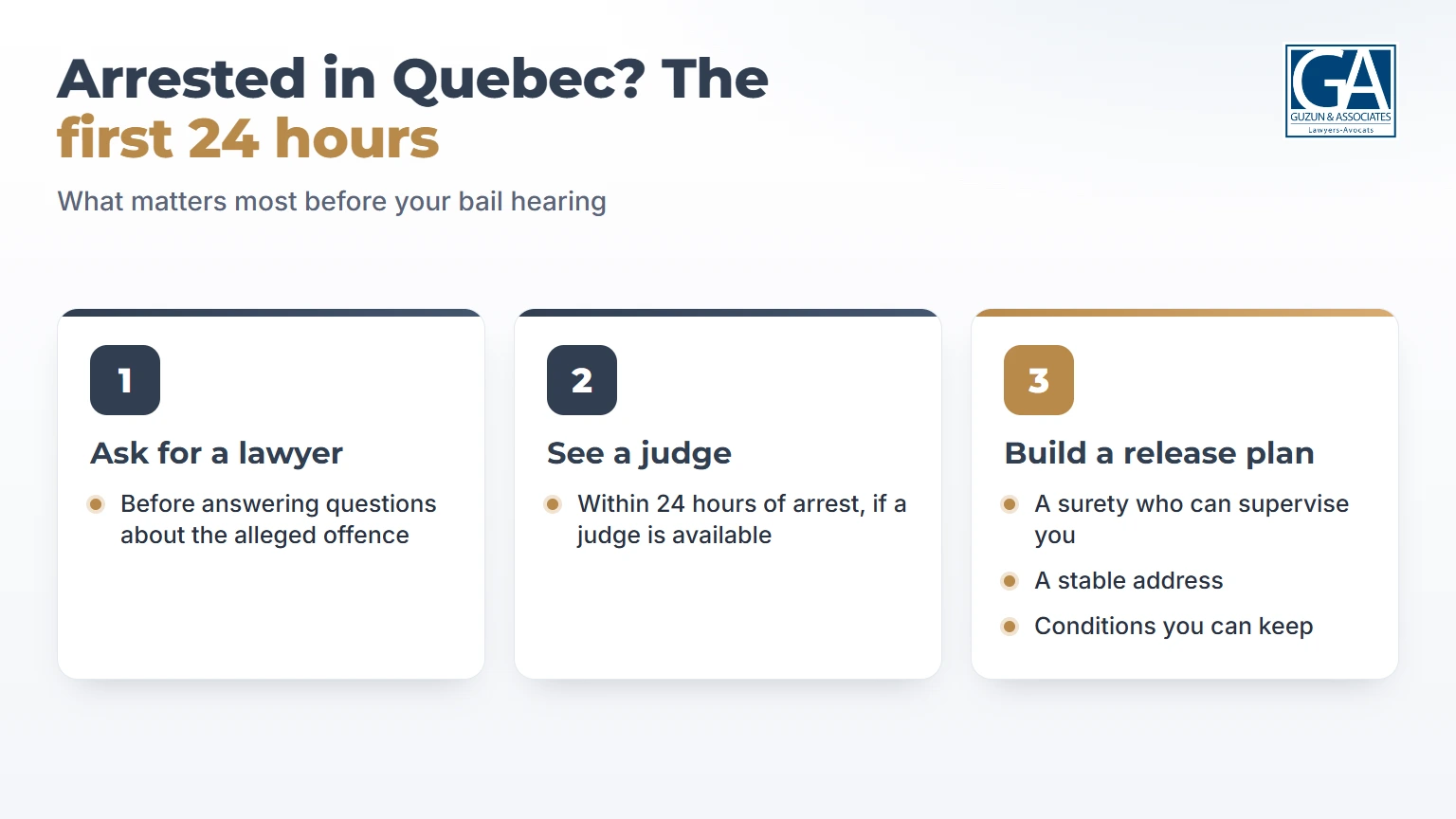
- Know the 24-hour rule. Under Criminal Code section 503, a detained person must be brought before a judge without unreasonable delay, and within 24 hours if a judge is available. Bill C-14 did not change this.
- Use your right to counsel. Ask to speak with a lawyer as soon as you are detained, before answering questions about the alleged offence.
- Start on a release plan. If a reverse onus could apply, your lawyer will want to know early about a potential surety, a stable address, and conditions you could meet.
- Take conditions seriously. Breaching a bail condition can bring a separate charge and puts your release at risk.
For a fuller walkthrough of a bail hearing in Quebec, see our guide on bail hearings and what to expect after being charged.
Real Case Examples
Case 1. A young man in Montreal is arrested after allegedly forcing entry into a neighbour’s apartment during an argument. Because break-and-enter into a home now falls under reverse onus, the burden at his bail hearing shifts to him. His lawyer spends the first 48 hours lining up a surety — his sister, no record, stable home — and preparing a written release plan. The judge still has full discretion; reverse onus guarantees nothing, but it changes what must be ready before the hearing starts.
Case 2. A permanent resident is charged after an alleged workplace altercation. Her lawyer flags early that a sentence approaching six months could raise immigration consequences under IRPA. That shapes the defence strategy from the first meeting, rather than after a plea.
Frequently Asked Questions
1. Does Bill C-14 apply to charges laid before July 15, 2026?
The main provisions took effect on July 15, 2026. Whether they apply to an earlier charge can depend on where the case stood when the law came into force — confirm this with a lawyer for your specific file rather than assuming either way.
2. Does “reverse onus” mean I am considered guilty until proven innocent?
No. Reverse onus affects only the bail decision — whether you are released while the case is pending. At trial, the Crown still has to prove the charge beyond a reasonable doubt.
3. Can I still be released if my charge falls under a new reverse onus category?
Release is still possible. The practical difference is preparation: because you carry the burden, the plan — surety, address, conditions, contact with the complainant — generally needs to exist before the hearing, not be assembled during it.
4. When should I raise my immigration status with a criminal lawyer?
At the first meeting, before any decision about how to plead. Immigration exposure depends heavily on the sentence imposed, and sentence length can be argued — but usually only while the case is still open.
5. If there are no new mandatory minimums, what could make my sentence longer?
Two mechanisms. Where the offence combinations named in the bill apply, sentences must run one after another. And where a new aggravating factor is present, the judge must weigh it when setting the sentence.
This article is provided for general informational and educational purposes only and does not constitute legal advice. Reading this article does not create a lawyer-client relationship between you and Guzun & Associates. Bill C-14 came into force on July 15, 2026, and case law interpreting its bail and sentencing provisions is still being developed by Quebec courts. How these changes apply to any specific charge, bail hearing, or sentencing outcome depends on the individual facts of the case and should be reviewed directly with a lawyer.
Facing a Bail Hearing Under the New Rules?
If you or a family member has been arrested since these changes took effect, the details of your charge matter more than ever. Book Your Free Orientation Call: a brief, no-obligation conversation to understand what the next steps typically look like.
📞 Call us: +1 (514) 842-7414
📧 Email: office@avocatguzun.com
📍 Visit: 105-1 rue McGill, Suite 15B, Montreal, Quebec