In this article
- What a PGWP Actually Is
- Who Qualifies: The Basic Conditions
- Language Requirement: CLB Levels and the Upload Problem
- Field of Study: Who It Affects, and the 2026 Freeze
- How Long Your PGWP Lasts — and the Passport Rule
- Processing Times and Working While You Wait
- If Your PGWP Application Is Refused
- The Quebec Connection: PEQ and CSQ
- Real Case Examples
- PGWP Document Checklist
- Frequently Asked Questions
A Post-Graduation Work Permit (PGWP) lets eligible international graduates work for almost any employer in Canada after finishing their studies, generally for as long as their program lasted, up to three years. Through 2026, the PGWP requirements themselves — program length, language, and field of study — remain largely what they were after the major 2024–2025 changes. What has shifted is how those rules are applied, and a share of refusals now turns on paperwork rather than on eligibility.
One piece of good news before you start: IRCC has frozen the list of PGWP-eligible fields of study for all of 2026. Combined with the “either filing date” rule explained below, that freeze may work in your favour if your credential is one the field of study rule can touch — a college diploma or certificate, or a university certificate or diploma that isn’t a degree — and its program code changed status in an earlier update.
This guide walks through who qualifies, how long a PGWP lasts, what to expect while you wait, and what your options are if your application is refused. It reflects federal IRCC rules; where Quebec programs apply, we flag that separately, since immigration in Quebec runs through both IRCC and Quebec’s own ministry, the Ministère de l’Immigration, de la Francisation et de l’Intégration (MIFI).
What a PGWP Actually Is
A PGWP is an open work permit — you’re not tied to one employer or job — issued to eligible graduates of a PGWP-eligible designated learning institution (DLI) in Canada. Not every DLI qualifies, so checking your school’s status on IRCC’s DLI list is worth doing before anything else. It’s meant to give you a bridge between finishing school and building Canadian work experience, which can later support permanent residence applications.
The permit comes with one hard limit that catches people off guard: you can generally only receive one PGWP in your lifetime. As IRCC puts it, “you aren’t eligible for a PGWP if you […] already received a PGWP.” If you already had one from an earlier program, a second credential typically won’t qualify you for another.
Who Qualifies: The Basic Conditions
Before language or field of study even come into play, a PGWP application generally needs to meet these baseline conditions:
- Your program was at least 8 months long (or 900 hours for qualifying Quebec programs) at a PGWP-eligible DLI.
- You studied full-time in every semester, with part-time study permitted only in your final term.
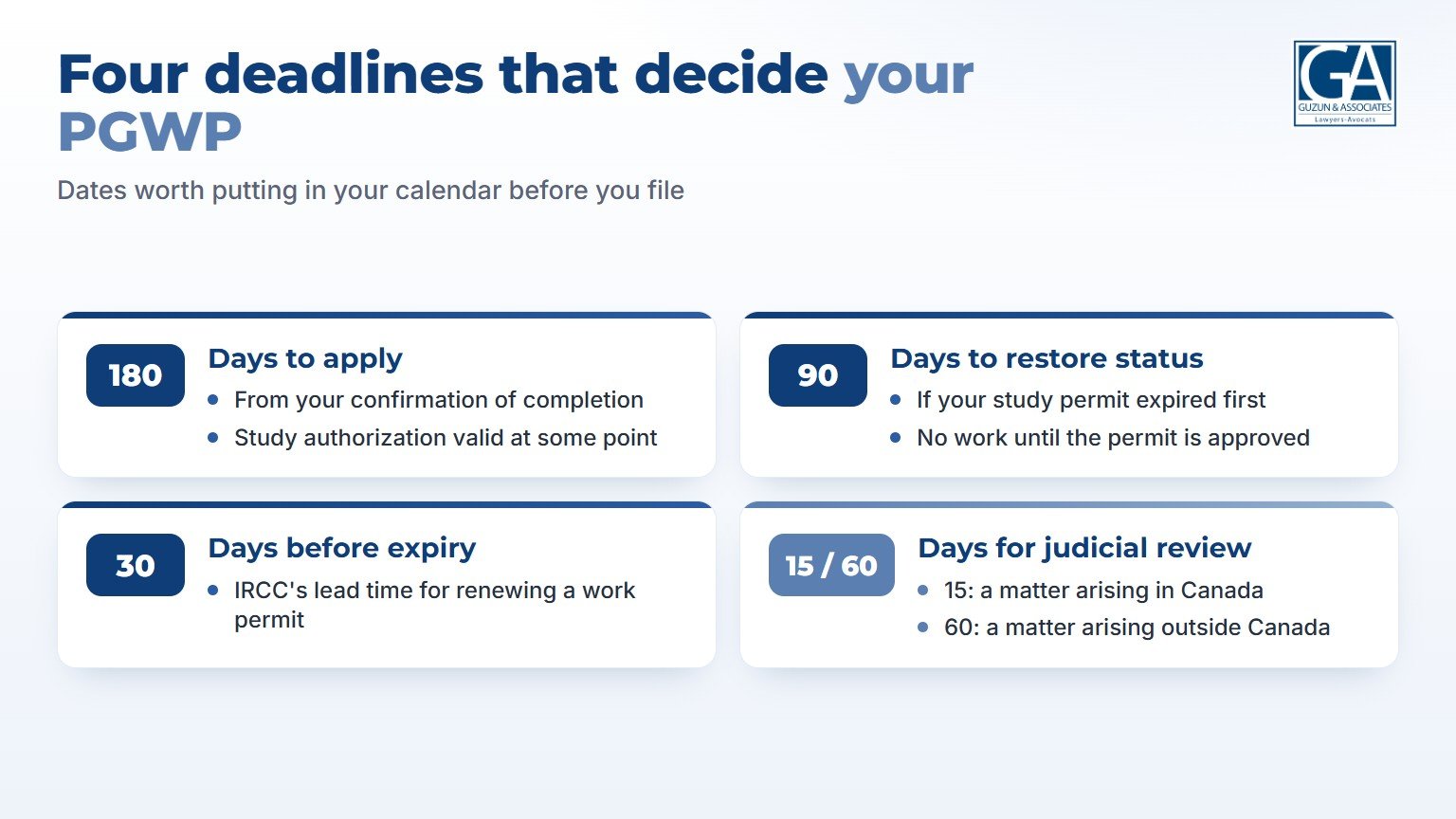
- You apply within 180 days of receiving official confirmation that you completed your program.
- You had authorization to study in Canada at some point during that 180-day window — the wording IRCC uses in its own program delivery instructions. Maintained status is not a substitute: IRCC instructs officers that a graduate who has only applied to extend a study permit, and is studying under section 189 of the Immigration and Refugee Protection Regulations, must wait until the new study permit is issued before applying from inside Canada.
- You apply either from inside Canada or from abroad — and if you file from inside Canada, you have to be physically here when you submit.
Miss the 180-day window, drop to part-time before your last semester, or lose student status and miss the 90-day restoration window described below, and PGWP eligibility is generally lost. IRCC does publish a set of special cases — accelerated programs, transfers between institutions, an authorized leave of up to 150 days approved by your school — but each is narrow and each carries its own proof requirement.
If your study permit expires before you apply. Losing student status doesn’t automatically end your PGWP chances, but it changes the process. IRCC’s instructions are explicit: if you didn’t change to visitor status and your study permit expires, “you have up to 90 days after your study permit expires to apply for a PGWP and restore your status as a student.” It goes in one application — you apply online for the PGWP and pay the restoration fee separately, with no separate restoration application.
Two things make this route risky: you can’t work until the permit is approved, and if the 90 days pass without an application, you have to leave Canada.

Language Requirement: CLB Levels and the Upload Problem
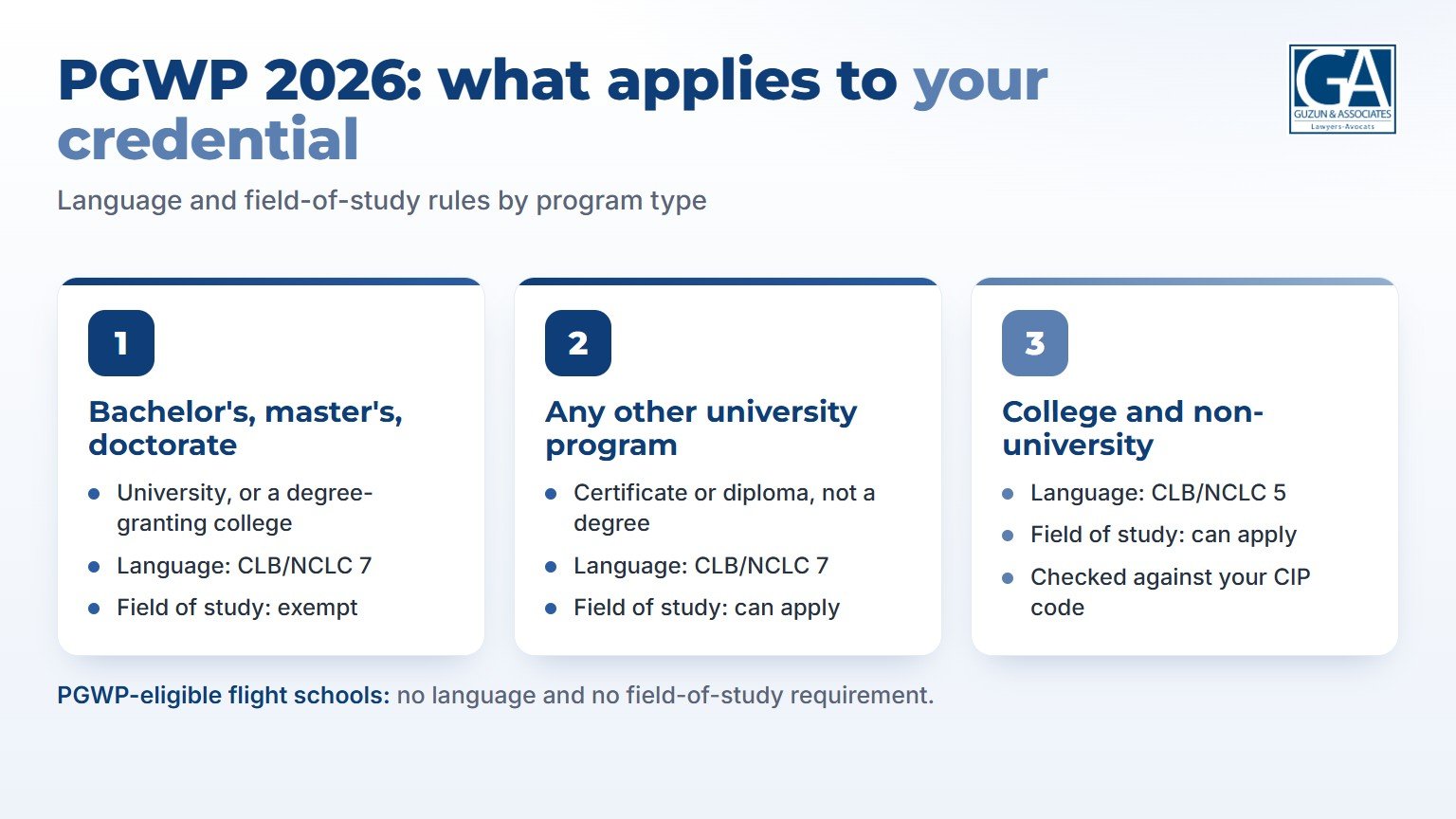
Since November 1, 2024, most PGWP applicants must show a valid language test result — the exception is people who filed the PGWP application itself before that date, whatever their study permit date (one group is exempt outright — see the last bullet). The level depends on your credential:
- Bachelor’s, master’s and doctoral graduates — a degree, whether from a university or from a degree-granting college or polytechnic — need CLB/NCLC 7 in all four language areas (reading, writing, listening, speaking), and no field of study requirement applies to them.
- Graduates of any other university program — a university certificate or diploma that isn’t a degree — also need CLB/NCLC 7, but the field of study requirement can still apply. This is the group most often missed.
- Graduates of any other college, polytechnic or non-university program need CLB/NCLC 5 in all four language areas, and the field of study requirement can apply.
- Graduates of a PGWP-eligible flight school have neither a language nor a field of study requirement.
CLB and NCLC — the Canadian Language Benchmarks and their French counterpart, the Niveaux de compétence linguistique canadiens — are the scales IRCC uses to convert your raw test score into a level.
One distinction is easy to miss. As of March 11, 2025, graduates of non-university degree-granting programs — a bachelor’s degree earned at a college or polytechnic, for example — are assessed under the same language and field-of-study rules as university graduates. Graduates of college diplomas and certificates stay in the CLB/NCLC 5 category and may still face the field-of-study requirement.
Accepted tests are CELPIP General, IELTS General Training, PTE Core, TEF Canada, and TCF Canada. Your results must be less than 2 years old on the day you submit — a test taken for admission three years earlier won’t carry the application.
Here’s the part that matters most in practice. The portal builds a personalized checklist from a questionnaire, and on that checklist the language result is labelled optional. IRCC’s own instructions explain what the label really means: “your PGWP document checklist will list the proof of language results as an optional document. You must include this proof with your application if it’s a requirement for your study program.”
In plain terms: if your credential falls into any of the categories above, the test result is mandatory — “optional” describes the form field, not the rule.
A second, separate trap sits next to it. Proof that you graduated in an eligible field of study isn’t on the checklist at all — “due to system limitations,” IRCC says — and has to be uploaded in the “Client information” section, which saves only the most recent file. Upload twice there and the first document is gone.
The cost of that labelling is measurable, and it has been growing. Of the 302,000-plus PGWP applications submitted between November 1, 2024 and December 31, 2025, 945 were refused for language-related reasons — figures a spokesperson for the Immigration Minister’s office gave Global News in May 2026, which also reported that almost 80% of those refusals came in the last six months of 2025. The same spokesperson said a dedicated field for language results is being developed for the work permit site as part of broader IT changes at IRCC.
Until it exists, reading the checklist as instructions rather than as a shopping list — and checking what actually landed in each slot before you submit — is one of the simplest ways to avoid a refusal that has nothing to do with your language ability.
Field of Study: Who It Affects, and the 2026 Freeze
The field of study requirement works differently depending on your credential level:
- Bachelor’s, master’s, and doctoral graduates are exempt — including degree graduates from colleges and polytechnics, since the March 2025 change. This rule doesn’t apply to you at all.
- University certificate and diploma graduates (non-degree) may be affected — the CLB/NCLC 7 they need on language doesn’t exempt them from this rule.
- College diploma and certificate graduates may be affected, depending on whether your program’s classification code appears on IRCC’s eligible list.
Eligibility is tracked through Classification of Instructional Programs (CIP Canada 2021) codes. IRCC revised the list twice in 2025, and the order matters. On June 25 it did both things at once: it added 119 new fields — mostly health care and social services, education and the trades — and removed 178 that were no longer tied to long-term labour shortages, leaving, in its own words, “920 fields of study eligible for a PGWP.”
On July 4 it reversed the removals and put those 178 back. Nothing has moved since: the list still reads “Last updated: July 4, 2025” and runs to roughly 1,100 eligible CIP codes.
IRCC has stated it plainly: “For 2026, we won’t add or remove any eligible fields of study.” That stability matters because of a related rule: your CIP code has to be on the list either when you submitted your study permit application or when you submit your PGWP application — either one is enough. It isn’t measured against today’s list alone. A code that was eligible when you filed your study permit still carries you through, even if it has since come off.
Whatever your credential level, the field of study rule also drops away if your study permit application — or the PGWP application itself — was filed before November 1, 2024, or if you graduated from a PGWP-eligible flight school.
Note which date governs which exemption: for field of study it’s normally the study permit application date, while the language requirement turns on the date you file the PGWP itself. Whether your code is on the list is the separate “either filing date” question above. A pre-November 2024 study permit doesn’t exempt you from the language test.
| Factor | Degree programs (university, or degree-granting college) | College diplomas and certificates |
| Language requirement | CLB/NCLC 7, all four skills | CLB/NCLC 5, all four skills |
| Field of study requirement | Not applicable — exempt | May apply, depending on your program’s CIP code |
| Which list your code is checked against | Not applicable | The list as it stood on either filing date — study permit or PGWP |
University certificates and diplomas that aren’t degrees sit between the two columns: CLB/NCLC 7 like a degree, but with the field of study requirement still in play.
How Long Your PGWP Lasts — and the Passport Rule
Permit length is tied to your program length, with one notable carve-out:
- Programs between 8 months and under 2 years generally receive a PGWP equal to the program’s length.
- Programs of 2 years or longer — or Quebec vocational programs of 1,800 hours or more — generally receive a PGWP of up to 3 years.
- For applications received on or after February 15, 2024, a degree-granting master’s program of at least 8 months qualifies for a 3-year PGWP even if it ran shorter than 2 years. Graduate-level certificates and diplomas are expressly excluded — a distinction that catches people who assume any postgraduate credential counts.
One rule trips up graduates who don’t plan for it: IRCC generally won’t issue a PGWP for longer than your passport remains valid. If your passport expires before your full entitled PGWP term would end, IRCC will typically issue a permit only up to that expiry date. Once you renew your passport, you can generally submit a paper application to extend your PGWP up to the length you originally qualified for.

Processing Times and Working While You Wait
IRCC doesn’t publish a processing time standard specific to PGWP applications — its online tool groups them with the broader work permit category and updates weekly. IRCC’s published service standard is 120 days — about four months — for work permit extensions from inside Canada, which is the bucket a PGWP filed in Canada lands in; the department aims to meet it 80% of the time. Applications filed from outside Canada run under a separate 60-day standard.
That is a target rather than a promise, and real processing times move up and down through the year, so check IRCC’s processing times tool close to your own filing date. If you later renew a work permit, IRCC recommends applying at least 30 calendar days before it expires. That is a separate deadline from the PGWP itself, which runs on its own 180-day window.
While your PGWP application is pending, many applicants can keep working — but only if the study permit was still valid, not expired, on the day the application was submitted. When IRCC’s system confirms that, it sends an interim work authorization letter (WP-EXT for PGWP, IMM 0127 E), valid for 180 days from receipt. IRCC adds that you can keep working past that date: “You can work until we make a decision on your work permit application even if the validity period of the letter expires.”
That right doesn’t come from the letter itself — it comes from paragraph R186(w) of the Immigration and Refugee Protection Regulations, and it applies provided that:
- your study permit was valid when you applied for the PGWP;
- you had already met all of your program requirements at that point; and
- you were allowed to work off campus without a work permit while studying, and didn’t work more hours than allowed — currently 24 hours a week during a regular academic session under R186(v).
If your application is refused, that right to work stops the day IRCC notifies you. Leaving Canada, by contrast, doesn’t end it: IRCC states plainly that “leaving and re-entering Canada doesn’t stop you from working full-time while you wait.”
The risk of travel lies elsewhere — in getting back in. You need a valid visitor visa or eTA, the border services officer decides admissibility, and if you applied from inside Canada, IRCC won’t issue you a new visitor visa when it approves your permit — if yours has expired and you want to travel, you apply for a new one separately. If you need an eTA rather than a visa, IRCC does issue that one on approval.
If Your PGWP Application Is Refused
Refusals tend to trace back to a small set of causes: an incomplete package, a missing or misplaced language test result, a field of study that doesn’t match the eligible list, a break in full-time status, a missed 180-day window, a school or program that isn’t PGWP-eligible, or a PGWP already received once before.
The usual first step is to request the GCMS notes (Global Case Management System) — the officer’s internal notes on the file, obtained through an access to information request. They show what the officer actually had in front of them, which is what tells you whether the answer is a reconsideration request, a stronger new application, or judicial review.
They also take several weeks to arrive, which is longer than the judicial review deadline below — so when judicial review is a realistic option, the application for leave is normally filed first and the notes reviewed afterward.
There’s no formal administrative appeal process for a refused PGWP. Depending on your situation, the paths generally available are:
- Reconsideration — a discretionary request asking the same office to look again; the officer decides whether to revisit the file.
- A new application, submitted with additional or corrected evidence.
- Judicial review in the Federal Court, which examines whether the decision was reasonable and procedurally fair — it does not re-decide the case on its merits.
Judicial review runs on short deadlines under section 72(2) of the Immigration and Refugee Protection Act (IRPA): generally 15 days for a matter arising in Canada and 60 days for a matter arising outside Canada. Which one applies isn’t always obvious, so the shorter deadline is the safer working assumption. A judge may allow more time for special reasons, but that is discretionary and not something to plan around.
What protects the option is filing the application for leave inside the deadline — the supporting record is filed afterward, on the Court’s schedule. Our related guide on work permit refusals in Canada walks through these options in more depth.
The Quebec Connection: PEQ and CSQ
If you studied and plan to work in Quebec, provincial programs run separately from — but alongside — your federal PGWP status. The Programme de l’expérience québécoise (PEQ — Quebec’s page is in French only) was temporarily reopened for two years, from July 2, 2026 through July 2, 2028, in both of its streams — Quebec graduates and temporary foreign workers. Applications in either stream are received through Quebec’s Arrima portal only from July 2 to October 31, 2026. The two years are how long the measure stays in force; the intake itself is those four months.
Eligibility for this window is limited to people who already held a qualifying Quebec diploma or relevant work experience as of November 19, 2025. Qualifying credentials are a baccalauréat, maîtrise or doctorat, a DEC technique, or a diplôme d’études professionnelles (DEP). Only the DEP route carries an hours condition: it has to total at least 1,800 hours, on its own or followed by an attestation de spécialisation professionnelle (ASP). The ASP is optional; the hours are not. For the full eligibility breakdown, see our guide to the 2026 PEQ reopening.
Two 2026 changes matter if you’re still studying, or if a family member is — they sit next to the PGWP rules and are easy to confuse with them.
Study permit numbers remain capped nationally, with Quebec allocated its own share. Since January 1, 2026, master’s and doctoral students at public institutions have been exempt from the federal provincial or territorial attestation letter (PAL/TAL) requirement, while undergraduates still need one. That federal exemption does not touch Quebec’s own rule: a Certificat d’acceptation du Québec (CAQ) is still required for studies in Quebec lasting more than six months, at every level.
Back to the PEQ itself: it leads to a Certificat de sélection du Québec (CSQ), a provincial step toward permanent residence. Quebec’s rules never name the PGWP, but they don’t exclude it either. For the 2026 intake, the temporary-worker stream asks for at least two years of Quebec work experience in a TEER 0, 1, 2 or 3 occupation (the skill-level categories of the National Occupational Classification) counted as of November 19, 2025 — the same cut-off date as the graduate stream — plus an intention to work in Quebec in a job outside the excluded sectors and in a business you don’t control.
Work done on a PGWP can count toward that experience. What stops most PGWP holders is the other condition: both streams require oral French at level 7 or higher on Quebec’s own scale, the Échelle québécoise des niveaux de compétence en français — and the graduate stream adds written French at level 5 or higher. It’s a separate scale from the CLB/NCLC used by IRCC, and it measures French only — a CLB 7 result on an English test, enough for your PGWP, counts for nothing under the PEQ. Check that first, then confirm your situation with an immigration lawyer rather than assuming the two programs connect automatically.
Real Case Examples
A university graduate in Montreal submitted her PGWP application with an IELTS General Training score comfortably above CLB 7. Her checklist listed the language result as an optional document, so she left that line empty and attached her test report in the “Client information” section instead — a slot that saves only the most recent upload, and one she had already used for another document. Her application was refused for missing language evidence; the officer’s notes indicated no language test result was found on file.
Her lawyer filed a reconsideration request with a clear index of exactly what had been submitted and where. The permit was later issued.
A college graduate had filed his study permit application in the spring of 2025 — after November 1, 2024, so the field of study rule did apply to him, but before the list was revised that June. His program’s CIP code wasn’t on the list the day he filed that application. It was added on June 25, 2025, among the 119 new fields, and it was still there when he applied for his PGWP in 2026 — and because either filing date can be used, that second date carried his program through.
Outcomes like these depend entirely on the facts, documents and timing of each file, and are not a prediction of what will happen in yours.
PGWP Document Checklist
Needed in essentially every file:
- The work permit application form from your personalized checklist — IMM 5710 from inside Canada, IMM 1295 from outside; IRCC’s guide 5580 walks through the in-Canada application, guide 5487 the one from abroad
- Proof of payment — CAD $155 for the work permit plus the CAD $100 open work permit holder fee, CAD $255 in total, and CAD $85 for biometrics if you’re asked for them
- Confirmation of completion letter (or official transcript showing program completion) from your DLI
- A valid passport, with enough remaining validity to cover your intended permit length — or a plan to renew before applying
- Proof you held study authorization at some point during your 180-day application window
- A copy of your current or most recent study permit
- Your language test result from an accepted test — uploaded to the correct field and double-checked before you submit
- Official transcripts showing full-time enrolment in each semester (part-time only in your final term, if applicable)
- Proof of program length — 8 months or more, or 900 hours for qualifying Quebec programs — at a PGWP-eligible DLI
Depending on your situation:
- Documentation of your program’s CIP code and its standing on the eligible list — college diploma and certificate graduates only; degree graduates are exempt
- If your study permit expired before you applied, the receipt for the restoration fee (the 90-day rule is explained above)
- If you studied at certain Quebec schools: an official letter from the school confirming both the length of the program and its program code, plus either your credential or an official transcript from the school board or recognized private school
- Certified translations of any document not issued in English or French
- Documentation of any interruption in full-time study — a scheduled break or an authorized leave
Frequently Asked Questions
1. Do I need a language test to apply for a PGWP in 2026?
Yes, in almost every case. The exceptions are PGWP applications filed before November 1, 2024 and graduates of PGWP-eligible flight schools. Degree graduates generally need CLB/NCLC 7 in all four language areas; so do graduates of other university programs, who also face the field of study rule. College and other non-university graduates generally need CLB/NCLC 5. Any of the five accepted tests works, and the result has to be less than 2 years old when you submit.
2. How long does PGWP processing take in 2026?
There’s no service standard specific to PGWP — it sits inside the general work permit category, where IRCC’s target is 120 days for 80% of work permit extensions filed inside Canada. Check the live tool close to your filing date rather than relying on a fixed number, and apply at least 30 days before any current permit expires.
3. Can I keep working while my PGWP application is being processed?
Many applicants can, if their study permit was still valid — not expired — on the day they submitted the PGWP application. Maintained status on a pending study permit extension is not enough. An interim work authorization letter is typically issued first, and full-time work may continue after it expires while a decision is pending.
4. Can I travel outside Canada while my PGWP application is pending?
Three different things get confused here. Your right to work is safe: if your study permit was valid when you applied, IRCC says leaving and re-entering Canada doesn’t stop you from working full-time while you wait.
Your temporary resident status is a different matter: the period authorized for your stay ends the day you leave Canada. Your re-entry is the real exposure: check that your visitor visa or eTA is still valid before you book, since the border services officer decides admissibility in every case.
5. What happens if my passport expires before my full PGWP term would end?
You apply on paper, once the new passport is in hand, to extend the permit up to the length you originally qualified for. Two practical points make this easier than it sounds: you don’t have to provide proof of language ability again when you extend for this reason, and the extension is a fresh application rather than an automatic top-up — so the cleanest route is still to renew the passport before you file the PGWP at all.
6. What happens if my PGWP application is refused?
Your right to work stops the day IRCC notifies you of the refusal. Most applicants start by requesting their GCMS notes to see what the officer relied on. Depending on your situation, options may include requesting reconsideration, submitting a new application with stronger evidence, or seeking judicial review in Federal Court within 15 days for a matter arising in Canada, or 60 days for a matter arising outside Canada.
7. Can my spouse get an open work permit while my PGWP is pending?
Generally not while it’s pending. IRCC’s own guidance ties the spousal open work permit to approval: if your PGWP is approved, your spouse or common-law partner may be eligible, depending on the job you hold once the permit is issued. Filing both applications together is a common and expensive mistake.
This article is provided for general informational and educational purposes only and does not constitute legal advice. Reading this article does not create a lawyer-client relationship between you and Guzun & Associates. Post-Graduation Work Permit eligibility depends on IRCC rules and processing practices that change frequently, and Quebec-specific programs are governed separately by MIFI — your own timeline, program, and documentation can significantly affect the outcome of your file. For guidance specific to your situation, consult a licensed immigration lawyer.
Ready to Turn Your Study Permit Into a Career in Canada?
Book Your Free Orientation Call:
Not sure whether your program qualifies, or worried a document went to the wrong place on the portal? A brief, no-obligation orientation call can help you understand what your PGWP file needs before you submit.
📞 Call us: +1 (514) 842-7414
📧 Email: office@avocatguzun.com
📍 Visit: 105-1 rue McGill, Suite 15B, Montreal, Quebec