
In this article
- What the Basic Support Payment Already Covers
- Three Categories of Extra Expenses — and Why They Get Confused
- How the Split Actually Works: Proportional, Not Equal
- When an Expense Actually Qualifies
- Orthodontics, School Fees, and Activities in Practice
- If You’re Divorcing and the Other Parent Lives Outside Quebec
- Getting the Other Parent’s Agreement First
- How to Formalize the Split — and How to Revisit It
- Real Case Examples
- Practical Checklist: Before You Pay, and After the Bill Arrives
- Frequently Asked Questions
September brings more than backpacks and timetables. It brings the first tuition installment, the orthodontist’s estimate, and the registration fee for hockey or dance. If you’re separated or divorced, the question that follows every one of those bills is the same: who actually pays this, and how much?
The short answer under Quebec law: these costs are generally not split fifty-fifty. They’re shared in proportion to each parent’s share of the parents’ combined disposable income — the same percentage used to calculate the basic child support contribution. A parent who accounts for 60% of that combined disposable income generally covers roughly 60% of a qualifying expense, not half.
That principle sounds simple, but the details trip up a lot of parents. Quebec’s rules separate expenses into three distinct categories, only one of which covers primary and secondary school fees, extracurriculars, and orthodontics. Getting the category wrong — or assuming an even split — is where disputes usually start. Here’s how the model actually works, what it means in real numbers, and what to do whether the bill is still ahead of you or already on the table.
What the Basic Support Payment Already Covers
Under article 587.1 of the Civil Code of Québec (CcQ), the basic parental contribution “is presumed to meet the needs of the child and to be in proportion to the means of the parents.” That figure — calculated from a table based on combined disposable income and the number of children — is meant to cover the child’s ordinary day-to-day needs.
The official Child Support Determination Form is explicit on this point: the basic contribution covers the totality of the child’s needs, except for the expenses listed separately on the form. The base amount isn’t a partial payment topped up by whatever else comes along.
Quebec’s Ministry of Justice sets those ordinary needs out on its JuridiQC portal as nine headings: food, housing, communications, household maintenance, personal care, clothing, furnishings, transportation, and a portion of recreation. That qualifier is the part parents miss: only part of a child’s recreation is built into the basic contribution — which is why an ordinary neighbourhood activity is usually treated as already paid for, and an expensive one may not be.
The narrower list the form sets apart is where school fees, sports, and dental work live — but only if they fit into one of three specific categories.
Three Categories of Extra Expenses — and Why They Get Confused
Article 9 of Quebec’s child support regulation defines three separate categories of expenses that can be added on top of the basic contribution. Parents — and sometimes the articles they read online — regularly lump these together, but the Child Support Determination Form tracks each one on its own line.
Frais de garde (childcare expenses) cover the annual childcare costs required to fulfil the child’s needs and, in addition, the care costs the custodial parent must incur in particular to hold employment, to receive training, or by reason of the parent’s health condition. Frais d’études postsecondaires (post-secondary education expenses) cover the annual cost of a child’s post-secondary studies — CEGEP or university tuition among them — including required course materials and related travel or housing.
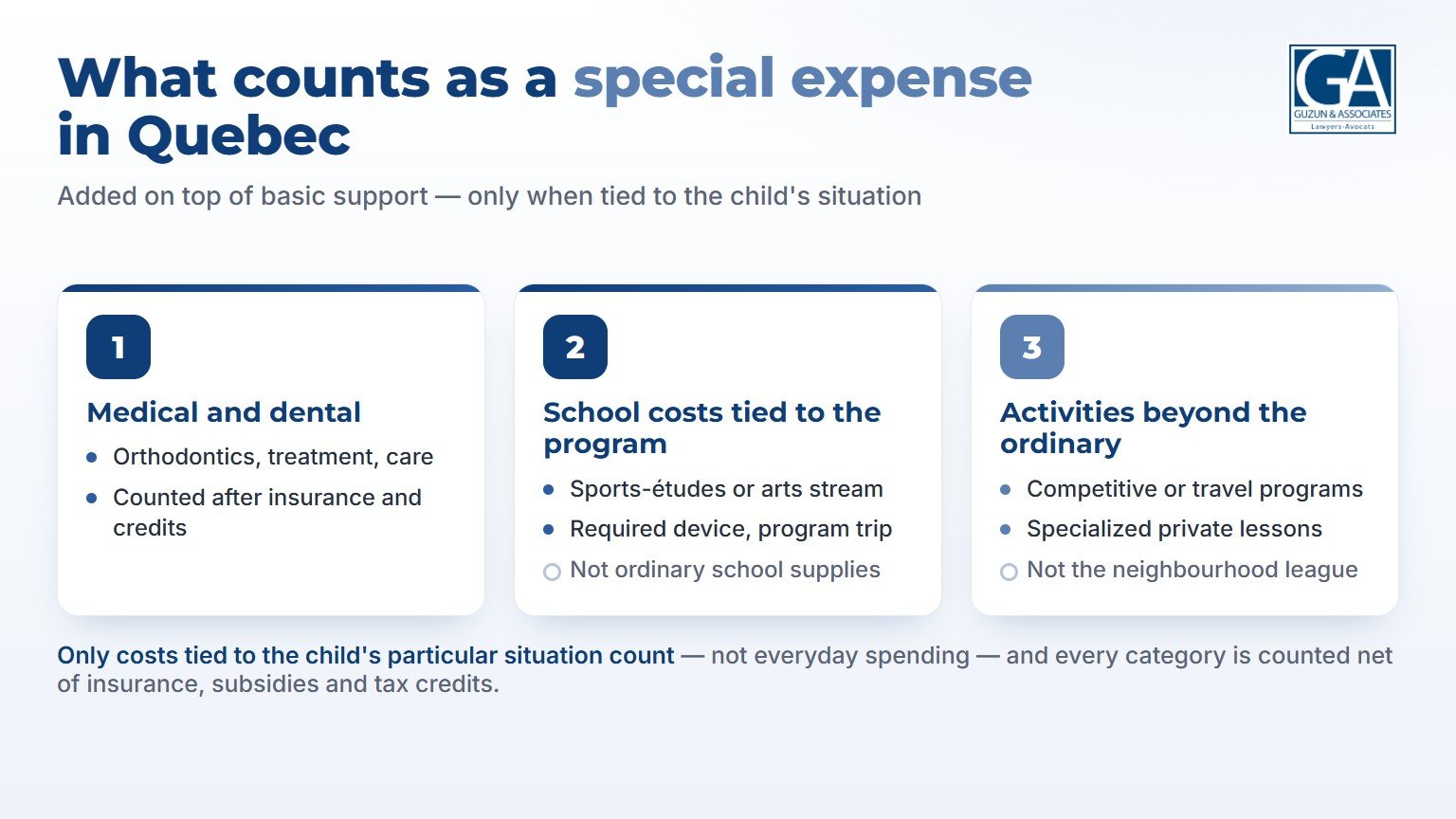
The third category, frais particuliers (special expenses), is the one most relevant to a September inbox full of invoices. The regulation defines it as annual expenses other than the first two categories, “such as medical expenses, expenses for primary or secondary studies or for any other educational program and expenses related to extracurricular activities, where those expenses are linked to the needs required by the particular situation experienced by the child.”
Confusing these categories matters because each is calculated and reported separately on the support form. A daycare bill and an orthodontist’s invoice are not interchangeable line items, even though both eventually get added to what a parent owes. If you’ve come across the phrase “special or extraordinary expenses,” that’s the federal wording for a related but separately structured list — more on that below.
| Category | What it covers | How it’s shared |
| Frais de garde (childcare expenses) | Annual childcare needed for the child and, in addition, care the custodial parent needs to work, train, or manage a health condition | Net cost, split by each parent’s income-share percentage |
| Frais d’études postsecondaires (post-secondary education) | Post-secondary studies (CEGEP, university and other programs): tuition, required materials, and related transport or housing | Same income-share formula, net of financial aid received |
| Frais particuliers (special expenses) | Medical and dental care (including orthodontics), primary/secondary school program costs, and extracurricular activities tied to the child’s particular situation | Same income-share formula, net of insurance, subsidies, deductions, and tax credits |
How the Split Actually Works: Proportional, Not Equal
Here’s the mechanism behind the “not fifty-fifty” rule. On the official form, each parent’s income is reduced by a basic deduction and by union and professional dues to give a disposable income figure; the two are added together, and each parent’s share of that combined total becomes their percentage. That same percentage is applied twice — once to the basic contribution from the table, and again to the total of qualifying expenses. A parent at 45% of combined disposable income generally pays 45% of childcare, post-secondary and special expenses alike, not half.
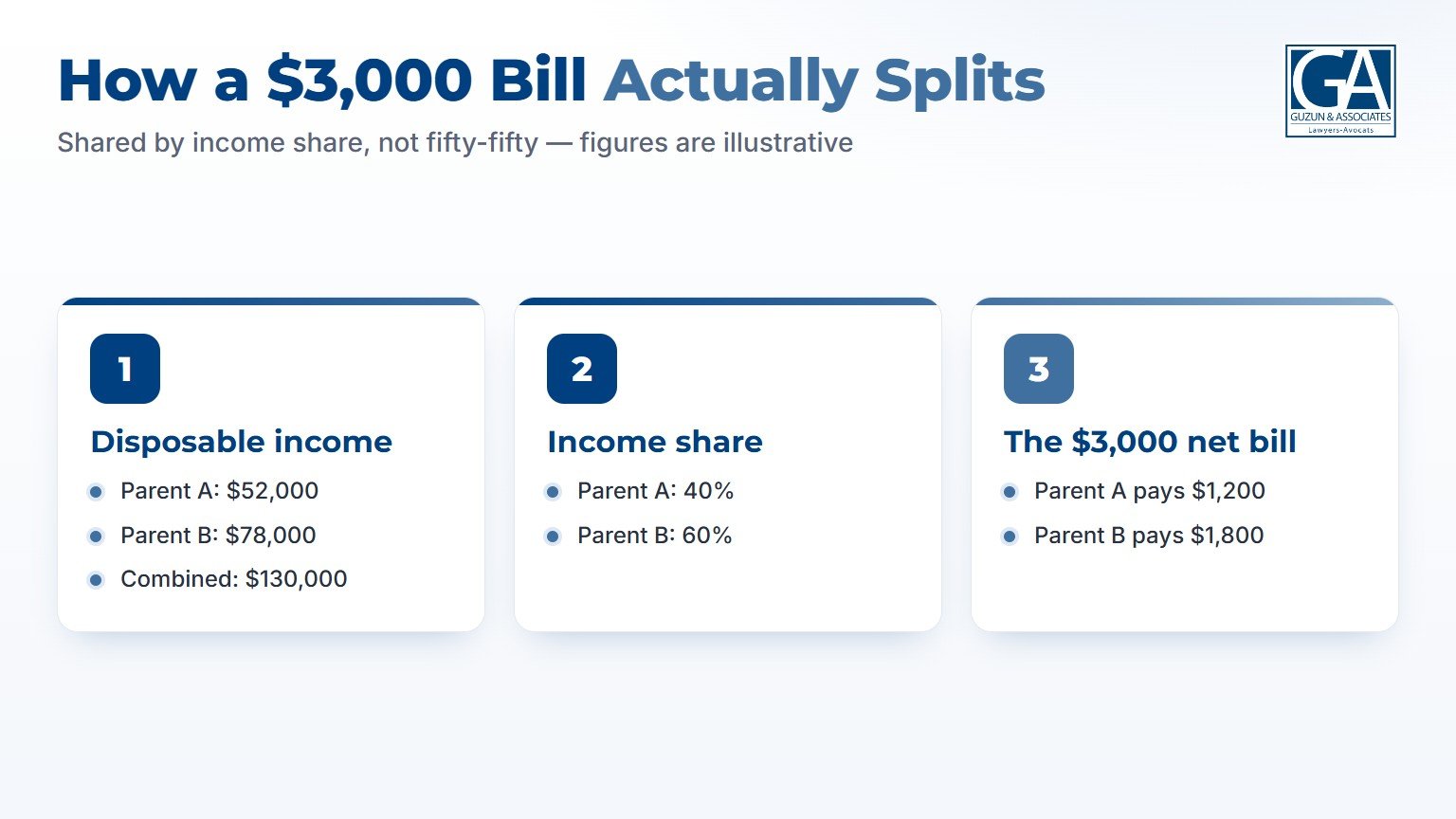
A worked example. Say Parent A has a disposable income of $52,000 and Parent B has $78,000, for a combined total of $130,000. Parent A’s share is 52,000 ÷ 130,000, or 40%. Parent B’s share is 60%.
If the child needs orthodontic treatment and the net cost — after insurance reimbursement and any applicable tax credit — comes to $3,000, Parent A would generally owe about $1,200 and Parent B about $1,800. The same 40/60 split that applies to the basic support table applies here.
These figures are illustrative only; every family’s actual disposable income, deductions, and expense totals differ, and Quebec’s official support table — applicable since January 1, 2026 — sets the real contribution amounts based on combined disposable income and the number of children.
You don’t have to do that arithmetic by hand. Quebec’s Ministry of Justice runs a free Child Support Payments Calculation Tool, built on the same data as the official form, which estimates what you would pay or receive. Two caveats. The official Child Support Determination Form still has to be filed if the matter goes to court. And if support has never been set between you, there is no percentage already on record to work from: special expenses are then claimed in the same application that fixes the support itself, not separately afterwards.
On the form, the arithmetic runs in four steps: line 307 is each parent’s income-share percentage, lines 403 to 405 hold the net childcare, post-secondary and special expenses, line 406 totals them, and line 407 multiplies that total by line 307. One trap is buried in Note 2: the calculation assumes the parent who receives the support is the one actually paying the line 406 expenses. If that is not your arrangement, the form requires an explicit adjustment — which line depends on your custody arrangement — with the reasons given. Skipping it quietly overstates what one parent owes.
Two thresholds are worth knowing, and the first turns on a different 40% — unrelated to the income share in the example above. Custody is treated as shared under the regulation where each parent assumes at least 40% of custody time — a share of time, not of income. That changes how the basic contribution is allocated between the parents, but it does not change the percentage used for expenses: childcare, post-secondary and special expenses are still divided according to each parent’s share of the combined disposable income.
Separately, support payable by a parent generally does not exceed half of that parent’s disposable income, unless the court decides otherwise, having regard in particular to that parent’s assets.
One thing the income-share percentage does not govern is everyday spending on ordinary needs. Note 3 to the official form assumes that in shared custody each parent carries the basic contribution in proportion to custody time — a presumption the form lets you depart from, with reasons given in line 534.1 or 564.1. Quebec’s Ministry of Justice puts it more plainly on JuridiQC: in shared custody a one-off purchase such as a winter coat is split according to custody time, while the three categories of expenses stay on the income-share percentage.
When an Expense Actually Qualifies
Not every activity a child enjoys automatically becomes a shared expense. The regulation ties eligible special expenses to costs that respond to “the particular situation” of the child, and article 587.1 CcQ allows the basic contribution to be increased only to the extent that those expenses are reasonable considering the needs and means of the parents and the child.
In practice, the expense should generally connect to something specific about that child — a documented health need, an established commitment, a programme the child is already enrolled in. Deciding on a significant cost without consulting the other parent is the biggest risk a parent takes at this stage: with no prior agreement, the parent who commits to the expense can end up carrying it alone. It does not automatically disqualify a genuine expense — a court still looks at the child’s needs and at both parents’ means — but it shifts the burden onto the parent who went ahead, and it is the easiest objection for the other parent to raise.
The regulation requires all three categories — childcare, post-secondary and special expenses — to be counted net of any related advantage, subsidy, deduction or tax credit. If a credit or reimbursement brings the net cost below zero, the expense is treated as zero for calculation purposes.
The calculation is also not the final word. Under article 587.2 CcQ, a court may increase or reduce the amount owed in light of a parent’s assets or the resources available to the child, or to take account of a parent’s support obligations toward children not named in the application — but only where the court considers those obligations entail hardship for that parent. Separately, the court may adjust the amount where it considers that leaving it unchanged would cause undue hardship to either parent.
Beyond the three categories on the form, there is a fourth possibility worth naming: a cost that is neither part of the child’s ordinary needs nor one of those three. The support model has no mechanism for sharing such a cost, so in practice the parent who chooses to incur it carries it alone unless the other parent agrees otherwise — which is how Quebec’s Ministry of Justice explains it on JuridiQC.

Orthodontics, School Fees, and Activities in Practice
Orthodontic work is the expense that most often lands on a separated parent’s desk in September, and it shows why the written record matters: a full course of treatment frequently runs into the thousands, and insurance or a tax credit is deducted before anything is split. Before booking, it’s worth pinning the cost down in writing with the other parent — what the insurer is expected to cover, and that the rest is being treated as a shared special expense. How to get that agreement is covered below, under Getting the Other Parent’s Agreement First.
Activities work the same way but with a blurrier line. Ordinary recreation is treated as already covered by the basic contribution; what can be claimed on top is the part of the cost that goes beyond what a family normally spends on activities — which is why a competitive travel program or a specialized private lesson is likelier to qualify than a Saturday league most kids in the neighbourhood play, and why, in practice, the size of the bill often weighs more than the label on the program.
The same test sorts out the everyday items parents argue over: a phone, a laptop or driving lessons normally sit inside the ordinary needs the basic contribution already covers, and move into the special-expense column only where something about the child’s situation makes them necessary — a device required by the school program, say, rather than an upgrade the child wanted.
Quebec practice puts a working number on that boundary: the recreation already inside the basic contribution is commonly treated as roughly 5% of it, and where an activity clearly goes beyond ordinary recreation, it is the balance above that share that gets claimed. On a basic contribution of $12,000 a year, that is about $600 of recreation already covered, so a $1,500 hockey season leaves roughly $900 to be shared by income percentage. It is a benchmark drawn from practice, not a figure written into the regulation — a court is not bound by it and looks at what the family actually spent and can afford.
School fees sit between the two. Costs tied to the specific program a child is enrolled in — a sports-études or arts concentration, a required device, a trip forming part of the program — match the regulation’s wording about expenses for primary or secondary studies linked to the child’s particular situation. Ordinary back-to-school supplies are a different matter: they belong to the everyday needs the basic contribution already covers.
If You’re Divorcing and the Other Parent Lives Outside Quebec
One clarification first: the federal framework comes into play only in a divorce, or in later proceedings under the Divorce Act such as an application to vary support. If you were never married to the other parent, your child support is generally determined under the Civil Code of Québec and Quebec’s regulation rather than the Divorce Act, even if the other parent has since moved to another province.
Quebec’s model is not limited to unmarried parents: it also governs a divorce where both spouses still live in Quebec. Which set of rules applies is settled by where both former spouses are habitually resident at the time an application is made.
If one of them is by then living outside the province, the case falls under the federal Child Support Guidelines, specifically section 7, which use a similarly proportional approach but a differently structured list of eligible costs — with their own test for what counts as “extraordinary,” and, on the health side, only costs whose portion left unreimbursed by insurance reaches at least $100 a year.
Getting the Other Parent’s Agreement First
Before registering a child for an expensive program or booking a costly procedure, it’s generally sound practice to get the other parent’s written agreement that the expense qualifies as shared — even though this isn’t a formal legal requirement under the Civil Code or the regulation. An email confirming the cost, its category, and the expected split can prevent a dispute months later.
A parent who skips that step may end up paying in full and negotiating reimbursement afterward, which is a harder conversation; and if the other parent simply won’t respond, that pattern may become useful context should the disagreement end up before the court.
Between an unanswered email and a courtroom sits family mediation, and it is largely state-funded. For parents with dependent children, the Family Mediation Service pays an accredited mediator for up to five hours on a separation, or two and a half hours where you are revisiting an existing agreement or judgment, on top of a group session on parenting after a break-up. The rate is set at $130 an hour; hours beyond the funded maximum are yours to pay.

How to Formalize the Split — and How to Revisit It
A separation agreement or parenting plan can set out how special expenses are treated, listing which categories are pre-approved and how new ones get resolved. A private agreement binds the parents, but it cannot be enforced like a judgment until a court homologates it (article 2633 CcQ), and homologation is not automatic: the special clerk — the court officer who signs off on consent agreements — refers the file to a judge where the agreement does not sufficiently protect the children’s interests or where consent was given under duress, and the court can amend it or refuse to homologate it.
Where support for a minor child is already set by a Quebec judgment — or by an agreement a court has homologated — and both parents ordinarily reside in Quebec, the Service administratif de rajustement des pensions alimentaires pour enfants (SARPA) can adjust the amount administratively, without returning to court, for a fee of $57.25. Eleven conditions apply, and three of them rule out a lot of families: the parents’ combined disposable income must not exceed $200,000, no pending case between them may affect the support, and the amount must not already have been adjusted by a court under article 587.2 CcQ.
Where both parents agree on a change and want it turned into a judgment, the Service d’aide à l’homologation (SAH) drafts and files the joint application for a total of $651 shared equally between them, with no financial eligibility test — and at no cost to a parent who qualifies for free legal aid. One prerequisite catches parents out: the SAH only modifies what a court has already decided, so you need a judgment on child support already in hand. If your only document is a private agreement that was never homologated, homologation of that agreement comes first.
For more complex disputes — including disagreement over whether an expense fits the frais particuliers category, or a parent’s refusal to pay an agreed share — the file goes to court by way of an application to vary child support, supported by an up-to-date Child Support Determination Form and proof of both parents’ current income.
Since June 30, 2025, which court hears that application depends on the parents’ status. Under article 37.2 of the Code of Civil Procedure, the Court of Québec’s Unified Family Tribunal now hears, to the exclusion of the Superior Court, applications about child custody and child support that relate to a parental union or a civil union.
The Superior Court of Quebec keeps the rest: married and divorcing parents, and de facto parents who are not in a parental union. Proceedings already under way when the reform took effect stay with the court seized of them.
Timing matters too if you have been carrying these costs alone. Article 595 CcQ allows child support to be claimed for needs that already existed before the application — but the claim cannot cover a period longer than the three years preceding it, unless the other parent behaved in a reprehensible manner towards you or the child. If you have been carrying an expense for five years, that limit does not disqualify the claim; it caps what you can recover.
Once a support order exists, ongoing collection and enforcement, including of special expenses folded into the support amount, generally runs through Revenu Québec‘s support collection program. Our guide to how child support is calculated in Quebec covers the base calculation and modification process in more depth.
Real Case Examples
Case 1: The orthodontist estimate nobody had budgeted for. A separated couple’s support order covered only the basic contribution. When their daughter was referred for orthodontic treatment, the custodial parent asked for half the cost up front; the other parent objected that insurance hadn’t been counted and that their incomes weren’t equal. With a lawyer’s help they recalculated the net cost after insurance, applied their actual income-share percentage, and amended the agreement to treat orthodontic and other medical costs as a recurring special expense.
Case 2: A competitive sports program added years later. One parent wanted to enrol their son in a competitive hockey program far beyond the recreational league he’d played in; the other objected that it wasn’t contemplated in their agreement and was disproportionate to their income. Working with counsel, the parents documented the child’s participation history, confirmed the income-share percentage under the existing calculation, and signed a written amendment naming the program a shared special expense — without a court application, though an amendment left unhomologated binds them only as a contract.
These examples are illustrative composites based on common situations and do not describe actual clients or predict the outcome of any particular case.
Practical Checklist: Before You Pay, and After the Bill Arrives
Before you register or pay:
- Confirm which of the three categories the expense falls into — childcare, post-secondary, or special expenses.
- Check that the activity or treatment connects to your child’s documented needs or an existing commitment, rather than being a one-sided decision.
- Get a written estimate, including what insurance, a subsidy, or a tax credit will likely cover, and work from the net cost rather than the sticker price.
- Confirm each parent’s current income-share percentage from up-to-date income figures — it moves whenever either income does, and it was never 50/50 by default.
- Get the other parent’s written confirmation before committing to a significant cost.
If the bill has already arrived:
- Keep the invoice, the insurance statement, and every message about the expense in one place.
- Put in writing what you’re claiming and under which category — an expense generally can’t be added to an existing support amount on one parent’s say-so.
- If the other parent disputes it, put the disagreement in writing with the calculation in figures — the net cost, each parent’s percentage, and the resulting share — before escalating.
Frequently Asked Questions
1. Do parents have to split school and extracurricular costs exactly 50/50?
Generally, no — and the difference can be significant. Qualifying special expenses follow each parent’s share of combined disposable income, so on a 40/60 income split a $3,000 bill comes to $1,200 and $1,800, not $1,500 each. An even split applies only where the parents agree to one.
2. What counts as a “special expense” under Quebec law?
Frais particuliers generally include medical and dental costs (including orthodontic treatment), primary or secondary school program fees, and extracurricular activities, provided they’re connected to the child’s particular situation and are reasonable considering the needs and means of both parents and of the child.
3. Can I ask the other parent to pay for a private school or an advanced sports program?
It depends on the facts. An expense tied to the child’s established needs, talents, or ongoing program may qualify as a shared special expense, but a new, unusually costly program introduced unilaterally may face more resistance and could require a written agreement or a court decision.
4. What if my ex refuses to pay their share of an expense we agreed on?
Where a court order or judgment already sets out support and expenses, unpaid amounts can generally be pursued through Revenu Québec’s collection program. Where there’s a genuine dispute over whether an expense qualifies, that question is settled by agreement between the parents or, failing that, by a judge — the Court of Québec’s Unified Family Tribunal where the parents are in a parental or civil union, and the Superior Court of Quebec otherwise.
SARPA is a different tool: it administratively adjusts support for a minor child where both parents ordinarily reside in Quebec and a Quebec judgment already exists — it does not decide whether a particular cost belongs in the frais particuliers category.
5. Do these rules apply if my child’s parents were never married?
Yes. The duty to support a child comes from article 585 of the Civil Code of Québec and applies to all parents regardless of marital status; article 587.1 then governs how the contribution is calculated. This is distinct from spousal support: common-law (de facto) spouses in Quebec do not have a right to support for themselves, but the duty to support a child applies equally to married, civil union, and de facto parents.
The parental union regime, in force since June 30, 2025, applies automatically to de facto parents who became the parents of a common child on or after that date, provided they meet the conditions in article 521.20 CcQ: they must live together and present themselves publicly as a couple, neither may still be married or in a civil union or another parental union, and they cannot be an ascendant, descendant, brother or sister of each other.
Parents whose common child was born before that date can opt in by mutual agreement, either by notarial act en minute or by a private writing signed before two witnesses. Either way, the regime changes the property rules between the parents — it does not change how a child’s expenses are shared.
6. What happens if one parent moves outside Quebec after a divorce?
It can shift which framework applies, but not retroactively. Under the Divorce Act, Quebec’s model governs where both former spouses are habitually resident in Quebec at the time the application is made. An order already rendered is not reopened by the move itself; it is the next application — including an application to vary — that may instead fall under section 7 of the federal Child Support Guidelines, a related but differently structured list with its own definition of “extraordinary” expenses. If that’s your situation, it’s worth confirming which set of rules governs before you calculate anything.
This article is provided for general informational and educational purposes only and does not constitute legal advice. Reading this article does not create a lawyer-client relationship between you and Guzun & Associates. Quebec’s rules on special expenses depend heavily on each family’s income, the nature of the expense, and whether the Quebec model or the federal Child Support Guidelines apply — outcomes vary case by case, and this article does not guarantee any particular result. For advice specific to your situation, consult a family law lawyer.
Sorting Out Who Pays for Your Child’s Expenses, Without the Guesswork
Book Your Free Orientation Call:
If you’re staring at a stack of September invoices and unsure what’s actually shared under Quebec law, a short orientation call can help you understand your next steps before the next bill arrives.
📞 Call us: +1 (514) 842-7414
📧 Email: office@avocatguzun.com
📍 Visit: 105-1 rue McGill, Suite 15B, Montreal, Quebec