
In this article
- Route 1: The Employer-Specific Work Permit for PSTQ Applicants
- Route 2: The Bridging Open Work Permit (BOWP) for CSQ Holders
- Route 3: Employer-Specific Permits for CSQ Holders Without LMIA
- What About Your Spouse or Common-Law Partner?
- Maintained Status, Restoration, and Working Without a Permit
- Real Case Examples
- When to Talk to an Immigration Lawyer
- Frequently Asked Questions
If your Quebec permanent residence case is still moving through the system, you may be able to keep working in the meantime — but which permit applies depends on exactly where your file stands.
Someone who already holds a Certificat de sélection du Québec (CSQ) and has submitted a federal application may qualify for a bridging open work permit (BOWP) once that application passes a completeness check. Someone who was invited under Quebec’s Programme de sélection des travailleurs qualifiés (PSTQ), has submitted a permanent selection application and already works in Quebec on an employer-specific permit may instead qualify for a temporary, employer-specific work permit, which IRCC is accepting applications for only until December 31, 2026.
A third route — an employer-specific permit without a Labour Market Impact Assessment (LMIA) — exists for CSQ holders already living in Quebec. Picking the wrong route, or assuming all three apply to you at once, can leave gaps in your authorization to work.
(If you are a recent graduate still weighing the post-graduation work permit, its rules are separate; if you already hold a PGWP and a CSQ, Route 3 or the BOWP may be your next step.)

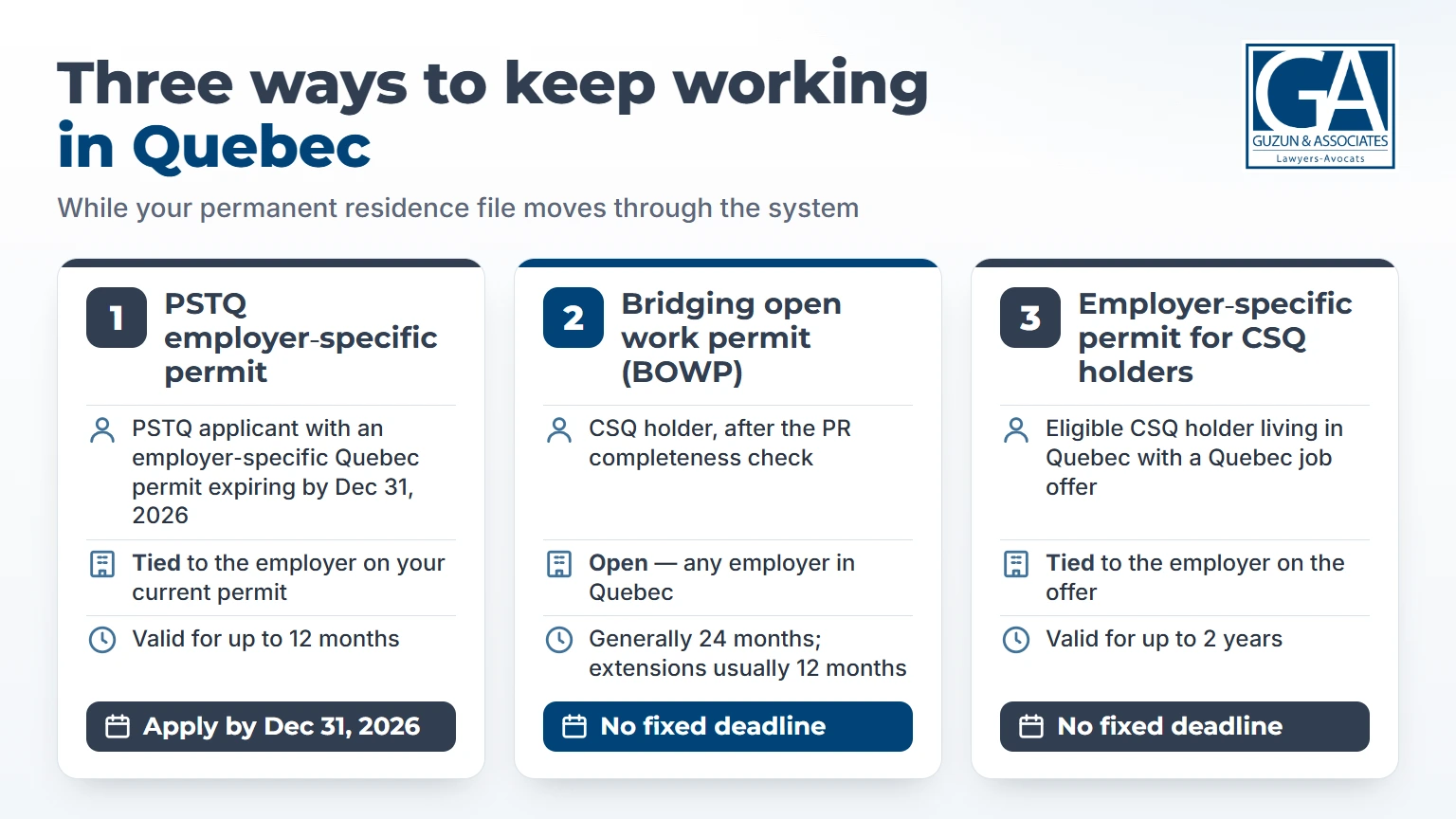
The table below compares the three main routes side by side.
| PSTQ Employer-Specific Work Permit | Bridging Open Work Permit (BOWP) | Employer-Specific Permit for CSQ Holders in Quebec | |
| Who it’s for | PSTQ principal applicants who submitted their demande de sélection permanente and hold an employer-specific permit for a Quebec employer expiring on or before December 31, 2026 (or recently expired) | CSQ holders who are the principal applicant on a federal PR application that has passed a completeness check | Principal applicants holding an eligible CSQ and Quebec’s acceptance letter, living in Quebec, with a valid work permit (or maintained status) and a Quebec job offer, before or after filing for PR |
| Tied to one employer? | Yes — the employer named on your current permit | No — open permit, but work location is restricted to Quebec | Yes — the employer named on the offer |
| LMIA / fees | No LMIA; employer does not pay the $230 compliance fee; you pay the $155 processing fee (plus $85 biometrics, if required, and $246.25 if you must restore your status) | No LMIA; you pay the work permit processing fee ($155) and the open work permit holder fee ($100) | LMIA-exempt, but the employer pays the $230 compliance fee |
| How long it lasts | Up to 12 months | Initial permit generally 24 months or until your passport expires, whichever is shorter; extensions usually 12 months | Up to 2 years, tied to the length of the job offer |
| Deadline to apply | Accepted until December 31, 2026 | No fixed deadline — available once you meet the eligibility conditions | No fixed deadline for this category itself |
Route 1: The Employer-Specific Work Permit for PSTQ Applicants
This option comes from a temporary public policy that IRCC introduced for workers caught in Quebec’s PSTQ pipeline. It is narrower than it first looks — you generally need to meet all of the following:
- you were invited to apply for permanent selection under the PSTQ and submitted your demande de sélection permanente to Quebec’s immigration ministry (Ministère de l’Immigration, de la Francisation et de l’Intégration, or MIFI) as the principal applicant;
- you hold an employer-specific work permit for a Quebec employer (under the Temporary Foreign Worker Program or the International Mobility Program) that expires on or before December 31, 2026 — or that expired after you applied to extend it, or that expired between March 13 and December 31, 2026 without an extension — in that case you are out of status, must also apply to restore it (restoration fee $246.25), and cannot work until it is restored;
- you have a new job offer from the employer named on that permit, and you will keep working in Quebec.
If you hold an open work permit instead, such as a post-graduation work permit, this measure as written does not cover you.
Your employer sends the new offer of employment through IRCC’s Employer Portal — they do not need to obtain an LMIA, and they do not need to pay the usual $230 employer compliance fee. IRCC has said this permit lets eligible workers keep working for their current employer for up to 12 more months while their provincial file is reviewed.
The catch is timing: IRCC is only accepting applications under this measure until December 31, 2026, and the policy may be revoked at any time without prior notice. If you have not yet submitted your demande de sélection permanente, our Arrima and PSTQ roadmap walks through the invitation-to-deadline timeline in more detail.
Route 2: The Bridging Open Work Permit (BOWP) for CSQ Holders
A bridging open work permit lets you keep working while you wait for the results of your permanent residence application. Unlike Route 1, it is not tied to a single employer.
For Quebec skilled workers, though, IRCC’s instructions to its officers restrict the work location to Quebec. Because these PR files usually take 24 months or more, the first BOWP is generally issued for 24 months or until your passport expires, whichever is shorter; extensions, if needed, are normally issued for 12 months.
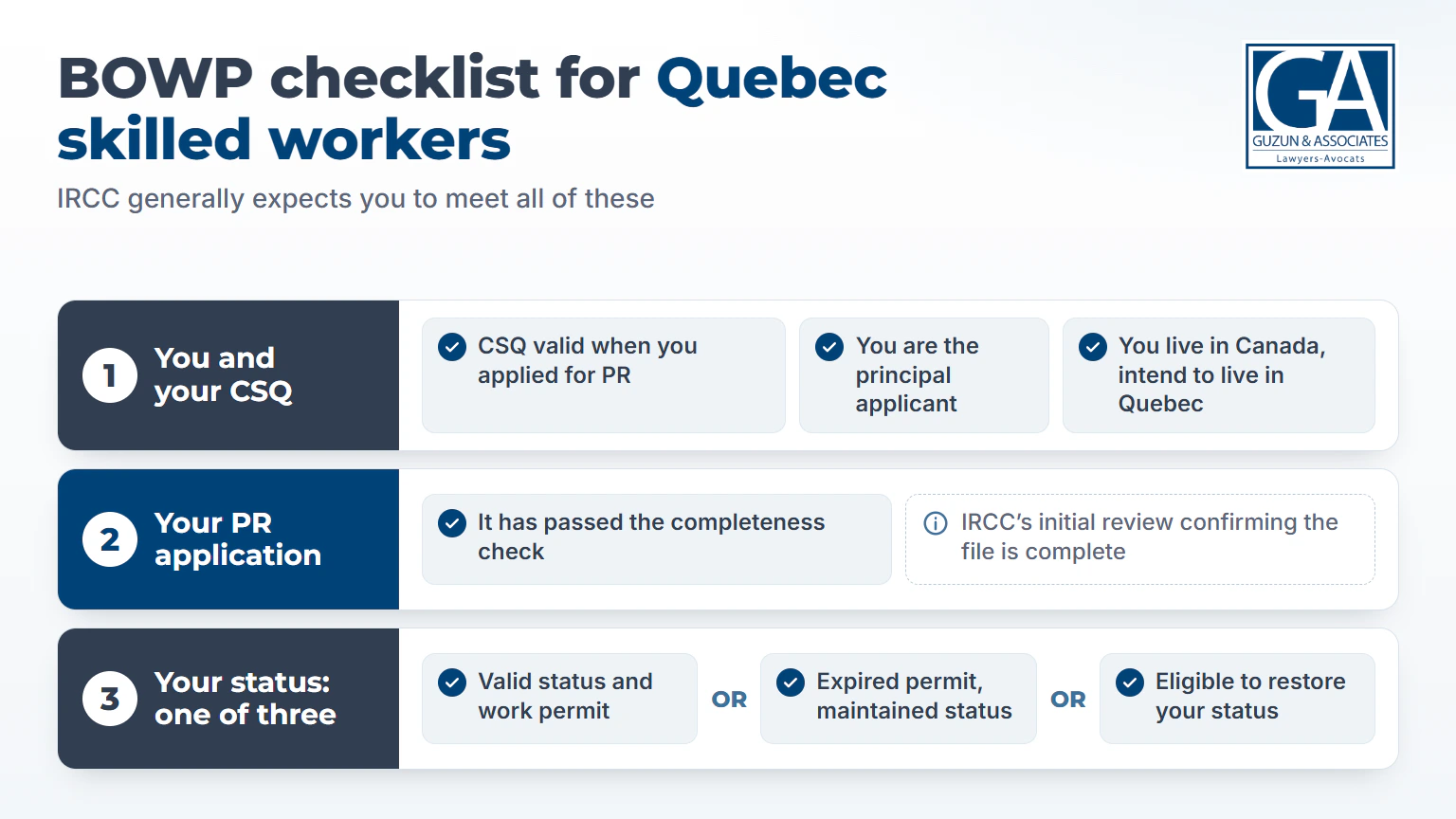
To qualify as a Quebec skilled worker, IRCC generally expects you to meet all of the following:
- you hold a CSQ that was valid when you applied for permanent residence;
- you are the principal applicant on that application;
- you live in Canada and intend to live in Quebec;
- your PR application has passed a completeness check (IRCC’s initial review confirming that the file is complete);
- you meet one of three status conditions: valid temporary resident status with a valid work permit, an expired work permit but maintained status as a worker, or eligibility to restore your status and obtain a new permit.
You apply online, selecting “Open work permit” as the permit type. IRCC asks for a copy of your CSQ and a copy of the letter showing your permanent residence application number (it begins with “E”), and instructs you to answer “yes” to the question asking whether you’ve been approved in principle for permanent residence.
IRCC generally charges two separate official fees: the work permit processing fee ($155) and the open work permit holder fee ($100), plus biometrics ($85) if you’re asked to give them. Some websites present the $255 total as a single “BOWP fee,” but these are two distinct charges. If you can, apply before your current permit expires — that is what generally lets you keep working while IRCC decides (see the maintained status section below).
Route 3: Employer-Specific Permits for CSQ Holders Without LMIA
Separately from the PSTQ facilitation, a CSQ holder already living in Quebec can generally apply for an LMIA-exempt, employer-specific work permit if they:
- hold a CSQ under an eligible program, such as the Regular Skilled Worker Program or the Quebec Experience Program (IRCC lists the accepted category codes from section 9 of the CSQ);
- are the principal applicant and can provide Quebec’s letter accepting their permanent selection application;
- hold a valid work permit (open or employer-specific), have maintained status, or are eligible to restore their status;
- have a job offer from an employer in Quebec.
You can use this route before or after filing your federal PR application. If you have not filed yet, your CSQ must still be valid when you apply; if you have, it must have been valid when you filed and your PR application must still be in process. For CSQs issued under the Regular Skilled Worker Program and the Quebec Experience Program, Quebec’s immigration ministry states that no CAQ is required in either situation; if your CSQ comes from another program, confirm this before you apply.
Once your PR application has passed its completeness check, the BOWP is usually the more flexible option.
This route uses the “Exemption from Labour Market Impact Assessment” category, and the resulting permit is valid for the length of the job offer, up to a maximum of two years. Before you apply, your employer submits the offer of employment to IRCC and, unlike under the PSTQ facilitation, pays the $230 compliance fee.
A related but separate program — open work permits for CSQ holders living outside Quebec — currently has its invitations suspended indefinitely; only workers who received an invitation letter before January 16, 2025 are still being processed under it. Don’t assume this option is open to you simply because you hold a CSQ.
What About Your Spouse or Common-Law Partner?
Spousal eligibility is a common source of confusion, because three different regimes can apply depending on which permit the principal applicant is using.
Under the PSTQ public policy, your spouse or common-law partner may be eligible for an open work permit if they are included as an accompanying family member on your demande de sélection permanente. That is a different test from the family-member open work permit category for workers who have already applied for permanent residence through an eligible economic program — which includes CSQ holders in the Quebec skilled worker class.
That category instead asks that your own work permit was issued because you applied for permanent residence through an eligible economic program (a BOWP is the typical example) and that it remain valid for at least six months after IRCC receives your spouse’s application — there is no TEER-level or high-skilled-occupation requirement in this version of the rule.
Be careful not to apply the stricter TEER 0/1 (or listed TEER 2/3) and 16-month rule here: that version applies to spouses of high-skilled workers who are not on a permanent residence pathway, not to spouses of Quebec-selected PR applicants. Finally, for the separate International Mobility Program Plus (IMP+) open work permit, available only to CSQ holders who received a Quebec invitation letter before January 16, 2025, a legal or de facto spouse may obtain an open work permit for up to three years — but again, this only applies to the specific group still being processed under that older invitation stream.
Maintained Status, Restoration, and Working Without a Permit
If you apply for a new work permit before your current one expires, Canadian immigration regulations generally let you continue working under the same conditions while IRCC decides — this is often called maintained (or implied) status.
IRCC updated its guidance on maintained status effective May 28, 2025, to clarify what happens after a refusal: if your first extension application is refused and you submit a new one before your status expires, you keep maintained status while that second application is processed. If you submit the new application after your status has already expired, you do not have maintained status for that processing period.
If your permit has already lapsed, restoration is a separate process: IRCC must generally receive your restoration application within 90 days of your status expiring, and you are normally not allowed to work until your status is restored and a new permit is issued.
There is a narrower exception for some foreign workers who hold a letter of support from a participating province or territory, who are exempt from several of the usual restoration conditions, including the 90-day window — check whether such a letter is actually available to you before counting on this exception. As a general rule, switching to a new employer or starting a new job before the matching permit is actually issued is not covered by any of the protections described above.

Real Case Examples
Amara holds a CSQ and works for a manufacturing company near Montreal. She submitted her federal permanent residence application earlier in 2026, and it passed its completeness check over the summer. Because she is the principal applicant, lives in Quebec, and still holds a valid work permit, she applied for a BOWP so she would not lose her ability to work if her current permit expired before IRCC finished reviewing her file. Once her BOWP was issued, she could work for any employer in Quebec while waiting, instead of being tied to the employer named on her previous permit.
Hugo is a chef at a restaurant in Trois-Rivières, working on an employer-specific permit for that restaurant that expires in November 2026. After receiving an invitation to apply for permanent selection under the PSTQ, he submitted his demande de sélection permanente to Quebec. His employer used the Employer Portal to send a new offer of employment without needing an LMIA, and Hugo applied for the employer-specific work permit under IRCC’s temporary policy well ahead of the December 31, 2026 deadline. If the permit is approved, he can keep working at the same restaurant for up to 12 more months while his provincial application moves forward.
Mei holds a still-valid CSQ issued under the Quebec Experience Program and works in Laval on a post-graduation work permit. She was never invited under the PSTQ, and she has not yet submitted her federal permanent residence application — so neither the PSTQ measure nor the BOWP applies to her yet. A logistics company near Laval offered her a job, submitted the offer through the Employer Portal and paid the $230 employer compliance fee.
Mei then applied for an LMIA-exempt, employer-specific work permit, selecting the “Exemption from Labour Market Impact Assessment” category; as a Quebec Experience Program CSQ holder, she did not need a CAQ. The permit was issued for the two-year length of her job offer, so she can keep working while she finalizes her PR application — which she still has to file while her CSQ is valid, since Quebec no longer renews CSQs.
When to Talk to an Immigration Lawyer
Each route depends on details that are easy to get wrong: whether your CSQ was valid on the exact date you applied, whether your application has passed its completeness check, and which spousal rule applies to your family. If your permit is close to expiring, an earlier application was refused, or you’re unsure which route fits your case, have your file reviewed before you submit anything. Our immigration lawyers regularly handle these situations. If the PSTQ measure is your route, do this well before the deadline, since there is limited room to fix an application once it is filed.
Frequently Asked Questions
1. What’s the difference between a bridging open work permit and the PSTQ employer-specific work permit?
A BOWP is open — you can work for any employer in Quebec — but you only qualify once your federal permanent residence application, filed as a CSQ holder, has passed a completeness check. The PSTQ employer-specific work permit ties you to the employer already named on your current permit and is available earlier in the process, once you’ve been invited under the PSTQ and submitted your demande de sélection permanente as the principal applicant — but only if you already hold an employer-specific permit for a Quebec employer expiring by December 31, 2026 (or recently expired), and only if you apply by that date.
2. How long does it take IRCC to process a bridging open work permit?
IRCC does not publish a separate processing time for the BOWP. IRCC’s own officer instructions note that Quebec skilled worker PR files usually take 24 months or more, which is why the first BOWP for this class is normally issued for 24 months. The nearest official reference for the permit itself is the “Work permit extension in Canada” category in IRCC’s online processing-times tool, which changes regularly; treat any specific BOWP figure quoted elsewhere online as unofficial. The safer approach is to apply before your current permit expires, so that you can generally keep working under its conditions while you wait.
3. Do I need a Labour Market Impact Assessment (LMIA) or a new CAQ for these permits?
Under the temporary PSTQ policy, IRCC states you do not need to submit a new LMIA or Quebec Acceptance Certificate (CAQ) with your application. The employer-specific permit for CSQ holders already living in Quebec is also LMIA-exempt, and, for CSQs issued under the Regular Skilled Worker Program or the Quebec Experience Program, Quebec’s immigration ministry states that no CAQ is required for it — whether or not you have filed your federal PR application — nor for the BOWP after your completeness check. Confirm the requirements for your exact route before filing.
4. Can my spouse or common-law partner work too?
It depends on the route. If you are using the PSTQ policy, your spouse’s eligibility hinges on being listed in your demande de sélection permanente. If you have already applied for permanent residence as a CSQ holder, your own permit must have been issued on the basis of that PR application (for example, a BOWP) and still have at least six months of validity when IRCC receives your spouse’s application. Each regime has its own conditions, so check the one that matches your file.
5. What happens if my work permit expires before IRCC decides on my application?
If you apply for a new permit before your current one expires, you generally keep working under your existing conditions while IRCC processes the request. If your permit has already expired, you may need to apply for restoration within 90 days of the expiry date, and you are generally not allowed to work until your status is restored and a new permit is issued — although some foreign workers with a letter of support from a participating province or territory are exempt from the 90-day limit.
This article is provided for general informational and educational purposes only and does not constitute legal advice. Reading this article does not create a lawyer-client relationship with Guzun & Associates. Canadian and Quebec immigration rules, including IRCC policies and the requirements of Quebec’s immigration ministry (MIFI), change frequently, and the temporary measures described above are subject to amendment or early termination without notice. Your eligibility for any of these routes depends on the specific facts of your file — consult an immigration lawyer before relying on this information or before submitting an application.
Ready to Find Your Path to Keep Working in Quebec?
Not sure which permit applies to your situation, or worried your current one will expire before IRCC decides? A short orientation call can help you understand your options before you submit anything.
Book Your Free Orientation Call:
📞 Call us: +1 (514) 842-7414
📧 Email: office@avocatguzun.com
📍 Visit: 105-1 rue McGill, Suite 15B, Montreal, Quebec