
5 things you’ll learn
- Why an expired PR card doesn’t, by itself, cost you your permanent resident status
- Which days abroad count toward the 730-day residency obligation
- What to include in a PR card renewal application, what it costs, and how long it takes right now
- How to get back to Canada without a valid card: land border vs. PRTD
- What to do within 60 days if your PRTD is refused, and when to call a lawyer
In this article (contents)
- An Expired PR Card Isn’t the Same as Losing Your Status
- The 730-Day Residency Obligation: What Actually Counts
- How to Apply for PR Card Renewal: Documents, Fees, and the 9-Month Window
- PR Card Renewal Processing Time in 2026
- Travelling Without a Valid PR Card
- If Your PRTD Application Is Refused: Appeals and Humanitarian Grounds
- PR Residency vs. Citizenship: Don’t Confuse the Two Clocks
- Real Case Examples
- When to Talk to an Immigration Lawyer
- Frequently Asked Questions
Short answer: an expired PR card is an inconvenience, not a loss of status. You generally start your PR card renewal once your card has less than nine months left, or after it has already expired, and current processing takes several weeks (exact numbers below — they shift often). The harder question isn’t the card at all. It’s whether you’ve met the 730-day residency obligation, because that’s what decides whether your permanent resident status is actually at risk.

An Expired PR Card Isn’t the Same as Losing Your Status
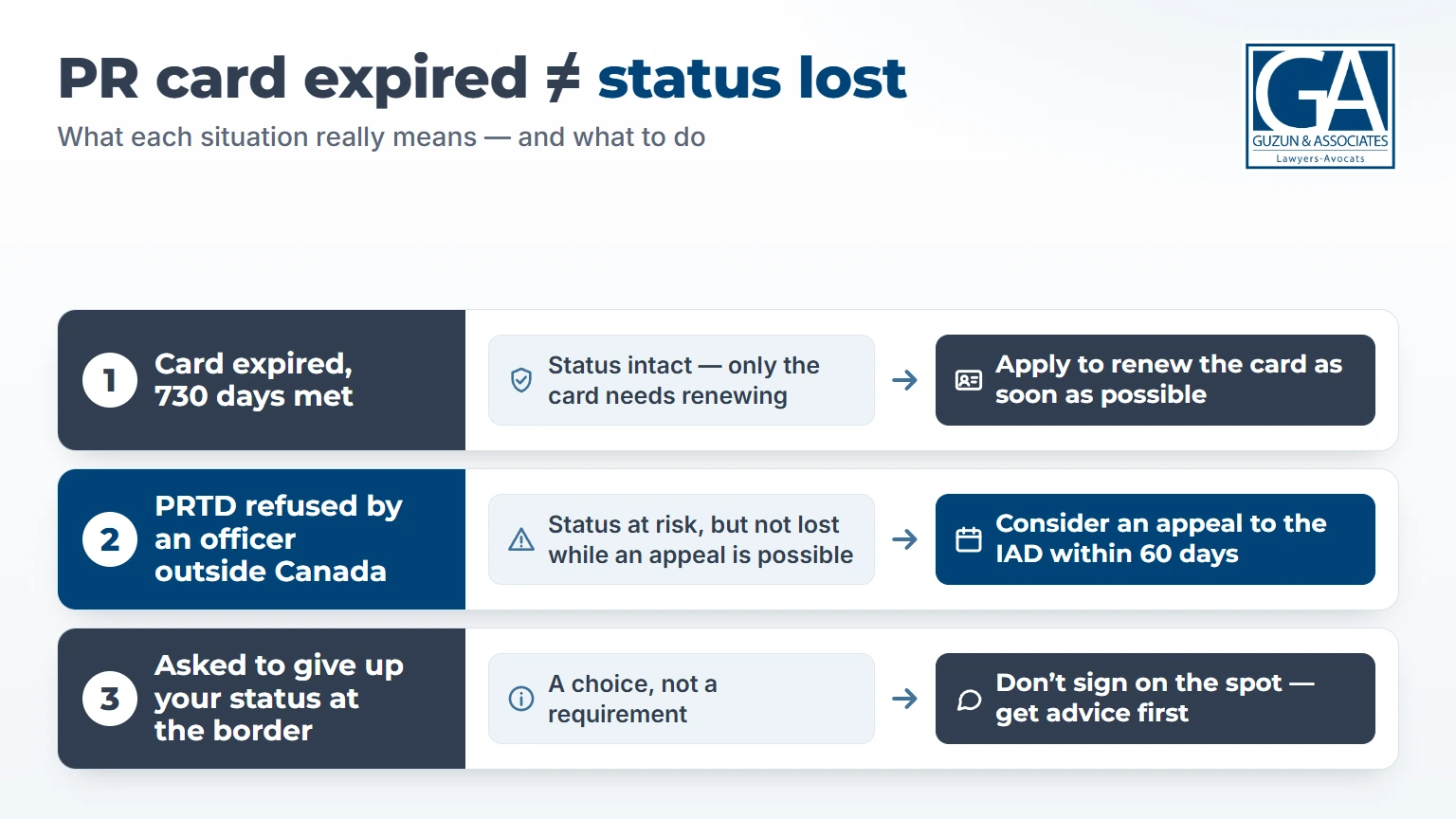
The card is a travel and identity document; your status is a separate legal standing. According to Immigration, Refugees and Citizenship Canada (IRCC), permanent resident status does not expire — even if you haven’t lived in Canada for years, you could still be a PR. Status ends only on the grounds set out in the Immigration and Refugee Protection Act (IRPA) — not automatically, and not by a border officer on the spot.
| Situation | What it actually means | What to do |
| Card expired, you’ve met the 730-day rule | Status intact, card just needs renewing | Apply for PR card renewal as soon as possible |
| Card expired, you’re unsure about the 730 days | Status may be at risk, not yet decided | Add up your days before applying; talk to a lawyer if it’s close |
| An officer outside Canada decided you breached the residency obligation (for example, a PRTD refusal) | Status at risk, but not lost while an appeal is still possible | Consider an appeal within 60 days — see the IAD section below |
| You’re asked to sign away your status at the border | A choice, not a requirement | Don’t sign anything on the spot; ask questions first |
The 730-Day Residency Obligation: What Actually Counts
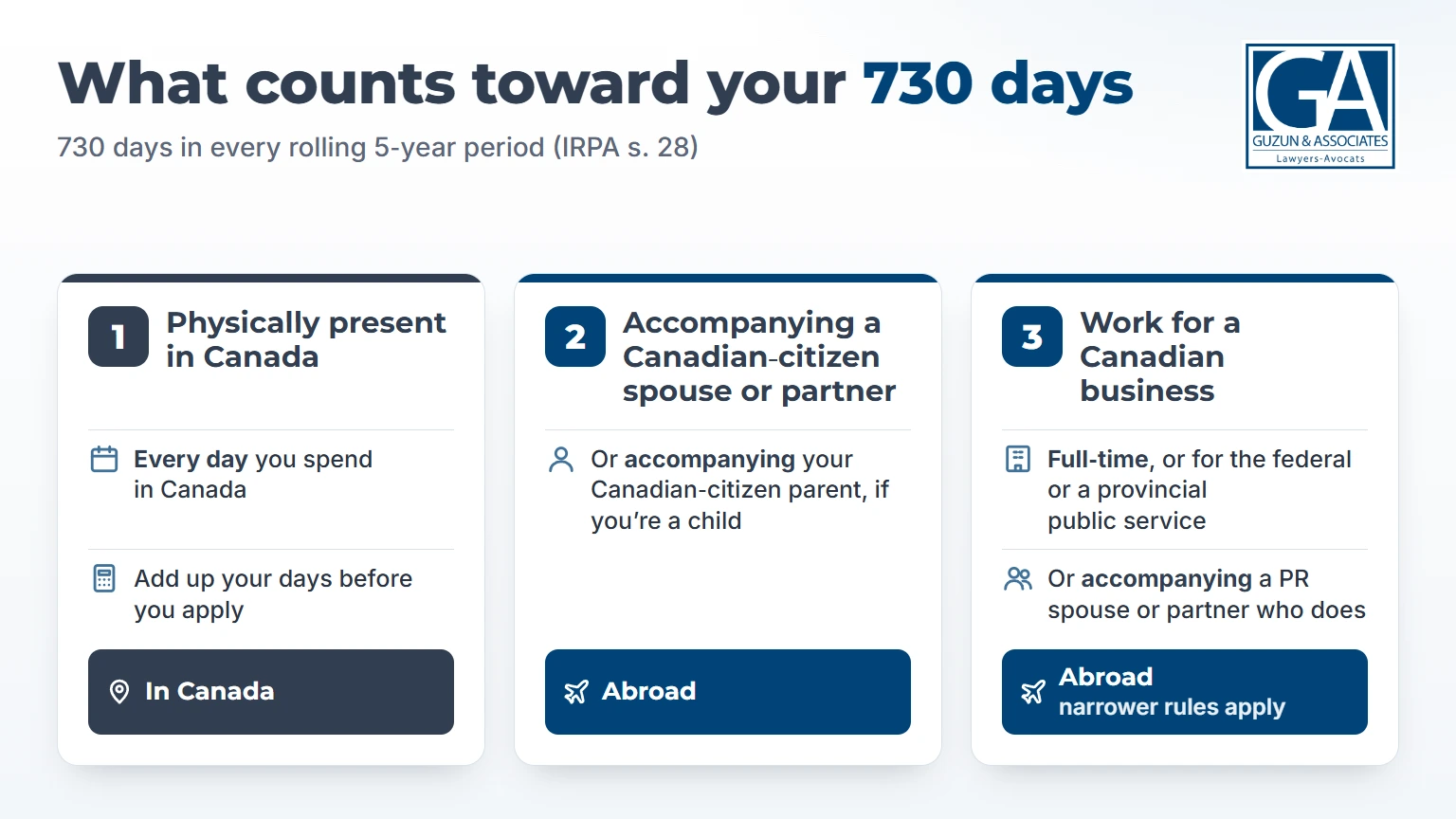
Section 28 of IRPA requires every permanent resident to meet a residency obligation of 730 days in each rolling five-year period. If you live in Quebec, this is still a federal matter: the obligation comes from IRPA, and PR cards are issued by IRCC, not by Quebec’s immigration ministry (MIFI). And a “day” covers more than physical presence in Canada.
Under section 28(2)(a) of IRPA, a day counts if you were, on that day:
- physically present in Canada;
- outside Canada accompanying a Canadian citizen spouse, common-law partner, or (if you’re a child) a parent;
- outside Canada working full-time for a Canadian business or in the federal public administration or a provincial public service (the regulations narrow what counts as a “Canadian business” here, so check before relying on it);
- outside Canada accompanying a permanent resident spouse, common-law partner, or (if you’re a child) a parent who is working full-time for a Canadian business or in the federal or a provincial public service; or
- covered by another method the regulations may allow.
There’s also a safety valve: an officer can decide that humanitarian and compassionate (H&C) considerations — including the best interests of a child directly affected — justify keeping your status despite a shortfall. This is discretionary and depends heavily on your facts.
How to Apply for PR Card Renewal: Documents, Fees, and the 9-Month Window
According to IRCC, you apply to renew your PR card if it will expire in less than nine months, or if it has already expired. If your card is still valid for more than nine months, IRCC generally asks you to wait, unless your legal name or gender marker has changed — applying too early can get your application returned.
The application itself is Form IMM 5444, which you fill out in IRCC’s Permanent Residence Portal, uploading the Document checklist (IMM 5644) alongside it. The government fee is $50: you pay it to IRCC online, separately from the portal, and then upload your receipt. For a renewal, the instruction guide (IMM 5445) asks for:
- a copy of your current PR card;
- a copy of a primary identity document, such as your passport;
- a photo taken within the last 12 months that meets IRCC’s photo specifications;
- your fee receipt;
- proof that you’ve met the residency obligation in the five years immediately before you apply.
That last item matters: a renewal is also a residency check. IRCC’s guide states that you must meet the residency obligation to get a PR card, and files where it isn’t met can be referred to a local IRCC office, which may interview you. If you’re short of 730 days, question 5.7 of the form is where you explain the humanitarian and compassionate reasons for keeping your status. Treat that answer seriously: it may become the core of your case.
If you have urgent travel coming up in the next three months, urgent processing may be available, though the minimum processing time even for urgent cases is three weeks, and qualifying doesn’t guarantee the card arrives in time. To request it, you’ll generally need one of these reasons:
- your own serious illness;
- the serious illness or death of a family member;
- work related to your current job or a job opportunity;
- a crisis, emergency, or vulnerable situation.
Include proof of travel and of payment for it, a letter explaining the urgency, and proof of the reason (such as a doctor’s note or an employer letter).
PR Card Renewal Processing Time in 2026
IRCC publishes a live number on its processing times tool, updated weekly. As of October 21, 2026, it showed 40 days for a PR card renewal and 30 days for a first-time card. Those figures cover processing only. The card then comes by mail — IRCC says it can take up to 6 weeks beyond the normal processing time to arrive — and IRCC sends PR cards only to Canadian addresses. These figures change often, so check the tool again close to when you apply.
Travelling Without a Valid PR Card
If you’re boarding a plane, train, bus, or boat to Canada, or transiting through a Canadian airport, you need a valid PR card (or a Permanent Resident Travel Document); airlines and carriers check for it before you board, not just at the border.
Driving across the land border in a private vehicle is treated differently: IRCC says you can use your PR card or other documents to return to Canada — a private vehicle includes a car, truck, motorcycle, or recreational vehicle you own, borrow, or rent. It’s still safer to travel with a valid card.
When You Need a PRTD Instead
If you’re already outside Canada without a valid PR card, renewing the card isn’t your way back — to return by plane, train, bus, or boat, you apply for a Permanent Resident Travel Document (PRTD) instead.
Here, too, your 730-day count is checked. If you’ve been a PR for five years or more, you need to show at least 730 days — physical presence or the other qualifying situations listed above — within the five years immediately before you apply. If you became a PR more recently, you instead need to show that you’ll be able to meet that 730-day threshold within five years of becoming a PR.

If Your PRTD Application Is Refused: Appeals and Humanitarian Grounds
A refusal comes with a letter explaining the reasons and your appeal rights — it isn’t the end of the road by itself.
Under section 63(4) of IRPA, a permanent resident can appeal a residency-obligation decision made outside Canada to the Immigration Appeal Division (IAD) — but the window is tight: under Rule 16(c) of the Immigration Appeal Division Rules, 2022, your notice of appeal must reach the IAD within 60 days of receiving the officer’s decision and written reasons; after that, a late appeal goes ahead only if the IAD agrees to extend the time limit (Rule 4(e)). A removal order made in Canada follows a different route with a shorter, 30-day deadline (Rule 16(b)), so check exactly which decision you received.
At the hearing, the IAD can allow the appeal on humanitarian and compassionate grounds under section 67(1)(c), weighing the best interests of any child directly affected and the overall circumstances — in practice, factors like how far short of 730 days you fell, why you left, your ties here, and hardship. If the IAD orders you to appear in person, section 175(2) of IRPA requires an officer to issue you a travel document for that purpose.
Separately, under section 31(3)(c), if you were physically present in Canada at least once in the 365 days before an officer examines your travel document application and your appeal is filed (or the 60 days haven’t run out), an officer must issue you a travel document to come back while the appeal is pending.
At a port of entry, permanent residents are sometimes asked to voluntarily give up their PR status — generally when the only issue is a residency-obligation shortfall. This is a choice, not a requirement — but if you sign and the application is approved, your status ends (section 46(1)(e) of IRPA). Without that, a border officer can’t take your status on the spot. Asked to sign? Pause and get advice first.
PR Residency vs. Citizenship: Don’t Confuse the Two Clocks
Citizenship uses a different count. Eligibility requires 1,095 days of physical presence over a five-year period, including at least 730 days as a permanent resident — a longer, stricter count than the 730-day PR residency obligation. If citizenship is the end goal, our guide to the PR-to-citizenship path walks through what else is involved.
Real Case Examples
Case 1: The caregiver abroad. A permanent resident spent nearly four of the last five years abroad caring for an aging parent. Her card expired, and her PRTD application showed she was well short of 730 days. With a lawyer, she documented her caregiving, her ties to Canada, and the hardship involved, and built an H&C argument on those facts. The lesson: gather proof of why you left early — ideally, submit it with the PRTD application itself, not after a refusal.
Case 2: The procrastinated renewal. A permanent resident kept postponing his renewal. Then a family emergency meant he had to fly abroad within six weeks, and his card had already expired. He requested urgent processing, pulled together proof of his travel dates and a letter explaining the emergency, and IRCC accepted the request. The lesson: urgent processing has real conditions, and gathering proof at the last minute is harder than renewing on time. Last-minute, incomplete paperwork is one of the common immigration mistakes that delay applications.
When to Talk to an Immigration Lawyer
Most straightforward renewals don’t need a lawyer. A few situations usually do, and this is where an immigration lawyer can help you weigh your options:
- You’re not sure you’ve met 730 days, or your time abroad involved several different jobs, employers, or countries.
- IRCC or a border officer has questioned your residency obligation, or you’ve received any written decision about your status.
- You’re asked to sign a voluntary renunciation of PR status at a port of entry.
- A PRTD application was refused and you’re weighing an appeal to the IAD — the 60-day window doesn’t leave much room to decide later.
- Your situation depends on an H&C argument, where how the facts are presented tends to matter a great deal.
Frequently Asked Questions
1. Does my PR card expiring mean I’ve lost my permanent resident status?
No. PR status doesn’t expire with the card; it ends only on specific grounds in section 46 of IRPA, such as a final determination that you breached the residency obligation.
2. How many days do I actually need for the 730-day rule?
730 days in a rolling five-year period. Besides physical presence, some time abroad can count — for example, accompanying a Canadian-citizen spouse or partner, or full-time work for a Canadian business or public service — subject to the regulations (see the full list above). An officer can also excuse a shortfall on humanitarian and compassionate grounds.
3. How long does PR card renewal take in 2026?
As of October 21, 2026, it was 40 days for a renewal, and the card can take up to 6 more weeks to arrive by mail — but that number updates weekly, so check IRCC’s live tool before you plan anything around it.
4. Can I still enter Canada by land if my PR card has expired?
Possibly, if you’re driving in a private vehicle — IRCC allows a PR card or other documents at a land border, unlike the rule for planes, trains, buses, and boats. A valid card is still the safer bet.
5. What happens if my PRTD application is refused?
You’ll get a letter with the reasons and your appeal rights. For a residency-obligation decision made outside Canada, the Immigration Appeal Division must generally receive your notice of appeal within 60 days.
This article is provided for general informational and educational purposes only and does not constitute legal advice. Reading this article does not create a lawyer-client relationship. Residency, PR card, PRTD, and appeal outcomes depend on how IRCC and the Immigration Appeal Division assess your individual circumstances, and rules and processing times change — nothing here guarantees a particular result. If you may be short of 730 days, have received a refusal, or are asked to sign anything at the border, speak with a qualified immigration lawyer before acting.
Short on Days in Canada? Let’s Look at Your Options Before You Travel
Whether your card already expired, you’re not sure your days add up, or you’re facing a PRTD refusal, a short conversation can help you understand what’s actually at stake and what to do next.
Book Your Free Orientation Call:
📞 Call us: +1 (514) 842-7414
📧 Email: office@avocatguzun.com
📍 Visit: 105-1 rue McGill, Suite 15B, Montreal, Quebec