

In this article
- Does the Parental Union Regime Apply to You?
- Your Home and Belongings: The Parental Union Patrimony
- Getting Out of the Patrimony Rules, and the Deadlines That Matter
- If You Separate: How the Patrimony Is Divided
- If Your Partner Dies: Inheritance Has Changed
- What the Regime Does Not Give You
- Practical Checklist: What to Do Now
- Real Case Examples
- Frequently Asked Questions
You live together in Quebec. You are not married. You have a child together. If you separated tomorrow, or if one of you died without a will, would you be protected?
Since June 30, 2025, the answer depends first on a date. That day, Quebec created a new legal status called parental union. It changed who inherits, what the family home is worth to each partner, and what happens when an unmarried couple with children splits up. Yet many parents still don’t know where they stand: some assume it covers every unmarried couple with kids, others assume it can’t apply to them because they never signed anything.
This article explains what the parental union regime actually does, who it covers, and which deadlines are easy to miss. The stakes are wide: according to the 2021 census, 42.7% of couples in Quebec live in a common-law union — the highest rate of any province, against 23% for Canada as a whole — and common-law couples are even more likely than married couples to have children living at home (49% versus 45%).
Does the Parental Union Regime Apply to You?
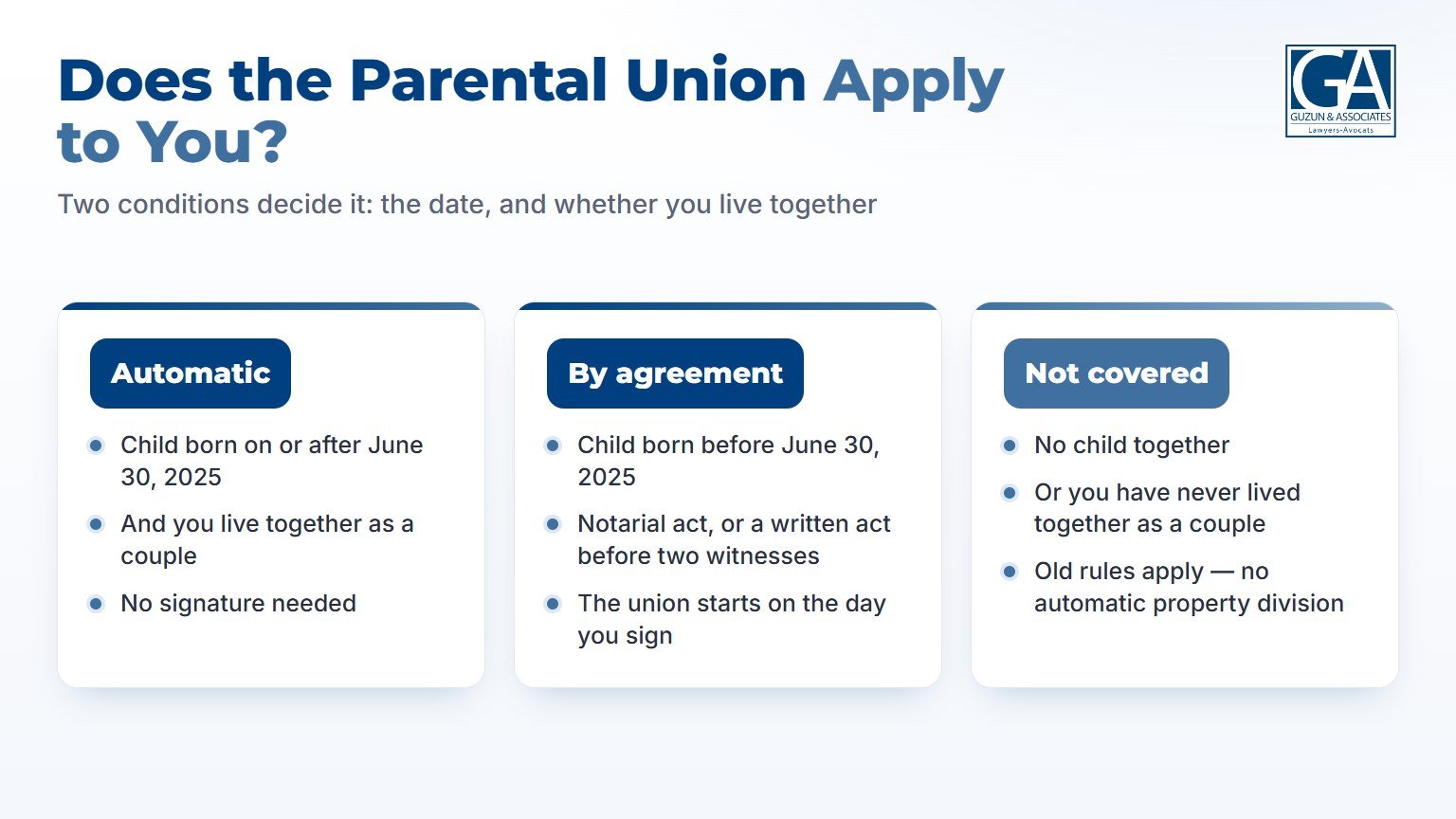
The regime comes from a 2024 law reforming Quebec family law (2024, chapter 22), in force since June 30, 2025. It applies automatically when two conditions line up:
- The date. Under the reform’s transitional rules, you became the father and mother, or the parents, of the same child on or after June 30, 2025.
- The relationship. You are de facto spouses (conjoints de fait): two people who live together and present themselves publicly as a couple. Parents of a shared child who live together are presumed to share a community of life, and there is no minimum period of living together.
If both are true, you are in a parental union whether you signed anything or not. If you and your child’s other parent do not live together as a couple when the child is born or adopted, the regime does not apply at that point — but for a child born or adopted on or after June 30, 2025, a parental union forms later if you move in together, or back in together, as a couple.
A union cannot form while one partner is still married, in a civil union or in another parental union, or between ascendants and descendants or siblings. Once formed, it ends with the death of one partner, the end of common life, or the partners marrying or entering a civil union with each other, or either of them doing so with someone else. Éducaloi’s plain-language summary of what it means to be in a parental union sets out the same conditions.
If your child was born before June 30, 2025, the automatic rules do not reach you, however long you have lived together. But couples who were already parents of a common child and live together as a couple can opt in voluntarily, by mutual agreement, through a notarial act (acte notarié en minute) or a written act signed before two witnesses — the second option requires no notary. The union is formed on the date the act is signed. The same act can also provide that the patrimony rules will not apply to the couple, or exclude specific property from the patrimony, although a later common child may trigger a 90-day notarial confirmation requirement for that withdrawal or exclusion to keep its effect.
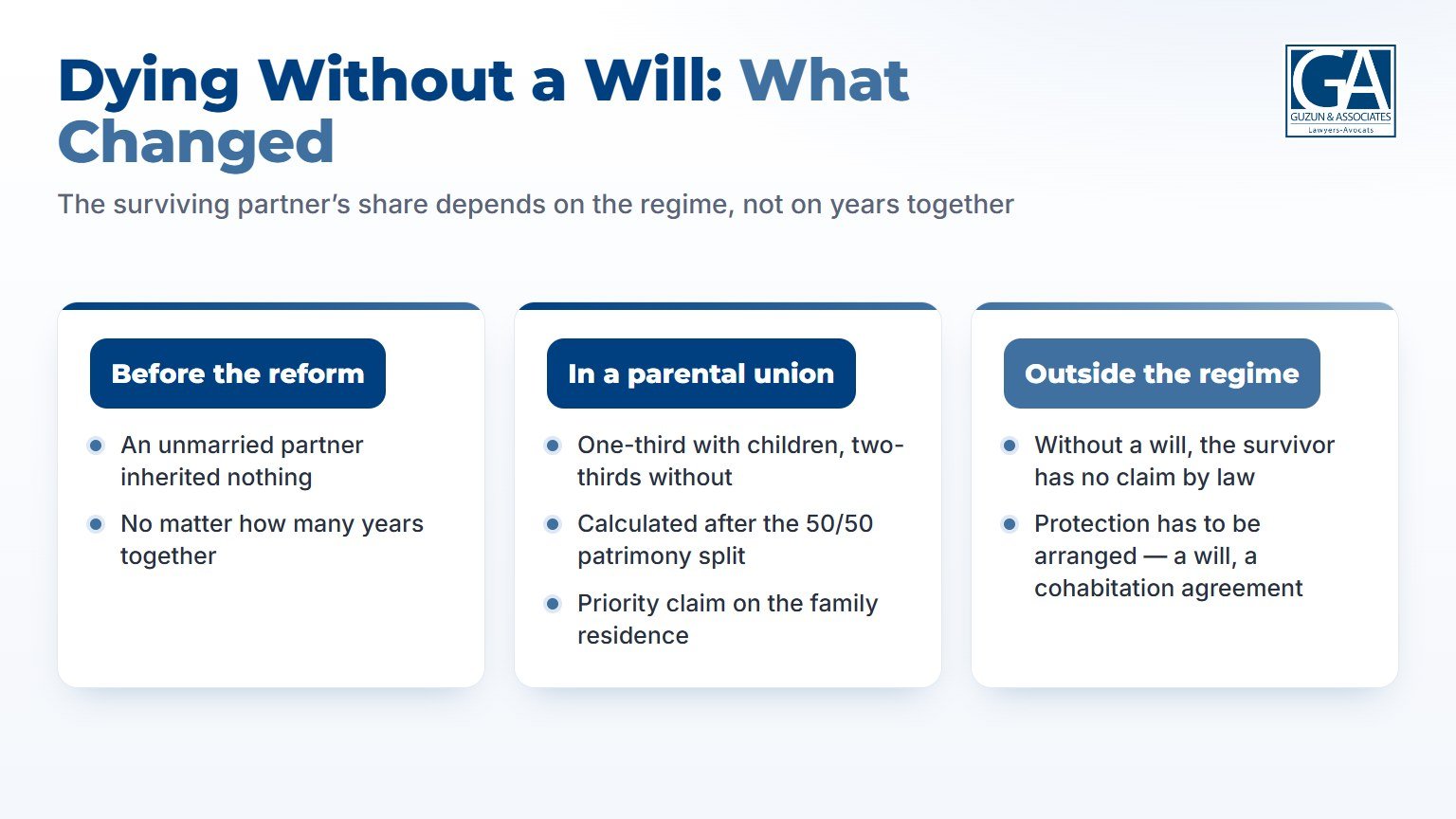
Couples outside the regime — no child together, an older child and no opt-in act, or no common life — remain under the older rules: each partner generally keeps what is in their name, there is no automatic division of property at separation, and a partner who dies without a will leaves nothing to the survivor by operation of law. For them, protection has to be built: a cohabitation agreement (convention de vie commune), a will or, for parents of an older child, the opt-in act.
Quick Test: Are You Automatically in a Parental Union?
You are generally automatically in a parental union if you are de facto spouses, live together as a couple, and became parents of a common child on or after June 30, 2025. If your common child was born or adopted before that date, you are not automatically covered, but you may be able to opt in by agreement.

Your Home and Belongings: The Parental Union Patrimony
The centrepiece of the regime is the parental union patrimony: a defined list of property that counts regardless of which partner owns it. Being inside the patrimony does not make you a co-owner — the partner whose name is on the deed still owns the house. What the regime creates is a right, in principle, to half the net value of that pool when the union ends, after certain deductions, settled in money or by a transfer of property. Éducaloi sets out the property that makes up the patrimony in the same terms.
| Included in the parental union patrimony | Excluded from the parental union patrimony |
| The family residence(s), or rights that confer their use | Property received by inheritance, before or during the union |
| Furniture that furnishes or decorates the family residence and serves the household | Property received as a gift, before or during the union |
| Motor vehicles used for the family’s transportation | — |
Retirement savings — RRSPs, pension plans, Quebec Pension Plan credits — are not on the list, unlike in the family patrimony of married and civil union spouses. That does not mean pensions can never be divided: Retraite Québec runs its own process for the partition of pension plans after a union breaks down, open to de facto partners with its own conditions. Property of a partner who is a minor enters the patrimony only once that partner reaches the age of majority.
The family home also gets real legal protection: the rules that protect a married couple’s family residence apply, with the necessary adaptations. The owner of a home with fewer than five dwellings cannot sell it, hypothecate it or lease the family’s part of it without the other partner’s written consent — but the other partner can have such an act annulled only if a declaration of family residence was registered against the property beforehand. A tenant partner cannot sublet, assign or end the lease without the other’s written consent once the landlord has been told the dwelling is the family residence.
If you are not the owner and the relationship ends, you are not at the other partner’s mercy. These protections continue for 120 days after you stop living together, and while proceedings about the end of the union are under way, a court can order one partner to leave the residence and allow one of them to keep, provisionally, the household furniture that was in common use.
Getting Out of the Patrimony Rules, and the Deadlines That Matter
Getting in is easy; getting out is not. Partners can withdraw from the patrimony rules only during the union, only by mutual agreement, and only by notarial act in minute, on pain of absolute nullity — one partner cannot do it alone. Once the union exists, the same form is required to exclude a specific piece of property; the only exception is the opt-in act described above.
A withdrawal takes effect on the day of the notarial act. After the first 90 days of the union, it does not erase the patrimony retroactively: the value built up until then is divided between the partners, as on separation. A withdrawal affects only the patrimony: the family home protections and the right to claim a compensatory allowance still apply.
The deadlines are the easiest part to get wrong. The 90-day windows concern couples who are still together; the 120-day periods run once the couple has stopped living together:
| Deadline | What it applies to |
| 90 days from the start of the union | Window to record a mutual withdrawal from the patrimony rules with retroactive effect — the patrimony is then deemed to have never existed |
| 90 days after the birth or adoption of a new common child | For couples who opted in by agreement: window to confirm, by notarial act in minute, a withdrawal or exclusion agreed before that child arrived, so that it keeps its effect |
| 120 days after the end of cohabitation | Family home protection measures continue to apply for this period |
| 120 days’ notice, after cohabitation ends | Required before one partner, acting alone, applies to cancel the registration of a declaration of family residence in the land register |
| 120 days after the union ends | Deadline to ask the court to award the lease or a right of use of the family residence, or the ownership or use of the household furniture — not the deadline for dividing the patrimony’s value |
If You Separate: How the Patrimony Is Divided
The patrimony is divided when the union ends (for example, by separation or death), when the partners withdraw from the patrimony rules after the first 90 days, or when a court allows the liquidation of an absent partner’s rights. The starting point is an equal split of its net value:
- What is divided. The net value of the patrimony: its market value on the date the right to division arises, minus the debts contracted to acquire, improve, maintain or preserve the property.
- What comes off first. The value of property a partner already owned when it entered the patrimony, with its proportional increase in value, and any contribution that came from property held before the union, from an inheritance or gift, or from income earned on them.
- How it is paid. In money or by a transfer of property. Where it is necessary to avoid prejudice, a court can spread the payment over up to ten years.
- Property sold or wasted. If patrimony property was sold or wasted in the year before the right to division arose and was not replaced, a court can order a compensating payment. The same applies to an earlier disposal made to reduce the other partner’s share.
- When 50/50 can change. A court can depart from equal shares where they would be unjust, for example because the union was brief, property was wasted, or one partner acted in bad faith.
Since June 30, 2025, applications relating to a parental union — including partition of the parental union patrimony, other patrimonial rights arising from the couple’s life together, and protection of the family residence — are heard by the Unified Family Tribunal of the Court of Québec under article 37.2 of the Code of Civil Procedure.
A partner who wants to give up the division must do so by notarial act or judicial declaration and register it in the Register of Personal and Movable Real Rights (RDPRM); without that registration within a year of the union’s end, they are deemed to have accepted the division.
Parenting arrangements — including custody or parenting time, access rights and child support — are not changed by the regime: for unmarried parents, those rules still come from the Civil Code of Québec. (married parents who divorce fall under the federal Divorce Act). What changed is the court: under a separate 2025 reform, parents in a parental union bring those applications to the same Unified Family Tribunal, while unmarried parents outside a parental union still go to the Superior Court. Our guide to common-law separation in Quebec covers the parenting rules in detail; for property, rely on this article — inside a parental union, the value of the home, furniture and family vehicles is shared regardless of title.

If Your Partner Dies: Inheritance Has Changed
Before the reform, an unmarried partner who died without a will left nothing to the surviving partner, however long they had lived together. For couples in a parental union, that has changed in two steps.
First, the union ends and the patrimony is divided: the survivor’s share of its net value is settled before anything forms part of the estate. Second, the Civil Code now gives a succession without a will to the surviving spouse — a category that expressly includes a partner linked to the deceased by parental union — along with the deceased’s relatives:
- If there are children, the surviving partner inherits one third, and the children two thirds.
- If there are no children but the deceased’s parents are alive, the partner inherits two thirds, and the parents one third.
- If there are no children and no surviving parents but there are siblings, the partner inherits two thirds, and the siblings one third.
A will can leave the estate to someone else, but it does not erase the survivor’s share of the parental union patrimony. The surviving partner also has priority to claim the family residence as part of their share, without giving up other rights arising from the union. All of this applies only if the couple was in a parental union at the time of death: with an older child and no opt-in act, if the deceased left no will, the surviving partner still inherits nothing automatically.
What the Regime Does Not Give You
The regime creates no support obligation, similar to spousal support, between former parental union partners. That is a real difference from marriage and civil union, where a spouse can claim support from the other.
What exists instead is a prestation compensatoire (compensatory allowance). A partner can claim it by showing they were impoverished by a contribution, in property or services, that enriched the other partner’s patrimony. It can be proven by any means and paid as a lump sum or in instalments; the court takes into account the advantages already received through the patrimony and, after a death, through the succession. Its value is based on the lesser of the impoverishment and the enrichment, and the court can also award it as rights in specific property, including the family home. It pays back a contribution — it does not replace an income.
Practical Checklist: What to Do Now
- Check the date and your living arrangement. Was your child born or adopted on or after June 30, 2025, and do you live together as a couple? Both must be true for the regime to apply automatically.
- If your child is older, decide whether to opt in — by a written act before two witnesses or by a notarial act.
- Keep proof of what you owned before the union, and of inheritances and gifts. Dated records support the deductions and exclusions you may be entitled to.
- Put the deadlines in your calendar. The table above lists them: the 120-day periods start as soon as you stop living together, and couples who opted in for an older child have 90 days after a new birth or adoption to confirm any earlier withdrawal or exclusion by notarial act.
- Ask about pensions separately. Retirement savings are outside the patrimony, but Retraite Québec has its own process for partitioning pension plans, including the Quebec Pension Plan, with its own conditions.
- Make or update your will. Without one, the law decides who inherits — and outside a parental union, your partner receives nothing. A will cannot, however, take away a surviving partner’s share of the parental union patrimony.
Illustrative Case Examples
The following examples are illustrative composites based on common situations in Quebec family law. They do not describe real clients or actual cases and should not be read as predicting the result of any specific file.
A couple who thought they were already covered. A Montreal couple had their first child in 2022 and assumed the 2025 law simply applied to them. Because their child was born before June 30, 2025, it did not. They signed a written act before two witnesses to opt in. A cottage one partner had inherited from a parent stayed outside the patrimony, since inherited property is excluded from it.
A separation where the clock nearly ran out. A couple had a daughter in late 2025, which placed them inside the regime automatically. When they separated, both accepted that the condo and the family car formed part of the patrimony, but a disagreement over who would keep the furniture dragged on for months. They settled it with only days left in the 120-day window for asking the court to award the household furniture — a reminder that the deadline runs no matter how amicable a separation feels.
A death without a will. A father died suddenly, without a will. He and his partner had a child born in 2026, which placed them inside the regime. His surviving partner inherited one third of the estate and the child two thirds — under the rules before the reform, the surviving partner would have received nothing.
Frequently Asked Questions
1. My child was born before June 30, 2025 — am I automatically covered?
No. The automatic rules only reach couples who became parents of a common child on or after that date and who live together as a couple. For an earlier child, if you live together as a couple, you can opt in by mutual agreement through a written act before two witnesses or a notarial act. Voluntary opt-in also requires both partners to be of full age and to give free and informed consent.
2. We have a child together but have never lived together — does the regime apply?
Not while you live apart. A parental union forms between de facto spouses, meaning two people who live together and present themselves publicly as a couple. Sharing a child does not, on its own, create the union. But if your child was born or adopted on or after June 30, 2025 and you later move in together as a couple — or get back together after a separation — the union forms at that point. There is no minimum period of living together.
3. We’re separating and the house is in my partner’s name. Can I be told to leave right away?
Not automatically. In a parental union, the family home keeps its legal protection for 120 days after you stop living together (for example, the owner generally cannot sell or hypothecate it without your written consent), and while proceedings are under way a court can decide which partner stays in the residence, regardless of whose name is on the title. An application to be awarded the lease or use of the residence, or the household furniture, must be brought within 120 days of the union ending; that deadline does not govern the division of the patrimony’s value.
4. Does the parental union change child support or custody?
No. The regime did not change the rules on custody or child support; for unmarried parents they still come from the Civil Code of Québec. What the regime changes is the property side and inheritance. A separate 2025 reform changed the court: for parents in a parental union, custody and child support applications now go to the Unified Family Tribunal of the Court of Québec.
5. If my partner dies without a will, will I inherit anything?
If you were in a parental union at the time of death, yes — the law now gives a surviving partner an inheritance share, alongside any children, parents or siblings of the deceased. If your relationship falls outside the regime, for instance an older child with no opt-in act, you would not inherit automatically.
This article is provided for general informational and educational purposes only and does not constitute legal advice. Reading this article does not create a lawyer-client relationship between you and Guzun & Associates. Quebec family law, including the rules governing the parental union regime, the parental union patrimony, and succession rights, is highly fact-specific — how it applies to your situation depends on the exact date your child was born or adopted, whether any act has been signed, and the property involved. For advice about your particular circumstances, speak with a licensed Quebec lawyer or notary.
Know Exactly Where You and Your Family Stand
Whether your child was born before or after June 30, 2025 can change what protections you already have — and what steps may still be worth taking. A brief information call with a family lawyer in Montreal can help you understand where your family stands before you decide what, if anything, to sign.
Book Your Free Preliminary Information Call:
📞 Call us: +1 (514) 842-7414
📧 Email: office@avocatguzun.com
📍 Address: 105-1 rue McGill, Suite 15B, Montreal, Quebec