
In this article
- What Is Arrima, and How Is a Declaration Different From an Application?
- The Four PSTQ Streams: Which One Actually Fits You?
- French Requirements: Levels, Tests, and No Exception for Native Speakers
- What Else Is Required From Everyone: Financial Contract and Values Attestation
- The Route and the Deadlines: 1 Year, 30 Days, 60 Days
- After Your CSQ: What the Federal Stage Means
- Invitation Rounds: How Often, and How Many
- What It Costs
- Where Invitations Get Lost
- Real Case Examples
- A Practical Checklist Before You Submit Your Declaration
- Frequently Asked Questions
If you’ve already logged into Arrima and created a déclaration d’intérêt (expression of interest), you may be staring at a dashboard that tells you very little about what comes after. That’s normal. The portal is built for data entry, not guidance — and most of the explanations online stop at “submit your profile,” which is just the first of several steps.
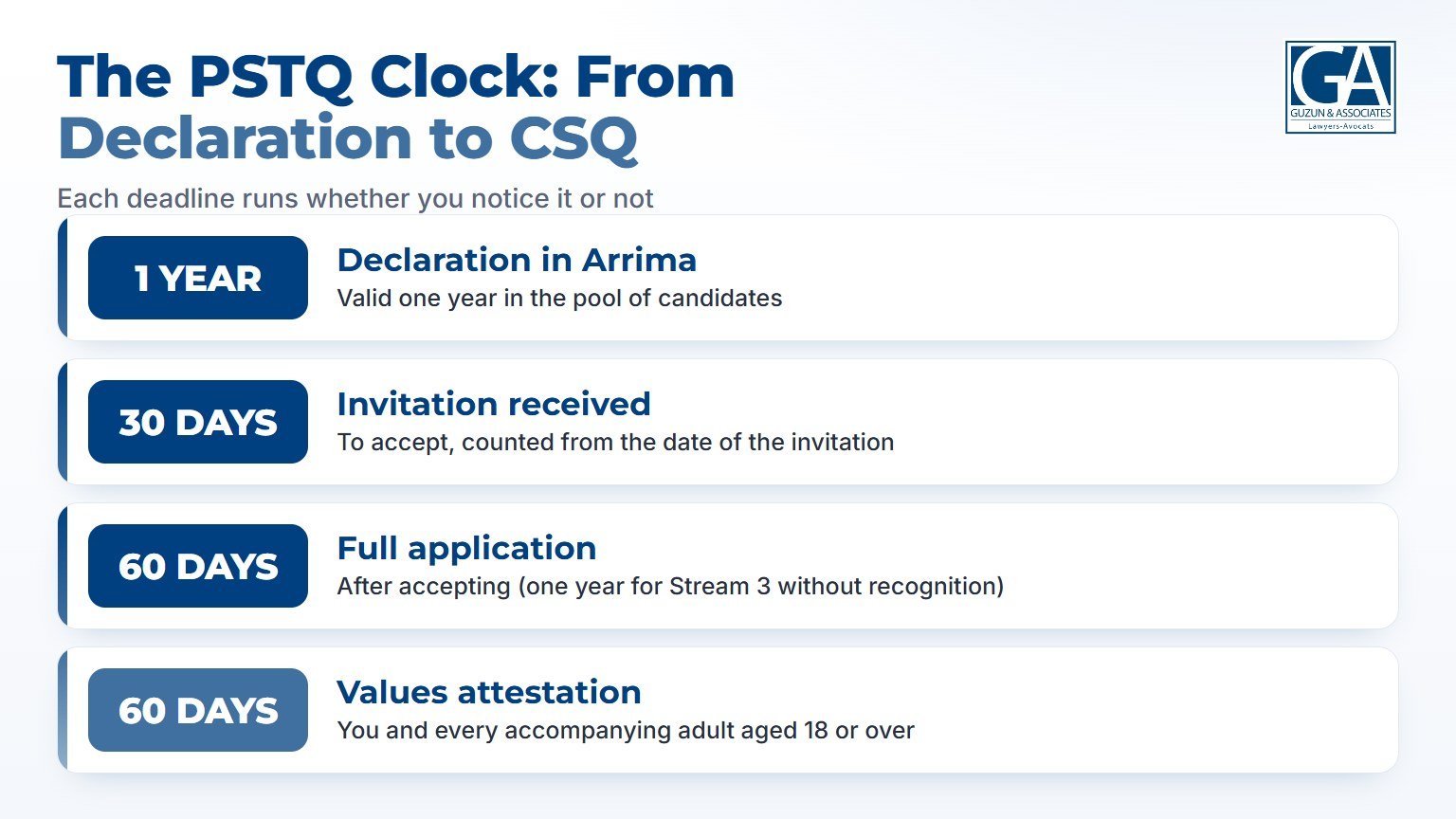
Here’s the short version. The route from an Arrima account to permanent residence generally runs through four stages: your declaration stays active in the pool for up to one year, an invitation (if it comes) gives you 30 days to accept, accepting starts a 60-day clock to submit your full application, and during the review you and every accompanying family member aged 18 or over have 60 days to obtain the required values attestation before Quebec can issue a Certificat de sélection du Québec (CSQ). After that, a separate federal application to Immigration, Refugees and Citizenship Canada (IRCC) follows.
None of these deadlines are optional, and missing one can end your file: an unanswered invitation voids your declaration, and an uncorrected document rejection leads to the application itself being rejected.
If you’re a temporary worker, a recent graduate, or a PGWP holder already living in Quebec, this article walks through what Arrima and the Programme de sélection des travailleurs qualifiés (PSTQ) actually require of you, in the order you’ll encounter it.
What Is Arrima, and How Is a Declaration Different From an Application?
Arrima is the online portal run by Quebec’s Ministère de l’Immigration, de la Francisation et de l’Intégration (MIFI), used to submit a déclaration d’intérêt under the PSTQ. The PSTQ itself took effect on November 29, 2024, replacing the former PRTQ; candidates who had been invited, or had already applied, under the old program before that date continue under the previous rules.
A declaration in Arrima is not an application, and it does not give you the right to live, work, or study in Quebec. It’s an expression of interest that places your profile in a database of candidates, valid for one year, which you can update as your circumstances change — a new job, a completed diploma, an improved French test score. Updating your declaration can improve your profile if your score changes, but it does not restart or extend the one-year validity period.
Being in the pool doesn’t guarantee anything. Quebec periodically draws candidates from Arrima and invites some of them to apply for permanent selection; only after that invitation does a real application process begin. Understanding this distinction matters, because the clock that actually decides your outcome doesn’t start until an invitation lands in your account.
The Four PSTQ Streams: Which One Actually Fits You?
PSTQ candidates apply under one of four streams, and the eligibility criteria differ enough that reading the wrong one wastes time. The streams are built around FEER categories (formation, études, expérience et responsabilités) — the French name for the TEER categories of Canada’s National Occupational Classification, which group jobs by the training, education, experience and responsibilities they normally require, from 0 (management) to 5 (work needing no specific schooling). Quebec uses these federal categories to define who fits which stream.
| Stream | Who It’s For | Key Conditions |
| Stream 1 – Highly Qualified and Specialized Skills | FEER 0, 1, 2 occupations | At least 1 year of full-time experience within the last 5 years (in Quebec or elsewhere); a diploma from a program lasting at least one year; a Quebec diploma needs at least 900 hours (secondary/college) or 30 credits (university); French: oral level 7+, written level 5+ |
| Stream 2 – Intermediate and Manual Skills | FEER 3, 4, 5 occupations | At least 2 years of experience within the last 5 years, including at least 1 year in Quebec; Quebec diploma — at least 600 hours (secondary) or 900 hours (college), or 30 credits (university); French: oral level 5+ |
| Stream 3 – Regulated Professions | Regulated occupations | A permit to practise in Quebec, or recognition of the equivalence of your diploma (issued within the last 5 years); the list of eligible professions is updated every January 31; French: level set by the occupation’s FEER category (see below) |
| Stream 4 – Exceptional Talent | Exceptional profiles | At least 3 years practising your main occupation within the last 5 years, plus an achievement on the Ministry’s list of accomplishments or an opinion from one of its partners (strategic economic sectors, research, arts, sports); no French level required |
Worth noting: of the four, Stream 2 is the one that explicitly requires a year of experience earned in Quebec, not just anywhere. If you’re a temporary worker who has already been employed here for a while, this stream is often the one built with your situation in mind — while Stream 1 stays open to experience gained abroad, and Stream 3 depends entirely on whether your profession is regulated.
French Requirements: Levels, Tests, and No Exception for Native Speakers
Quebec measures French proficiency using the Échelle québécoise des niveaux de compétence en français (Quebec Scale of French Proficiency Levels) — not the Canadian Language Benchmarks (CLB) used federally. If you’ve researched language requirements for other Canadian immigration programs, set that scale aside; it doesn’t apply here.
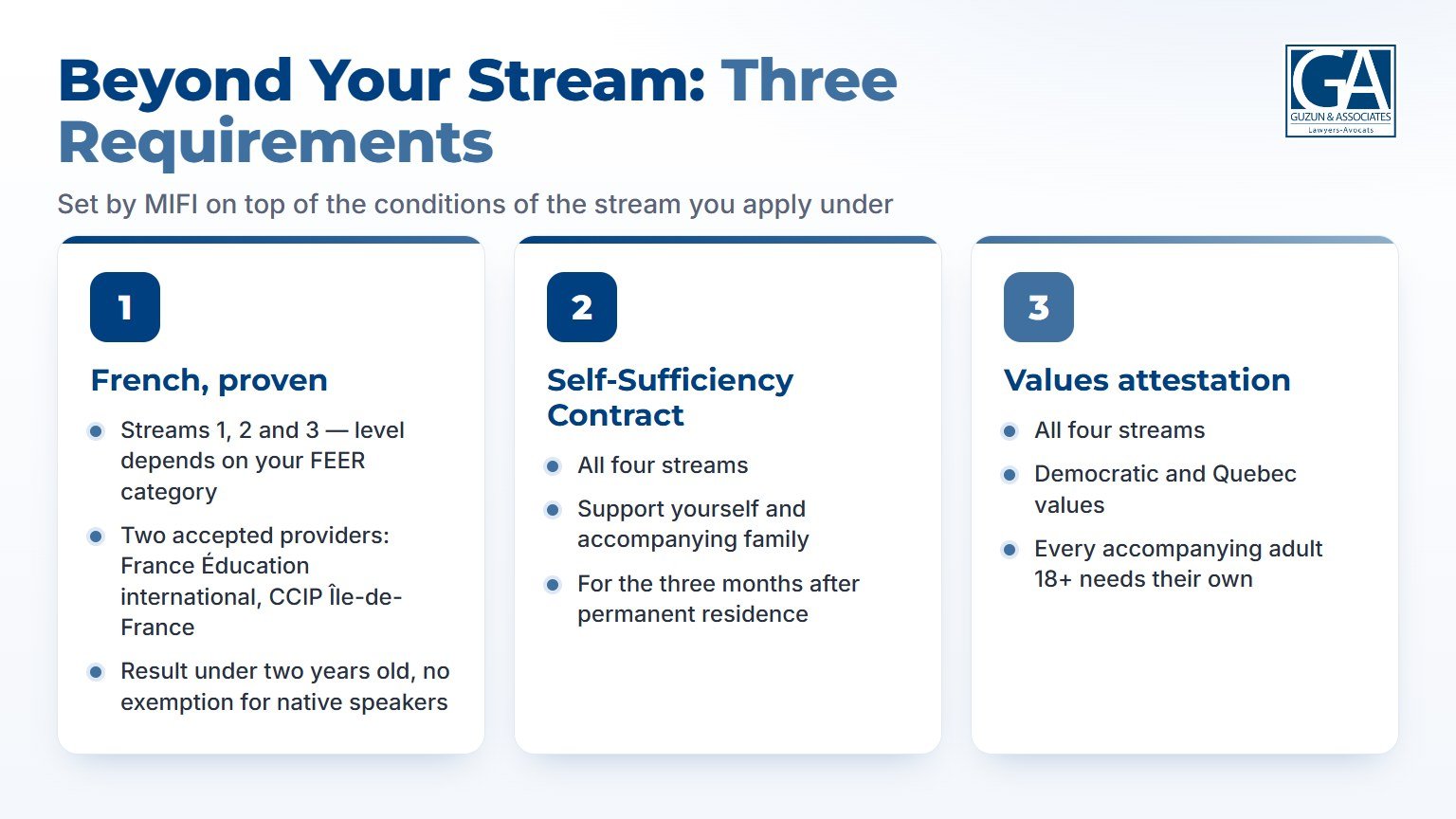
The required levels depend on your stream. Stream 1 asks for an oral level of 7 or higher and a written level of 5 or higher. Stream 2 asks for an oral level of 5 or higher. In Stream 3, the level follows the FEER category of your occupation rather than the stream itself: FEER 0, 1 or 2 means oral 7 and written 5, while FEER 3, 4 or 5 means oral 5. In these three streams, an accompanying spouse generally needs to demonstrate an oral level of 4 or higher. Stream 4 (Exceptional Talent) is the exception: its requirements set no French level.
Only two test providers are accepted: France Éducation international (TCF-Québec, TCF Canada, TCF, DELF, DALF) and the CCIP Île-de-France (TEFAQ, TEF Canada, TEF). The test has to be taken at a centre accredited by the provider itself, and the result cannot be older than two years on the date you submit your demande de sélection permanente — the permanent selection application, which you file only after an invitation.
Here’s the detail that trips people up: in Streams 1 to 3, you need to prove your French level even if French is your first language. There’s no exemption for native speakers. The only substitutes accepted are specific diplomas — a French baccalauréat, a Belgian CESS, or a Swiss maturité from a French-speaking canton — or, for Stream 3 only, documentation from a professional order.
The PSTQ has no English requirement; you can still declare your knowledge of English if you wish (with IELTS results), but it’s entirely optional. MIFI may also call you in for an interview to verify the French level you’ve declared, so the documentation on file should genuinely match your spoken ability.

What Else Is Required From Everyone: Financial Contract and Values Attestation
MIFI sets a short list of requirements common to all four streams. Your file has to still meet the criteria that led to the invitation, and two further requirements shape almost every application. First, you’ll need to sign a Financial Self-Sufficiency Contract, demonstrating that you can support yourself — and any accompanying family members — for the three months after you become a permanent resident. (A further condition applies only if a Quebec scholarship obliges you to return to your home country.) This isn’t a bank statement requirement in the abstract; it’s a formal commitment tied to your file.
Second, you and every accompanying family member aged 18 or older must obtain the Attestation d’apprentissage des valeurs démocratiques et des valeurs québécoises (attestation confirming knowledge of democratic and Quebec values). This is easy to overlook if you’re focused on your own paperwork and forget that an adult child or a spouse also needs their own attestation before the file can move forward. (People who hold a valid study or work permit and have already attended an Objectif Intégration session are exempt, as are those exempted by regulation.)
The Route and the Deadlines: 1 Year, 30 Days, 60 Days
Here is the full sequence, step by step — the part that rarely gets explained as one connected chain.
Step 1 — Declaration in Arrima. Once you create your déclaration d’intérêt, you have 90 days to complete and submit it — a declaration that isn’t submitted is deleted and never enters the pool. Once submitted, it stays valid for one year (12 months). You can update it during that time as your file improves, but updating doesn’t extend that one-year validity.
Step 2 — Invitation. If you’re selected, Quebec sends an invitation à présenter une demande. You then have 30 days from the date of the invitation — not from the day you open it — to accept or decline. The invitation is posted in the message centre inside your Arrima account, and MIFI also emails the address on file to say a message is waiting; an out-of-date email address quietly costs you days you can’t get back. If you don’t respond within those 30 days, your expression of interest becomes null and void and is removed from the database of expressions of interest.
Step 3 — Full application. Once you accept, you generally have 60 days to submit your complete demande de sélection permanente. The exception is Stream 3 candidates who don’t yet hold the required recognition of their qualifications — either a permit to practise in Quebec or a recognised diploma equivalency — for whom the window extends to one year. This extended deadline applies only to obtaining the required professional recognition, not to other missing documents. Separately, if part of your submission is rejected on formal grounds — a file that isn’t a PDF, an illegible scan, or a missing translation — you get 60 days to correct and resubmit it; once that window closes, the application is rejected.
Step 4 — Examination. During review, you and any accompanying family members aged 18+ have 60 days to obtain the values attestation, and MIFI may schedule an interview as part of this stage.
Step 5 — CSQ. If everything is in order, Quebec issues your Certificat de sélection du Québec, and the process moves to the federal stage with IRCC.
More detail on submission timing is on the official applying page.

After Your CSQ: What the Federal Stage Means
A CSQ is not permanent residence. It’s Quebec’s confirmation that you’ve been selected — the next step is a separate application to IRCC, since immigration to Canada is jointly administered by the province and the federal government. Work permit options also exist for CSQ holders while that application is under way, each with its own conditions.
One point reassures most applicants: according to IRCC, a CSQ generally remains valid for the purposes of your federal application even if its formal validity period has lapsed, as long as IRCC has not yet issued a decision on your file. In practice, a Quebec selection is not normally lost simply because the federal stage is still under way — though it’s worth confirming the status of your own file, since circumstances differ.
Full detail on the federal stage is on Canada’s official guide for Quebec-selected skilled workers.
Invitation Rounds: How Often, and How Many
Quebec has generally held invitation rounds approximately once a month, although there is no fixed schedule and the timing, number of invitations, and selection criteria may change from one round to another. As of mid-September 2026, rounds had landed on January 29, February 26, March 19–20, April 30, June 4, July 3, July 30, and August 27.
Invitations are issued stream by stream, so the number that matters is the one for your stream, not the round total. In Stream 1, the draws held between January and June 2026 ranged from roughly 890 to 1,100 invitations, while the rounds of July 3, July 30 and August 27 issued 74, 105 and 87. Declarations in the pool are ranked using the PSTQ scoring system, set by a ministerial order published in July 2025; people with a high score who meet a round’s criteria may be invited. Each round is published together with the criteria the invited profiles had to meet, so the pages for past rounds are the most reliable guide to what it currently takes to be invited.
Quebec’s 2026 Immigration Plan aims to admit 45,000 permanent immigrants, and the government has said openly that its 2026–2029 planning seeks to limit overall immigration volumes. That’s one reason the pool can feel more competitive than it did before.
If you already met the PEQ conditions on November 19, 2025 — through a qualifying Quebec diploma, or at least two years of Quebec work experience in a FEER 0, 1, 2 or 3 occupation — the temporarily reopened PEQ may also be relevant: applications are accepted in Arrima until October 31, 2026. We cover its conditions in our guide to the 2026 PEQ reopening.
Can You Improve Your Chances of Receiving an Arrima Invitation?
Although no one can guarantee an invitation, improving your French results, updating newly acquired Quebec work experience, completing additional education, or correcting outdated information in your declaration may improve your ranking if those factors affect your score under the PSTQ selection system.
What It Costs
Fees apply at both the provincial and federal stages, and they’re generally non-refundable regardless of the outcome. The amounts below are those in effect in September 2026 — MIFI and IRCC adjust their fee schedules periodically, so confirm the current figures on the official MIFI pages and the IRCC fee list before you pay.
| Stage | Principal applicant | Spouse | Each child |
| MIFI — demande de sélection permanente | $940 | $201 | $201 |
| IRCC — with Right of Permanent Residence Fee | $1,590 | $1,590 | $270 |
| IRCC — without Right of Permanent Residence Fee | $990 | $990 | $270 |
Because these fees are paid at different stages and don’t come back if a file is refused or a deadline is missed, budgeting for the full sequence — not just the first payment — is worth doing early. Biometrics add a separate $85 per person, capped at a maximum of $170 per family.
Where Invitations Get Lost
There’s no official list of PSTQ mistakes, and there doesn’t need to be: the deadlines above already show where files fall apart, and the pattern matches the common immigration application mistakes seen across other file types.
The most common loss point is silence: an invitation lands in the Arrima message centre, the 30-day window opens, and nobody sees it. Next comes documentation rejected on form rather than substance — a scan that isn’t a proper PDF, a missing certified translation — which allows a 60-day fix, but only if you notice the rejection quickly.
Then there’s assuming French isn’t required because it’s a first language, and reaching the documentation stage without a valid test result. And finally, forgetting that the values attestation applies to every accompanying adult: a spouse or adult child who hasn’t started it can hold up an otherwise complete file.
If a file goes wrong at the federal stage rather than the provincial one, the options differ — it’s worth speaking with an immigration lawyer in Montreal about what applies to your situation.
Illustrative Case Examples
The following examples are illustrative composites based on situations commonly seen in PSTQ files. They do not describe actual clients and are not a guarantee of any particular outcome.
Case 1 — A PGWP holder who almost lost her invitation. A recent graduate working in Montreal declared under Stream 1 and was invited months later. She had listed her work email in her Arrima profile, changed jobs, and never updated it, and the notice sat unread for nearly three weeks. With a lawyer’s help she confirmed the remaining window and submitted her acceptance before the 30-day deadline closed — with days to spare rather than weeks.
Case 2 — A temporary worker whose family held up the file. A skilled tradesperson qualified under Stream 2 on two years of Quebec experience and was invited without difficulty. The delay came later: his 19-year-old stepdaughter, included as an accompanying family member, hadn’t started her own values attestation, and the family assumed one attestation covered the household. Once flagged, it was completed within the review window and the file proceeded to CSQ.
A Practical Checklist Before You Submit Your Declaration
- If you’ve started a declaration, submit it within 90 days of creating it — unsubmitted declarations are deleted.
- Confirm which of the four PSTQ streams matches your occupation, diploma, and where your work experience was earned.
- Book a French test with an accredited France Éducation international or CCIP centre well before you need the result — even if French is your native language (Streams 1–3).
- Keep your contact details in Arrima current, and check two things regularly: the message centre, where an invitation appears, and the expiry date of your declaration.
- Set a personal reminder for the 30-day acceptance window the moment any invitation might realistically arrive.
- Start gathering diploma equivalency, employment letters, and identity documents before an invitation lands, not after.
- Confirm every accompanying family member aged 18+ understands they need their own values attestation.
- Budget for MIFI and IRCC fees separately, including biometrics, rather than assuming one payment covers the process.
Frequently Asked Questions
1. I created my Arrima login but haven’t heard anything — is that normal?
Yes, generally — but first check that you actually submitted your declaration: once you create one, you have 90 days to complete and submit it, or it is deleted. Once submitted, it stays in the database for up to one year, and Quebec draws from it periodically rather than on a fixed schedule. Not hearing anything for months doesn’t mean your profile is incomplete — it may simply reflect how rounds are structured for your stream. If the year runs out without an invitation, the declaration expires and you can submit a new one.
2. Does submitting a declaration in Arrima mean I’ve applied for permanent residence?
No. A declaration is an expression of interest, not an application. It places your profile in a pool of candidates; only after receiving and accepting an invitation do you submit a full demande de sélection permanente, which is the actual application stage.
3. My CSQ’s validity period is about to expire and my federal application is still pending — should I worry?
Generally not. According to IRCC, a CSQ generally remains acceptable for the purposes of a pending federal permanent residence application even if the validity period printed on the CSQ has expired, provided IRCC has not yet made a final decision on the application. It’s still worth confirming your specific file status with a professional, since outcomes can depend on the details of your case.
4. I’m a native French speaker — do I still need to take a French test?
Yes, if you’re applying under Streams 1, 2 or 3. There’s no exemption based on being a native speaker; MIFI requires documented proof of your French level through an accepted test or, in limited cases, a qualifying diploma. Interviews to verify the declared level are also possible. Stream 4 (Exceptional Talent) sets no French level.
5. What happens if I miss the 30-day deadline to accept my invitation?
Your declaration generally becomes invalid and is removed from the Arrima bank of declarations. The official pages set out no procedure for reopening a declaration after a missed response window — which is why keeping your contact details current and checking your Arrima message centre regularly matters as much as meeting the eligibility criteria in the first place. You can generally submit a new declaration afterwards, but you rejoin the pool from the beginning.
6. Which PSTQ stream applies if I’ve been working in Quebec for over a year already?
It depends on your occupation and diploma, but Stream 2 was designed with candidates who already have Quebec work experience in mind, since it specifically requires at least one year of experience earned in the province. Stream 1 may also apply depending on the skill level of your occupation — a professional assessment can clarify which fits your specific file.
This article is provided by Guzun & Associates for general informational and educational purposes only and does not constitute legal advice, and reading it does not create a lawyer-client relationship between you and the firm. Quebec’s skilled worker selection rules, invitation targets, and processing practices are set by MIFI and IRCC and may change without notice; outcomes in the PSTQ and CSQ process depend on individual circumstances, and nothing here should be treated as a guarantee of eligibility, invitation, or selection. For guidance on your specific situation, consult a licensed immigration professional.
Not Sure Where Your File Stands? Let’s Map Out What Comes Next.
Book Your Free Orientation Call:
Whether you’re waiting on an Arrima invitation, unsure which PSTQ stream fits your situation, or trying to keep track of a deadline that’s already ticking, a short orientation call can help you understand exactly where your file stands and what to do next.
📞 Call us: +1 (514) 842-7414
📧 Email: office@avocatguzun.com
📍 Visit: 105-1 rue McGill, Suite 15B, Montreal, Quebec