

In this article
- How Quebec’s Free Mediation Hours Work
- Who Can Be Your Mediator
- What Family Mediation Can (and Can’t) Resolve
- Confidentiality and the Right to Walk Away
- The Role of Your Lawyer During Mediation
- The Mandatory Parenting Information Session
- When Mediation Isn’t the Right Fit
- From Agreement to Homologation: What Happens Next
- Already Have a Judgment? SARPA and the SAH
- Real Case Examples
- Frequently Asked Questions
If you’re separating or divorcing in Quebec, family mediation can help you settle custody, parenting time, child support, and property division without a trial. Couples with common dependent children generally qualify for five free hours with an accredited family mediator (médiateur familial accrédité) the first time they mediate; couples without common dependent children get up to three. Beyond that, a mediator who participates in the government program charges the regulated rate of $130 an hour, plus taxes.
Mediation isn’t the right fit for every situation, and knowing when to work with a family mediator in Montreal versus heading straight to court can save months of conflict.

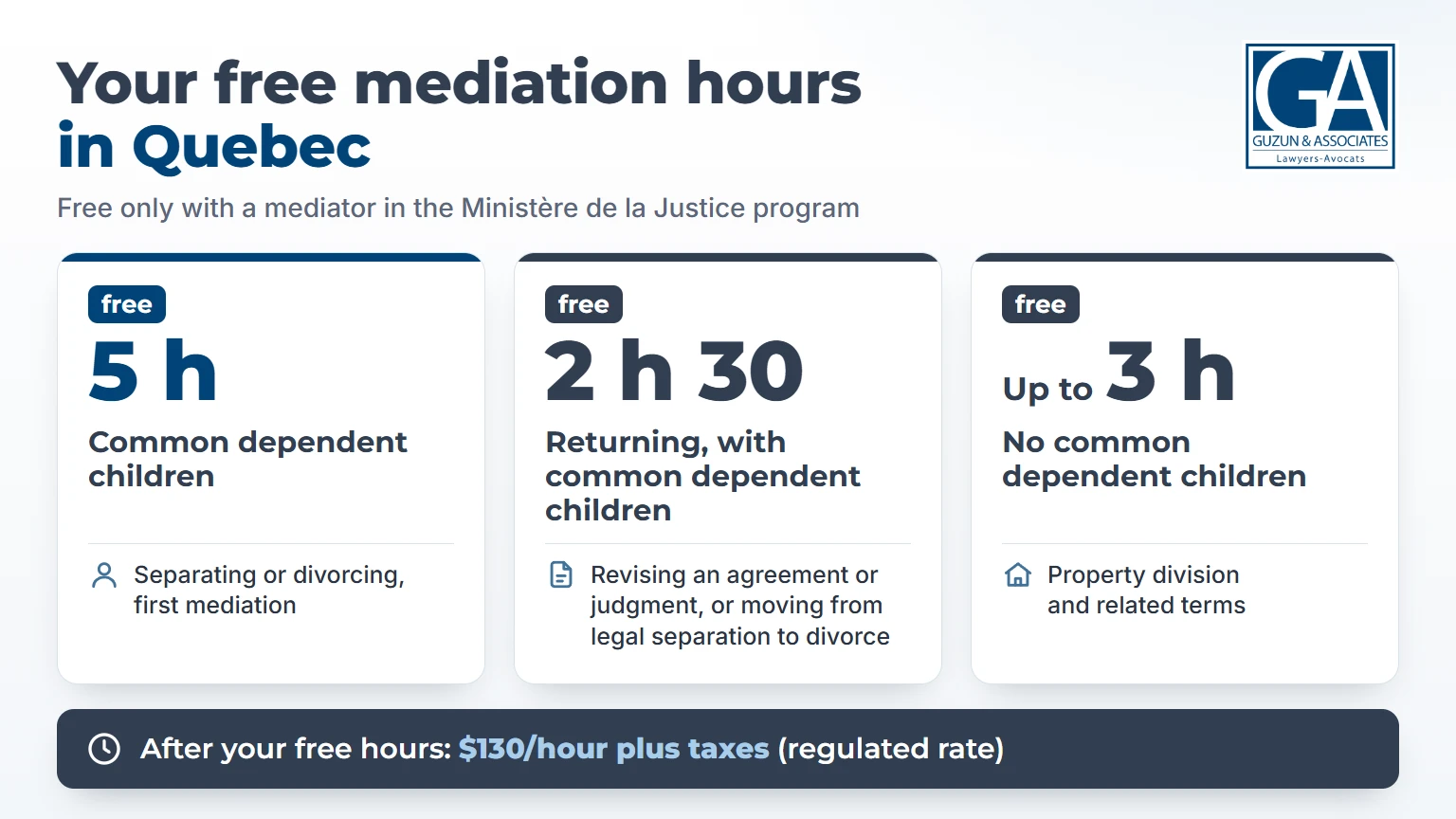
Here’s how the free hours break down depending on your situation:
| Your situation | Free hours | What’s covered |
| Separating or divorcing with common dependent children, mediating for the first time | 5 hours | Custody, parenting time, child support, division of property |
| Common dependent children: revising an existing agreement or judgment, returning after already using the program, or moving from legal separation to divorce | 2 hours 30 minutes | Revised or new terms (can be granted again when circumstances change) |
| No common dependent children | Up to 3 hours | Property division and related terms |
| Beyond your free hours | $130/hour plus taxes | Continued mediation at the regulated rate |
How Quebec’s Free Mediation Hours Work
The Ministère de la Justice pays an accredited family mediator directly for these free hours, so you don’t submit receipts or wait for reimbursement.
There’s one condition that catches people out: the free hours only apply if your accredited mediator participates in the Ministère’s family mediation program. Not every accredited mediator does, so ask before your first session — if yours doesn’t, every hour is at your expense, at the rate the mediator sets. The Institut de médiation familiale du Québec’s online search tool lets you filter for mediators who accept public funding.
Once the free hours run out with a participating mediator, mediation continues at the regulated rate of $130 an hour, plus taxes. The five hours are for a first agreement. If you’ve already used the program, later need to revise an agreement or judgment, or want to move from a legal separation to a divorce, parents with common dependent children are generally entitled to another 2 hours 30 minutes — and, according to Éducaloi, this can be granted again when your or your ex’s situation changes.
Who Can Be Your Mediator
An accredited family mediator isn’t necessarily a lawyer. In Quebec, mediators are accredited through one of six professional orders: the Barreau du Québec, the Chambre des notaires du Québec, and the professional orders for psychologists, social workers and marriage/family therapists, psychoeducators, and guidance counsellors. To be accredited, a professional must, among other requirements, complete a 60-hour basic training course in family mediation within the five years before applying and have at least three years of experience in their own field.
That range matters. A family therapist may be a better fit for an emotionally difficult separation involving young children, while a notary or lawyer-mediator may suit a dispute that’s mostly about dividing property. The government maintains a directory of accredited family mediators if you don’t already have one in mind.
What Family Mediation Can (and Can’t) Resolve
Mediation is built to work through the practical terms of a separation: custody and access to the children (called decision-making responsibility and parenting time under the federal Divorce Act for married couples), child support, spousal support for married or civil-union spouses, and how to divide property between you.
What mediation can’t do on its own is give your arrangement the force of a judgment: the mediator produces a résumé des ententes, not a court order (see homologation below). It’s also generally not suited to situations involving violence or a serious power imbalance, covered further down.
Confidentiality and the Right to Walk Away
Mediation is confidential: as a general rule, nothing revealed in a session can be used as evidence if your case later goes to court. Participation is voluntary on both sides: neither of you can be forced to keep going against your will, and either of you can suspend the process at any point, including to get advice from a lawyer or anyone else you choose.
The notable exception concerns starting mediation: since June 30, 2025, couples in a union parentale or union civile generally have to try mediation before their case can go to trial (see below).
A mediator can also end the process. If one participant is working to sabotage the sessions, or is in serious psychological distress, the mediator may decide to stop or postpone rather than continue something that isn’t functioning.
The Role of Your Lawyer During Mediation
Choosing mediation doesn’t mean going without legal advice. Throughout the process, you can consult a lawyer or notary for independent legal advice on your own situation — to understand what you’re agreeing to before you sign, or to check that a proposed arrangement reflects your rights. These consultations take place outside the sessions — lawyers don’t attend mediation itself — so plan a separate meeting whenever you want a second opinion on a draft term.
A common approach is to bring a specific question to a lawyer partway through mediation — how a proposed parenting schedule might affect child support, for instance.
The Mandatory Parenting Information Session
If you and your ex share children and you still disagree on any aspect of your separation by the time a judge is set to hear your case, Quebec generally requires you to attend a parenting after separation information session (séance d’information sur la parentalité après la rupture) before trial. The session is offered remotely by the Ministère de la Justice and covers the consequences of the breakup (about 90 minutes) and the family mediation process and legal information (about 30 minutes), followed by a period for questions. The session is free.
You’re not required to attend if you’re experiencing family or domestic violence — but you’ll generally need a supporting attestation from a victim-services organization recognized by the Minister of Justice to claim that exemption.
For couples in a union parentale (the regime that generally applies to unmarried couples living together whose child was born or adopted on or after June 30, 2025) or a union civile, the rules go further. In certain cases, their case generally can’t proceed to trial at the Tribunal unifié de la famille until they have started the family mediation process. Exceptions apply, notably where there is family, conjugal or sexual violence — again, supported by an attestation from a recognized victim-services organization.

When Mediation Isn’t the Right Fit
Mediation assumes both people can negotiate on reasonably equal footing, and that assumption doesn’t always hold. In situations involving domestic violence, mediation is generally considered unlikely to be appropriate, though it may still proceed if certain conditions are met.
The same caution applies more broadly to any serious power imbalance — one partner controlling finances, information, or decisions in a way that leaves the other unable to negotiate freely. If that describes your situation, it’s worth talking to a family lawyer before agreeing to sit down with your ex, mediator or not. An adapted process, or going straight to court, may serve you better than mediation.
From Agreement to Homologation: What Happens Next
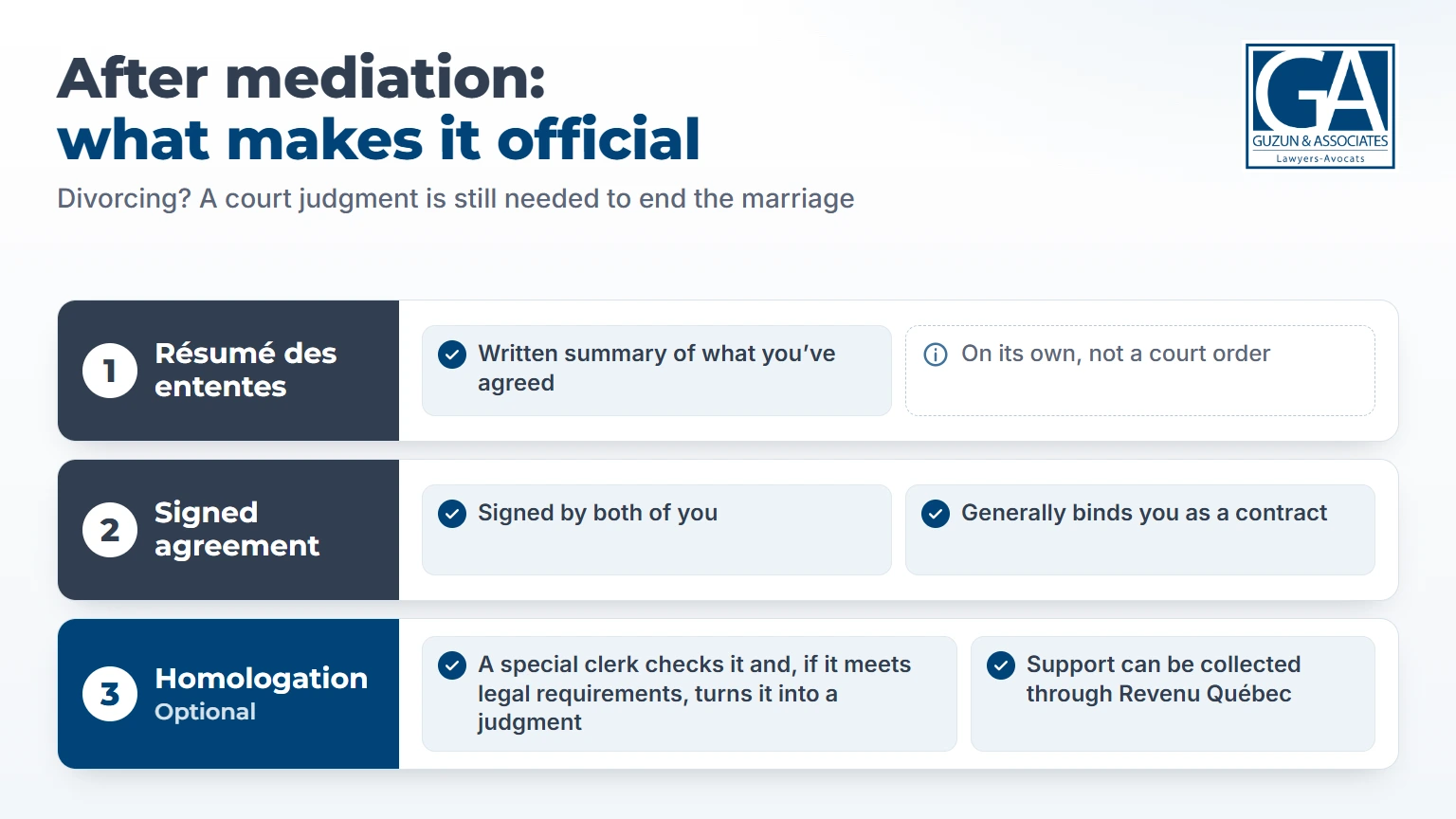
A successful mediation ends with a written summary of what you’ve agreed, called the résumé des ententes. On its own, that document isn’t a court order. If you’re married and divorcing, a court judgment is still needed to end the marriage itself. In other cases, if you want your agreement to have the force of a judgment, you can choose to have the court review and approve it, a process known as homologation: a special clerk checks the agreement and, where it meets the legal requirements, turns it into a judgment.
Which court handles that homologation depends on your situation. A union parentale is the regime that generally applies to unmarried couples living together whose child was born or adopted on or after June 30, 2025.
Since a reform that took effect the same day, custody and child support disputes connected to a union parentale or a union civile are generally directed to the Tribunal unifié de la famille at the Cour du Québec. Other cases — including divorces and unmarried couples outside a union parentale — generally remain with the Cour supérieure. Files opened before the reform generally stay with the court that first received them. A family lawyer can confirm which court applies before you file.
Already Have a Judgment? SARPA and the SAH
Mediation isn’t your only option for updating an existing judgment. If the only outstanding issue is adjusting the amount of child support already set by a judgment — with no other disputes — the Service administratif de rajustement des pensions alimentaires pour enfants (SARPA) may be a faster, cheaper option: it charges $57.25, shared equally between both parents, and a parent who qualifies for free legal aid generally pays nothing.
SARPA is only available when all eleven of its eligibility conditions are met — among them, the parents’ combined disposable income doesn’t exceed $200,000 and no court case about the same support payment is underway. Check the full list with a lawyer before assuming it applies to your file.
If a judgment already covers custody, parenting time, child support or spousal support and you both agree on how to change it, the Service d’aide à l’homologation (SAH), offered through Aide juridique Québec, can make those changes official for $651 total — $325.50 each, nothing for people eligible for free legal aid. A lawyer of your choice drafts the joint application. The SAH doesn’t handle a first agreement or the division of property.
Real Case Examples
Mathieu and Élise had an 8-year-old son and had never married. Because they agreed on almost everything except the parenting schedule, they used mediation to work through custody and time with their child, paying nothing for the first five hours. Once they’d put their terms, including child support, into a separation agreement, they had it homologated, which means Revenu Québec collects the support payments unless they ask to be exempted. Because their son was born long before June 30, 2025 and they had never opted into a union parentale, that regime didn’t apply to them, so their application went to the Cour supérieure rather than the Tribunal unifié de la famille.
Sophie and David, who had never married, had no children together and separated after six years of living together. With up to three free hours available, they used mediation mainly to agree on how to divide a jointly owned condo and some investments. Each consulted a different lawyer for independent advice before signing. Because no children or support payments were involved, they signed the final agreement as a private contract and decided homologation wasn’t necessary.
Frequently Asked Questions
1. Is family mediation really free in Quebec?
Partly, and only if your accredited mediator participates in the government program. The government pays for a set number of hours — generally five for couples with common dependent children reaching a first agreement, 2 hours 30 minutes when those parents return to revise an agreement or judgment, and up to three for couples without common dependent children. Extra hours cost the regulated $130 an hour, plus taxes.
2. Who qualifies as an accredited family mediator?
Not only lawyers and notaries: members of four other professional orders — psychologists, social workers and marriage and family therapists, psychoeducators, and guidance counsellors — can also be accredited once they meet the training and experience requirements.
3. Can I still talk to a lawyer while I’m in mediation?
Yes. You can pause mediation at any point to get independent legal advice, and many people check in with a lawyer between sessions before signing anything.
4. What happens if my ex refuses to go to mediation?
Generally, no one can force your ex into mediation. But if you have common children and still disagree on key issues when your case is set to be heard, you’ll generally both need to attend the parenting information session before trial. And if you’re in a union parentale or union civile, your case generally can’t go to trial at the Tribunal unifié de la famille until mediation has been tried, unless an exception applies — for example, family violence.
5. Does a mediated agreement need to go to court to become official?
Not always. Once you both sign it, the agreement based on your résumé des ententes generally binds you as a contract — but a divorce itself still requires a court judgment. Many couples choose homologation by a special clerk so the terms carry the same legal weight as a judgment; without it, Revenu Québec won’t automatically collect support payments.
This article is provided for general informational and educational purposes only and does not constitute legal advice, and reading it does not create a lawyer-client relationship. Quebec family law is highly fact-specific — family mediation, the mandatory information session, and the court process that follows (including the distinct rules that can apply when a union parentale or union civile is involved) vary with each couple’s situation. Speak with a family lawyer about your specific circumstances before relying on anything above.
Thinking About Mediation for Your Family?
Book Your Free Orientation Call:
Not sure whether mediation, SARPA, or going straight to court fits your situation? A short, no-obligation orientation call can help you understand your options and your next step.
📞 Call us: +1 (514) 842-7414
📧 Email: office@avocatguzun.com
📍 Visit: 105-1 rue McGill, Suite 15B, Montreal, Quebec