If you filed an asylum claim in Canada — or you’re about to — a new federal law may change how that claim is decided. Bill C-12 added two eligibility “bars” that can keep a claim from ever reaching the Immigration and Refugee Board (IRB) for a hearing.
This matters most for two groups: people who entered Canada some time ago and are only now filing, and people who entered Canada between official ports of entry along the Canada–US land border. If either applies to you, an officer may decide that your claim is not eligible to be referred to the IRB at all.
If you’ve already received a letter from IRCC raising this issue, you are not alone, and the letter does not mean your case is over. It usually means IRCC has reached a preliminary conclusion and is giving you a chance to respond before a final decision.
This article walks through what Bill C-12 does, who the one-year and 14-day bars affect, what happens if your claim is found ineligible, and what steps generally come next — including for the Quebec-specific parts of the process.
What Is Bill C-12?
Bill C-12, the Strengthening Canada’s Immigration System and Borders Act, is a federal law that received royal assent on March 26, 2026. It moved through Parliament over several months: first reading in the House of Commons on October 8, 2025, third reading in the House on December 11, 2025, third reading in the Senate on March 12, 2026, and finally royal assent.
If you’ve seen references online to “Bill C-2” and are confused about how it relates to C-12, here’s the short version. The asylum and border measures now in force under C-12 were originally introduced together, on June 3, 2025, as part of a larger bill called C-2, the Strong Borders Act. That bill was later split in two: the immigration and border provisions became Bill C-12, while a separate set of provisions on law enforcement access to data became Bill C-22, which has not been passed as of August 2026. When you’re researching this topic, treat mentions of “C-2” asylum rules as referring to what is now C-12.
You can read the official announcement of when Bill C-12 became law on the Government of Canada’s website.
The One-Year Bar
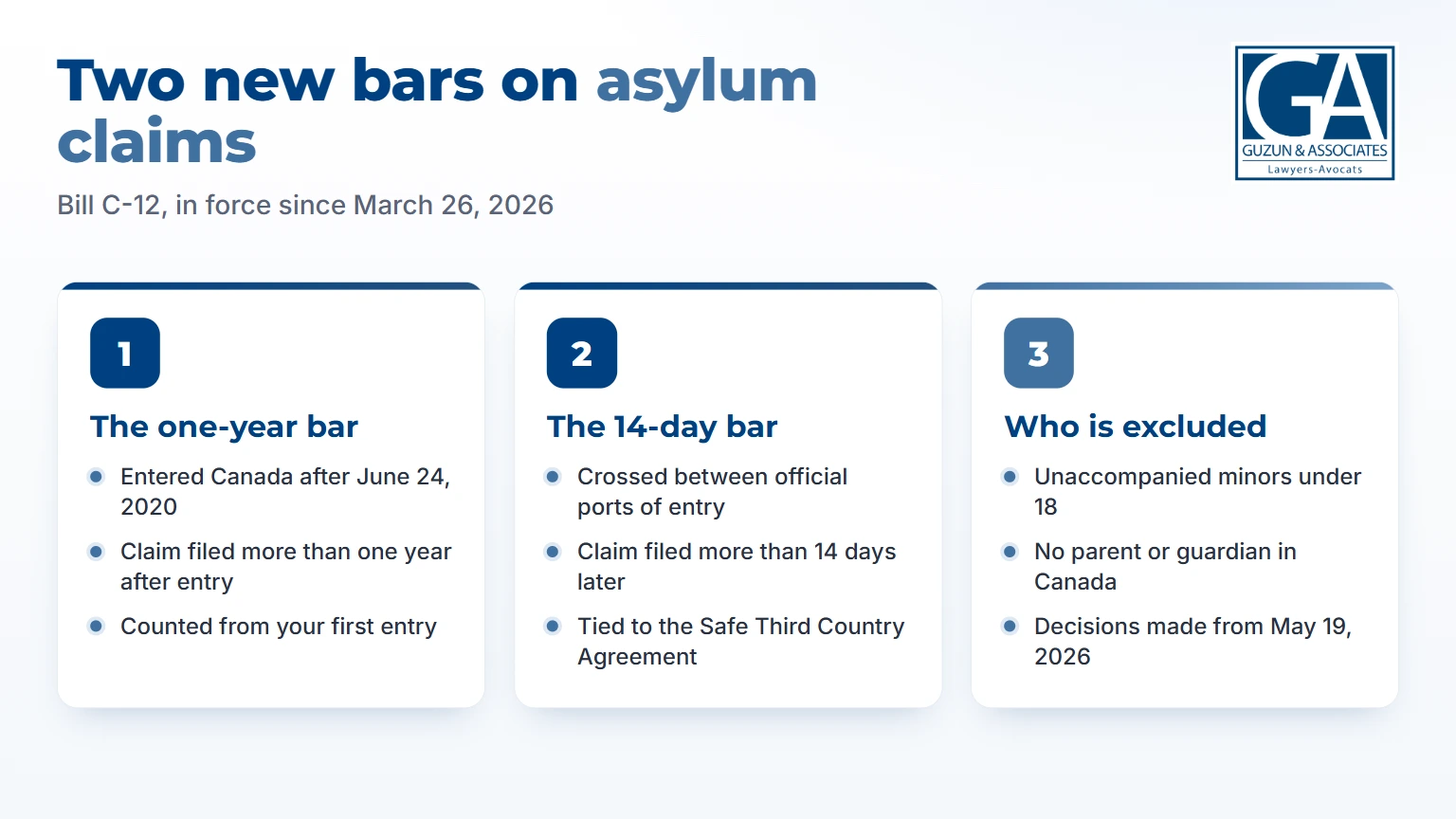
Under the amended section 101 of the Immigration and Refugee Protection Act, a claim is generally not referred to the Refugee Protection Division (RPD) of the IRB if the person entered Canada after June 24, 2020, and filed their asylum claim more than one year after the date they entered.
If someone entered and left Canada multiple times after June 24, 2020, the one-year clock is counted from the date of their first entry after that date — later departures and returns do not reset it.
One detail catches people off guard: this rule is retroactive. It applies to claims filed starting June 3, 2025 — the date the original Bill C-2 was introduced. That includes claims already filed before Bill C-12 became law, and even claims already referred to the RPD. This retroactive scope was built in as an anti-circumvention measure, so filing before royal assent does not automatically protect a claim from the bar.
The 14-Day Bar
A second, separate bar applies to people who entered Canada between official ports of entry along the border with the United States — commonly called irregular entry — and who filed their asylum claim more than 14 days after crossing. Claims caught by this bar are generally not referred to the IRB.
This rule interacts with the Safe Third Country Agreement (STCA) between Canada and the United States, which has long treated the first 14 days after an irregular crossing differently from the period that follows. Because the two sets of rules overlap, filing within 14 days does not by itself make a claim eligible for referral — other eligibility rules still apply. If you crossed between ports of entry, have your exact dates reviewed before you assume where you stand.
Exception for Unaccompanied Minors
Not everyone falls under these bars. Unaccompanied minors — people under 18 who do not have a parent or legal guardian in Canada — are excluded from both the one-year bar and the 14-day bar.
This exception comes from a temporary public policy issued by IRCC. It has been in effect since May 19, 2026, and applies to cases where the eligibility decision is made on or after that date.
What Happens Next: IRB Hearing vs. PRRA
Whether a claim is found eligible or ineligible changes the entire process that follows. The table below outlines the key differences.
| What changes | If Your Claim Is Found Eligible | If Your Claim Is Found Ineligible |
| Where it’s decided | Refugee Protection Division (RPD) of the Immigration and Refugee Board | Pre-Removal Risk Assessment (PRRA) conducted by an IRCC officer |
| Type of process | Oral hearing — you testify and can respond to questions | Written, paper-based assessment; generally no oral hearing |
| Who decides | An independent IRB member | An IRCC officer |
| Procedural protections | Fuller, hearing-based safeguards | Generally fewer procedural protections than an IRB hearing |
| If the decision is negative | Depends on the specific decision — worth reviewing with a lawyer | Judicial review at the Federal Court, with a leave application generally due within 15 days for matters arising in Canada |
The PRRA itself isn’t new — it’s an existing mechanism meant to prevent Canada from returning someone to a country where they would face serious risk. What’s new is that more claimants can now be routed to it instead of an IRB hearing.
If a PRRA application is made within the required regulatory timelines, removal is generally stayed until IRCC makes a decision on the risk assessment. Missing a PRRA deadline can affect that protection, so timelines should be confirmed immediately.

If You Received a Letter From IRCC
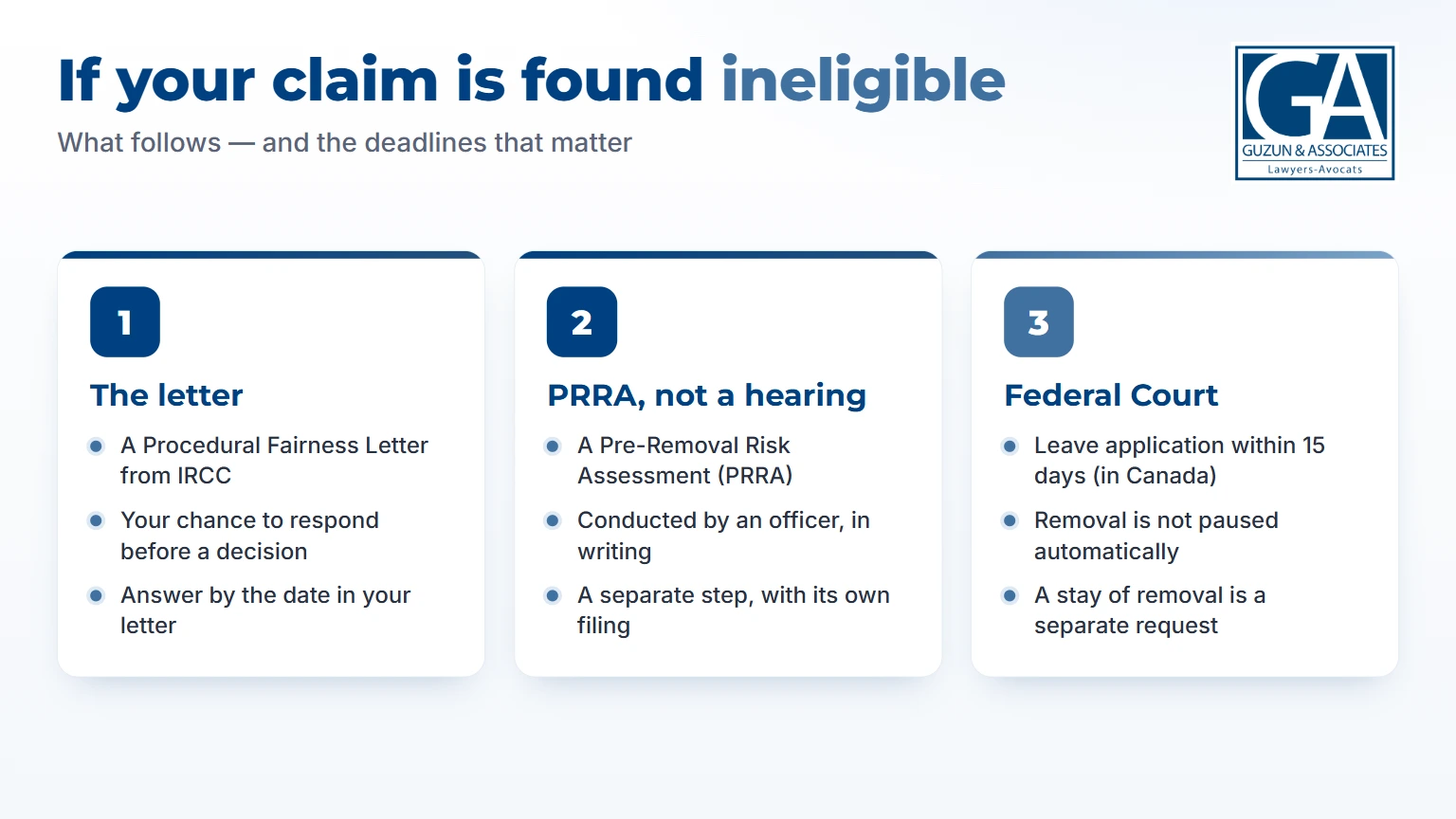
Many people going through this process receive what’s called a Procedural Fairness Letter. This letter tells you that IRCC has reached a preliminary conclusion that your claim may be ineligible — for example, because of the one-year bar or the 14-day bar — and it gives you an opportunity to respond before a final decision is made.
The single most important thing to know about this letter: it will state a deadline for your response, and that deadline needs to be treated as firm. Response windows are not the same in every letter, so check the exact date in the letter you received rather than a timeline you saw online. If that date passes without a response, IRCC may decide your eligibility on the information it already has.
A response usually addresses the facts IRCC is relying on: when and where you entered Canada, and when your claim was filed. Because these bars turn on dates and place of entry, the accuracy and completeness of that factual record is what matters most. Whether anything else can be raised in your situation is exactly the kind of question to review with a lawyer before you respond.
If this situation sounds familiar, our earlier guide on what to do after a refusal letter from IRCC covers the same underlying idea — reading the letter carefully and responding within the stated timeline — in a different immigration context.
Can Bill C-12 Make My Asylum Claim Ineligible?
Bill C-12 can affect an asylum claim if the timing or place of entry triggers one of the new ineligibility rules. The most important facts are usually the exact date you first entered Canada after June 24, 2020, whether you crossed between official ports of entry along the Canada–US border, and the date your asylum claim was filed.
Your Options If Your Claim Is Found Ineligible
Being found ineligible for an IRB hearing is not the end of the process. A few paths generally remain open, depending on the facts of the case.
PRRA. As shown above, people found ineligible are generally directed to a Pre-Removal Risk Assessment instead — a written review by an IRCC officer of the risk they would face if returned to their country. It is a separate step, so confirm with an immigration lawyer what has to be filed and by when.
Judicial review. A negative decision can be challenged at the Federal Court through an application for leave and for judicial review. For matters arising inside Canada, the application for leave is generally due within 15 days of the decision (60 days for decisions made outside Canada) — this is a standard timeline under the Federal Courts Immigration and Refugee Protection Rules, not something specific to Bill C-12.
The Federal Court publishes a practical guide to filing an application for leave and judicial review for people representing themselves. If that deadline has already passed, the application itself has to include a request for an extension of time — the Federal Court’s guide explains how.
Stay of removal. This is the part people miss most often: filing for judicial review does not, on its own, pause a removal order. If removal is scheduled, a separate, urgent motion for a stay of removal generally needs to be filed. Courts assess this request using what’s known as the Toth test — looking at whether there’s a serious issue to be tried, whether the person would suffer irreparable harm if removed, and where the balance of convenience lies. Missing this second step can mean a person is removed from Canada even while their judicial review is still pending.

What Quebec Handles — and What It Doesn’t
The asylum process itself — eligibility, IRB referrals, PRRA — is administered by the federal government through IRCC, not by Quebec. As of August 2026, Quebec’s page for asylum seekers covers settlement, health and community supports and points to federal information for the claim itself — it does not address the Bill C-12 changes. Provincial resources are still catching up to a law that only recently received royal assent.
That said, a few Quebec-specific supports are relevant once someone is in the asylum process:
- PRAIDA (Programme régional d’accueil et d’intégration des demandeurs d’asile) provides psychosocial and medical support for asylum claimants in Quebec, administered through Santé Québec and the CIUSSS du Centre-Ouest-de-l’Île-de-Montréal.
- Health coverage for asylum claimants generally runs through the federal Interim Federal Health Program, not through Quebec’s own RAMQ.
- Aide juridique (through the Commission des services juridiques) can provide free or reduced-cost legal help based on income criteria. Whether it is available for a particular immigration matter depends on your income and the type of case, so it isn’t something to count on automatically.
Real Case Examples
A one-year bar situation. A claimant entered Canada in mid-2023 but, due to a mix of confusion about the process and personal hardship, did not file an asylum claim until well over a year later. Because the entry date fell after June 24, 2020, and the claim was filed outside the one-year window, IRCC flagged the claim as potentially ineligible for an IRB referral. The claimant worked with a lawyer to document the exact entry and filing dates IRCC was relying on and to respond within the stated deadline, and the case proceeded through the eligibility review process from there.
A letter and a PRRA. Another claimant received a Procedural Fairness Letter several months after filing, raising questions about the circumstances of their entry into Canada. The letter set out a specific deadline to respond. With legal help, the claimant gathered documentation about their travel and entry, submitted a response before the stated deadline, and — after IRCC’s eligibility decision — proceeded to a Pre-Removal Risk Assessment rather than an IRB hearing.
Frequently Asked Questions
1. What is the difference between the one-year bar and the 14-day bar?
The one-year bar generally applies when someone entered Canada after June 24, 2020, and filed their asylum claim more than a year after that entry. The 14-day bar generally applies to people who crossed into Canada between official border points (irregular entry) and filed their claim more than 14 days after crossing. They are separate rules and can, depending on the facts, apply to different people or even overlap.
2. I already filed my asylum claim before Bill C-12 became law — does the one-year bar still apply to me?
It may. The one-year bar is retroactive to claims filed starting June 3, 2025, which can include claims filed before Bill C-12 received royal assent, and in some cases even claims already referred to the IRB. Whether it applies to a specific claim depends on the exact filing and entry dates involved.
3. What should I do if I receive a Procedural Fairness Letter from IRCC?
Read the letter carefully and note the deadline it states — that date controls, not general information found online. The letter is generally your opportunity to submit an explanation and evidence about your circumstances before a final eligibility decision is made, so it’s worth having a lawyer review both the letter and your response before you submit it.
4. If my claim is found ineligible for an IRB hearing, can I still get protection in Canada?
Often, yes, though through a different process. People in this situation are generally directed instead to a Pre-Removal Risk Assessment, and a negative PRRA decision may be challenged through judicial review at the Federal Court, subject to strict deadlines.
5. Are unaccompanied minors affected by the one-year and 14-day bars?
Generally not. IRCC introduced a temporary public policy, in effect since May 19, 2026, that excludes unaccompanied minors — people under 18 without a parent or legal guardian in Canada — from both bars for eligibility decisions made on or after that date.
This article is provided for general informational and educational purposes only and does not constitute legal advice. Reading this article does not create a lawyer-client relationship between you and Guzun & Associates. Bill C-12 is newly in force, and how IRCC and the courts apply the one-year bar, the 14-day bar, and the related exceptions is still developing. Every asylum case turns on its own facts — exact dates of entry, how someone crossed into Canada, and the content and deadline of any letter from IRCC — and nothing here guarantees a particular eligibility determination, PRRA outcome, or result on judicial review. If you have received a Procedural Fairness Letter, or you believe one of these bars may apply to you, consult a qualified immigration lawyer about your situation as soon as possible.
Received a Letter From IRCC About Your Asylum Claim?
Book Your Free Orientation Call: Whether you’re unsure if the one-year or 14-day bar applies to you, or you’re facing a Procedural Fairness Letter deadline, a brief, no-obligation orientation call can help you understand what your letter means and what your next steps could look like.
Whether you need an asylum lawyer in Quebec to review your Procedural Fairness Letter and next steps, or you want to avoid the kind of common immigration mistakes that cost people time they don’t have, reach out before a deadline passes.
📞 Call us: +1 (514) 842-7414
📧 Email: office@avocatguzun.com
📍 Visit: 105-1 rue McGill, Suite 15B, Montreal, Quebec