5 things you’ll learn
- What a discharge means, and why it’s a finding of guilt without a conviction
- When a discharge is removed from CPIC, and why in Quebec you still need to clear the plumitif yourself
- What can turn a conditional discharge into a conviction
- How a discharge can affect immigration, citizenship and travel to the United States
- What to answer when a job application asks whether you’ve been convicted
In this article (contents)
- What Is a Criminal Discharge in Canada? (Quebec Context)
- Absolute vs. Conditional Discharge: The Legal Difference
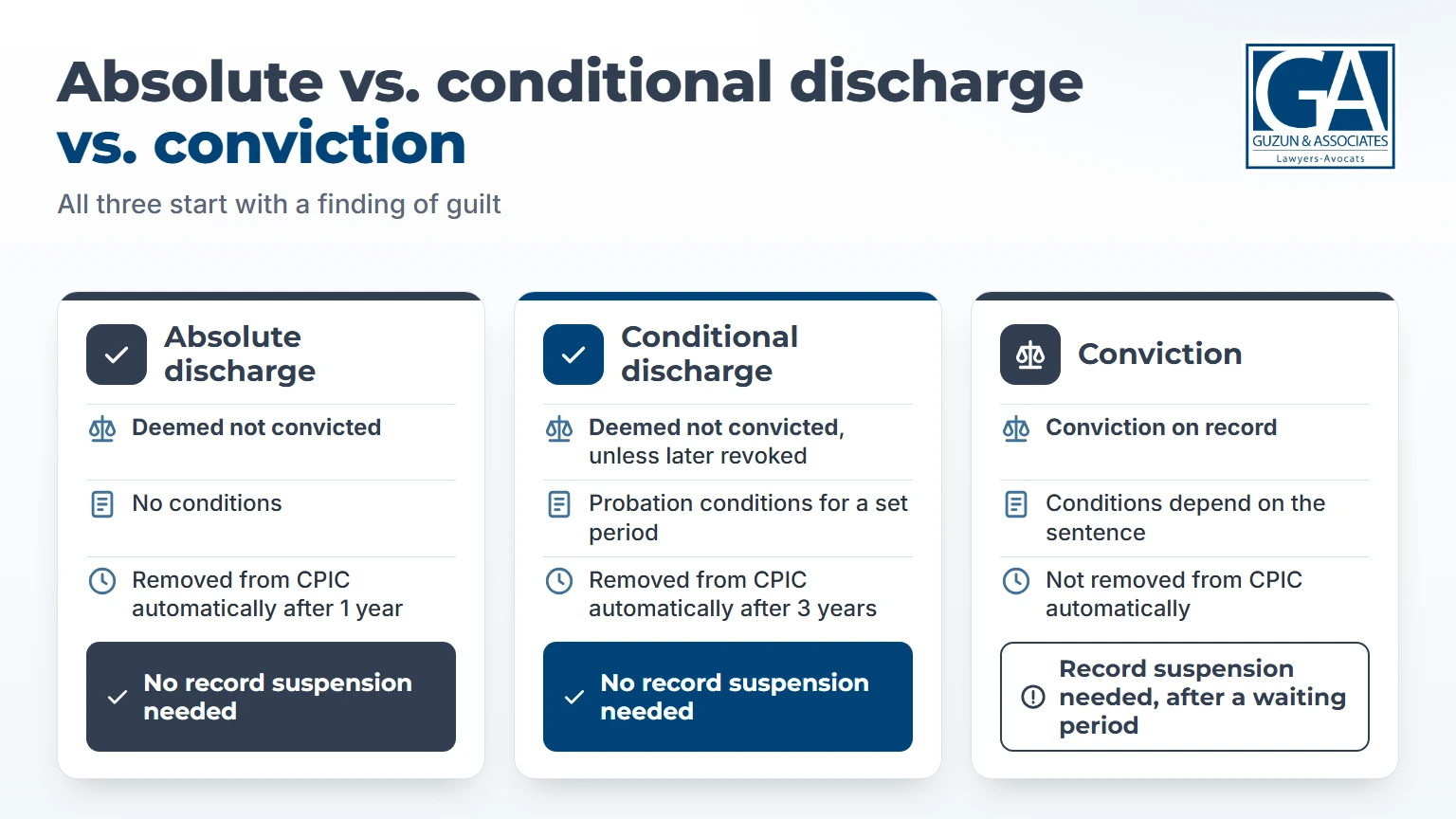
- Absolute Discharge vs. Conditional Discharge vs. Conviction at a Glance
- Is a Discharge a Criminal Record? What Employers and Background Checks See
- Discharges and Immigration to Canada
- Travel to the United States After a Discharge
- Discharge vs. Alternative Measures in Quebec: Two Separate Tracks
- Real Case Examples
- When to Talk to a Criminal Defence Lawyer
- Frequently Asked Questions
An absolute discharge and a conditional discharge are the two ways a court in Quebec — or anywhere in Canada — can find you guilty of an offence without entering a conviction against you. So, is a discharge a criminal record? Not in the sense of a conviction — but it does leave traces for a while. A discharge stays in the RCMP’s national police database for one year (absolute) or three years (conditional) before it’s removed automatically, and in Quebec it also stays in the court’s public records until you file a request to have it withheld.
That doesn’t make either one risk-free: both can raise separate questions around employment, immigration, and travel to the United States. If you’re facing a criminal charge in Quebec, these differences are worth discussing with a criminal defence lawyer before you enter a plea.

What Is a Criminal Discharge in Canada? (Quebec Context)
A discharge is only available for offences that don’t carry a minimum sentence and aren’t punishable by 14 years or life imprisonment. Within that limit, section 730 of the Criminal Code lets the court discharge an accused person — absolutely, or on the conditions of a probation order — “if it considers it to be in the best interests of the accused and not contrary to the public interest,” instead of convicting them.
Under section 730(3), a person who is discharged “shall be deemed not to have been convicted of the offence,” subject to a few technical exceptions (such as an appeal of the discharge itself). In plain terms: you were found guilty, but the law treats you as never having been convicted.
Absolute vs. Conditional Discharge: The Legal Difference
An absolute discharge takes effect immediately, with no conditions attached. Once the judge grants it, there are no probation conditions to follow — although the court can still attach orders that apply to discharges too, such as a victim surcharge under section 737 of the Criminal Code (which the judge can waive in cases of undue hardship).
A conditional discharge comes with a probation order — conditions set by the court that you must follow for a set period of up to three years, such as reporting to a probation officer (in Quebec, through the Services correctionnels du Québec) or staying away from a specific person or place. This is where the ongoing risk lies. Under section 730(4), if you’re convicted of an offence while on probation — including breaching the probation order itself — the court that made the order may revoke the discharge. It can then convict you of the original offence and impose any sentence that was available at the time of the discharge.
In practice, a missed appointment can lead to a breach charge, and a conviction for that breach — or for any new offence — can turn a non-conviction into a conviction after the fact.
Absolute Discharge vs. Conditional Discharge vs. Conviction at a Glance
Here is how the three outcomes compare on the points that matter most after sentencing.
| Outcome | Absolute Discharge | Conditional Discharge | Conviction |
| Finding of guilt | Yes | Yes | Yes |
| Conviction on record? | No — deemed not convicted | No — deemed not convicted, unless later revoked | Yes |
| Conditions / probation | None | Yes, up to 3 years | Depends on the sentence |
| CPIC record removed | Automatically, after 1 year | Automatically, after 3 years | Not automatic |
| Record suspension needed to keep it out of CPIC checks? | No | No | Yes — generally available after a waiting period (some offences are ineligible) |
Is a Discharge a Criminal Record? What Employers and Background Checks See
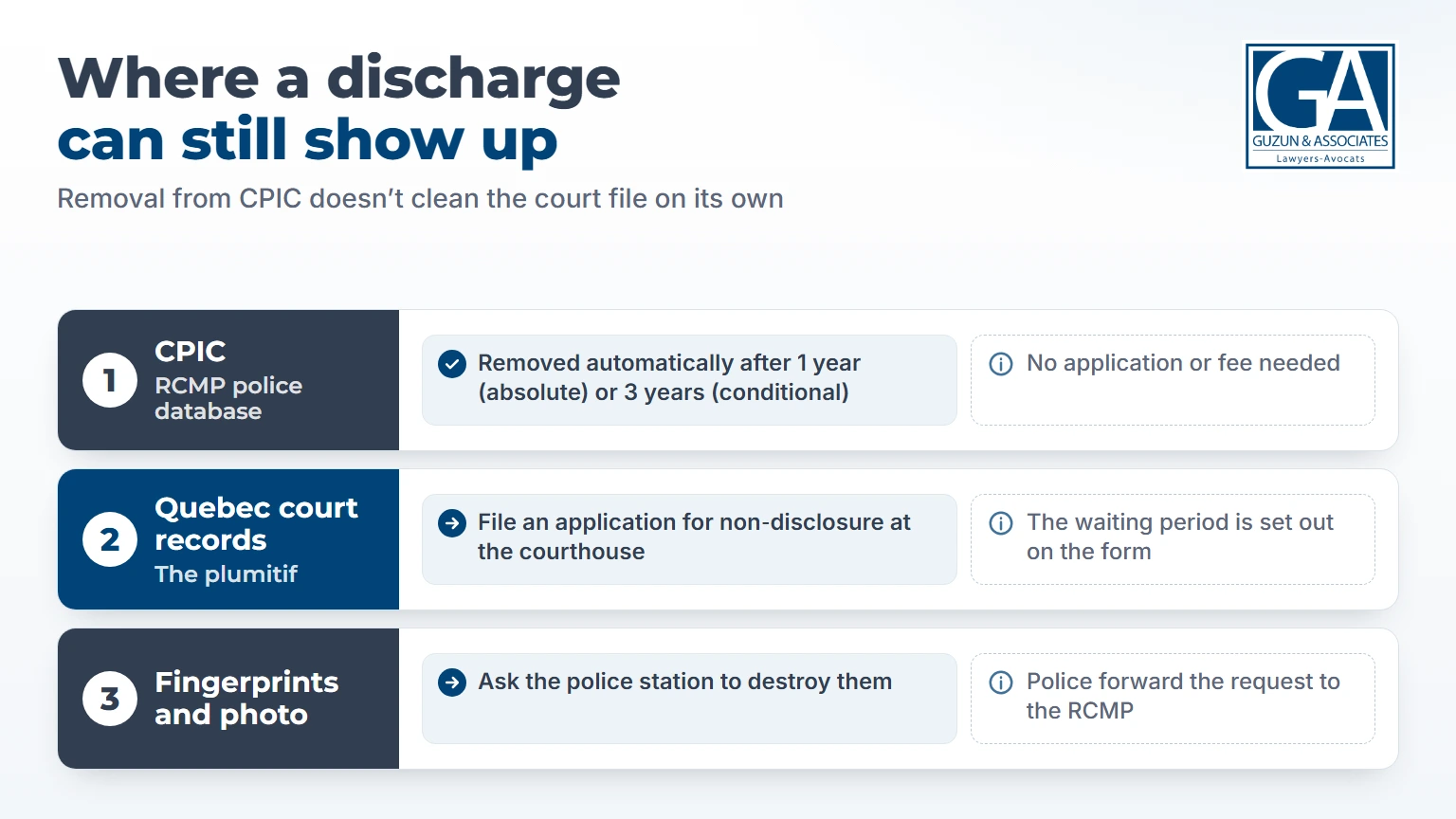
Strictly speaking, no — a discharge is not a conviction. But it isn’t invisible right away either. Many background checks search CPIC (the Canadian Police Information Centre), the RCMP’s national police database. Under section 6.1 of the Criminal Records Act, the Commissioner removes all references to a discharge from that database automatically — one year after an absolute discharge, or three years after a conditional one. You don’t need to apply or pay a fee for this removal.
That’s why the Parole Board of Canada says you do not need to apply for a record suspension if your record consists only of an absolute or conditional discharge. One exception: automatic removal covers discharges granted on or after July 24, 1992. Older ones are generally removed only on written request to the RCMP’s Pardon & Purge Services, which the Board names as the contact for questions about discharges.
Quebec adds one more place a discharge can show up: the court’s public records, known as the plumitif. Removal from CPIC doesn’t clean that file on its own — after a discharge, you file an application for non-disclosure of information at the courthouse so the discharge no longer appears in the court’s public records; the waiting period is set out on the form. You can also ask the police station to destroy your fingerprints and photo; the police then forward the request to the RCMP.
On the employment side, article 18.2 of Quebec’s Charter of Human Rights and Freedoms states that “no one may dismiss, refuse to hire or otherwise penalize a person in his employment owing to the mere fact that he was convicted of a penal or criminal offence, if the offence was in no way connected with the employment or if the person has obtained a pardon for the offence.”
The text doesn’t say exactly how this protection applies to a discharge rather than a conviction, so the answer can depend on the facts. If you believe a criminal record — or a past discharge — played a role in a hiring or employment decision, a lawyer can walk you through your options.
Discharges and Immigration to Canada
Criminal inadmissibility to Canada under immigration law is generally built around having a “conviction.” Because a discharge is deemed not to be a conviction under section 730(3), it has long been treated, as a matter of principle, as not triggering that kind of inadmissibility on its own.
A discharge granted abroad can be recognized too, but only if it passes a three-part test set out in IRCC’s enforcement manual ENF 3 (2022): a broadly similar legal system, a foreign law similar in aim, content, and effect, and no valid reason not to recognize it. Even then, for acts committed outside Canada, the Immigration and Refugee Protection Act allows inadmissibility based on committing the act itself, not only on a conviction (section 36).
Citizenship has firmer rules, and they do apply to a conditional discharge. Under the Citizenship Act, you can’t be granted citizenship or take the oath while you’re under a probation order (section 22), and days spent on probation don’t count toward the physical-presence requirement (section 21). If you’re a permanent resident planning to apply, build the probation period into your timeline.
Outside those citizenship rules, a discharge still isn’t automatically a non-issue on every immigration application. Officers look at the full file, and more than one offence, an unresolved charge, or a discharge that was later revoked under section 730(4) can change the picture.
Read the questions on immigration forms carefully, too: many IRCC forms ask whether you have ever been arrested for or charged with an offence, not only whether you were convicted. Leaving out a discharge where the question covers it can lead to a finding of misrepresentation, which carries its own consequences. If immigration consequences matter to your case, it’s worth having an immigration or criminal lawyer review your specific file before you submit anything.
Travel to the United States After a Discharge
The United States defines “conviction” for immigration purposes more broadly than Canada does. Under 8 U.S.C. §1101(a)(48)(A), a person is considered convicted if a judge or jury found them guilty — or if they pleaded guilty or admitted facts sufficient for a finding of guilt — and the judge ordered “some form of punishment, penalty, or restraint on the alien’s liberty.”
Probation, the condition attached to a conditional discharge, can fall within that broader definition — so a conditional discharge that reads as “no conviction” at home may not be read the same way by a US border officer. An absolute discharge carries no probation, so it is a weaker fit for the second part of that test — though if it came with a victim surcharge or another order, that detail may matter too.
That doesn’t settle the question, though. US law also bars people who admit having committed the essential elements of certain offences — a crime involving moral turpitude or a drug offence — even without a conviction (8 U.S.C. §1182(a)(2)(A)(i)), and a border officer can ask about the conduct behind a discharge. We’re not aware of any published Canadian or US guidance that tells you in advance how a particular discharge will be treated at the border.
Because the outcome can’t be predicted with confidence either way, the safer approach is to raise a discharge with a lawyer before you plan US travel — not after you’ve already been stopped. If you’re found inadmissible, Canadian citizens can apply in advance for a US entry waiver (Form I-192, Application for Advance Permission to Enter as a Nonimmigrant) with US Customs and Border Protection.
Discharge vs. Alternative Measures in Quebec: Two Separate Tracks
A discharge is granted by a judge at sentencing, after a guilty plea or finding of guilt. Alternative measures are a separate track that can divert a case away from the courtroom before a judge ever rules on guilt.
Since July 18, 2026, they’ve been governed by a new Part XXII.2 of the Criminal Code, added by the Protecting Victims Act (S.C. 2026, c. 19). Among other conditions, the person must freely consent and accept responsibility for the act.
In Quebec, adult alternative measures are offered through the Programme de mesures de rechange général pour adultes (PMRG). Both routes can keep a conviction off your record, but they’re decided at different points in a case, and one doesn’t substitute for the other.
Real Case Examples
The following composite examples illustrate how discharges play out in practice. They are not records of actual Guzun & Associates clients, and outcomes always depend on the specific facts of a case.
Amélie, in her early twenties, was charged with theft under $5,000 after a first-time shoplifting incident. With no prior record and a job that depended on a clean background check, she pleaded guilty, and the court granted an absolute discharge rather than a conviction. A year later, the discharge was removed from CPIC automatically; she then filed an application for non-disclosure at the courthouse so it would no longer appear in the plumitif.
Jordan was charged with simple assault following an altercation outside a bar. The court granted a conditional discharge, with probation conditions that included counselling and reporting to a probation officer. Partway through, Jordan missed two scheduled check-ins and was charged with breaching his probation order. Once he was convicted of that breach, the court revoked the discharge and convicted him of the original offence.
When to Talk to a Criminal Defence Lawyer
Whether a discharge is even available depends on the offence, your record, and how the Crown and court weigh the public interest — not something to assess from a general article.
Courts commonly look at factors such as the seriousness of the offence, whether it’s a first offence, signs of remorse or steps taken to repair the harm, and how a conviction would affect your work, studies or immigration status. A lawyer can tell you early whether your charge qualifies, help you gather supporting material (for example, an employer’s letter or proof of counselling or restitution), and make the case for a discharge.
It’s also worth involving a lawyer if:
- you’ve been accused of breaching the conditions of a conditional discharge;
- you’re weighing a past discharge against an immigration application or a trip to the United States;
- an employer or background check has raised a discharge from years ago;
- you need help clearing the plumitif or asking police to destroy your fingerprints and photo.

Frequently Asked Questions
1. Is an absolute discharge the same as being found not guilty?
No. An absolute discharge still requires a guilty plea or a finding of guilt — the court simply skips the conviction. That’s different from an acquittal, even though neither leaves a conviction on your record.
2. How long does a conditional discharge stay on my record?
It’s removed from the national CPIC database automatically three years after the court’s order, under the Criminal Records Act — no record-suspension application needed. In Quebec, the court’s public records (the plumitif) are separate: you file an application for non-disclosure at the courthouse to have the discharge withheld there.
3. Can I travel to the US with a conditional discharge?
It depends on factors that aren’t fully predictable from Canada. US immigration law defines “conviction” more broadly than Canadian law, and the probation attached to a conditional discharge can sometimes fall within that broader US definition. Speak with a lawyer before you travel if this applies to you.
4. What happens if I breach the conditions of a conditional discharge?
Breaching a probation order without a reasonable excuse is itself a criminal offence. If you’re convicted of that breach — or of any new offence — while on probation, the court that imposed the conditions may revoke the discharge, convict you of the original offence, and sentence you as if you’d been convicted at the time.
5. If a job application asks whether I’ve been convicted, what do I answer?
Under section 730(3) of the Criminal Code, a person who receives a discharge is deemed not to have been convicted, so if the form asks only about convictions, the answer is generally no. Read the wording carefully, though: some forms ask whether you’ve ever been charged, pleaded guilty or been found guilty — and a discharge does involve a finding of guilt. If the wording is unclear or the stakes are high (a professional licence, a security clearance), check with a lawyer before you answer.
This article is provided for general informational and educational purposes only and does not constitute legal advice. Reading this article does not create a lawyer-client relationship with Guzun & Associates. Canadian criminal law — including sentencing options such as discharges, the timelines for record removal under the Criminal Records Act, and the immigration or cross-border consequences of a criminal record — depends heavily on the specific facts of each case and on rules that can change over time. For advice about your own situation, consult a criminal defence lawyer.
Facing a Charge or Worried About a Past Discharge?
Book Your Free Orientation Call:
Wondering whether a discharge from years ago still shows up anywhere, or what your options are if you’re facing a charge now? A short, no-obligation orientation call can help you understand where you stand and what to do next.
📞 Call us: +1 (514) 842-7414
📧 Email: office@avocatguzun.com
📍 Visit: 105-1 rue McGill, Suite 15B, Montreal, Quebec